







Question: (Shortest Maximum Edge Problem) In the shortest path problem, we defined the length of a path as the sum of the edges' lengths: L(P)
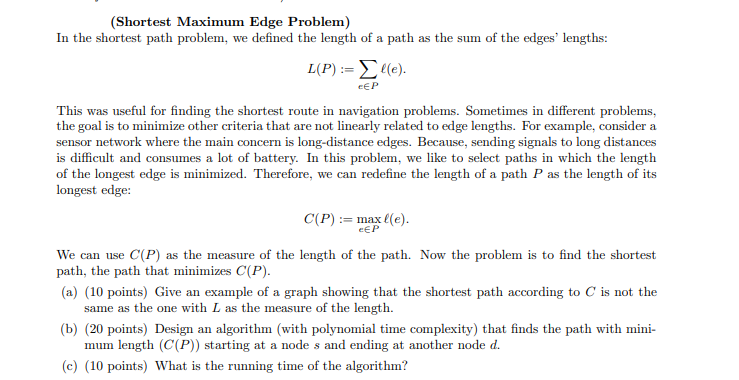
(Shortest Maximum Edge Problem) In the shortest path problem, we defined the length of a path as the sum of the edges' lengths: L(P) := l(e). CEP This was useful for finding the shortest route in navigation problems. Sometimes in different problems, the goal is to minimize other criteria that are not linearly related to edge lengths. For example, consider a sensor network where the main concern is long-distance edges. Because, sending signals to long distances is difficult and consumes a lot of battery. In this problem, we like to select paths in which the length of the longest edge is minimized. Therefore, we can redefine the length of a path P as the length of its longest edge: C(P) := max((e). We can use C(P) as the measure of the length of the path. Now the problem is to find the shortest path, the path that minimizes C(P). (a) (10 points) Give an example of a graph showing that the shortest path according to C is not the same as the one with L as the measure of the length. (b) (20 points) Design an algorithm (with polynomial time complexity) that finds the path with mini- mum length (C(P)) starting at a node s and ending at another node d. (c) (10 points) What is the running time of the algorithm?
Step by Step Solution
3.33 Rating (165 Votes )
There are 3 Steps involved in it
To determine the number of teeth on all the wheels and the exact pitch circle diameter of A we can f... View full answer

Get step-by-step solutions from verified subject matter experts
 Study Help