



Question: Show- 4 risks associated with switching suppliers for Deere on a SC Risk Matrix Negotiating Supplier Cost Reductions at Deere and Company Jack Williams, manager
Show- 4 risks associated with switching suppliers for Deere on a SC Risk Matrix
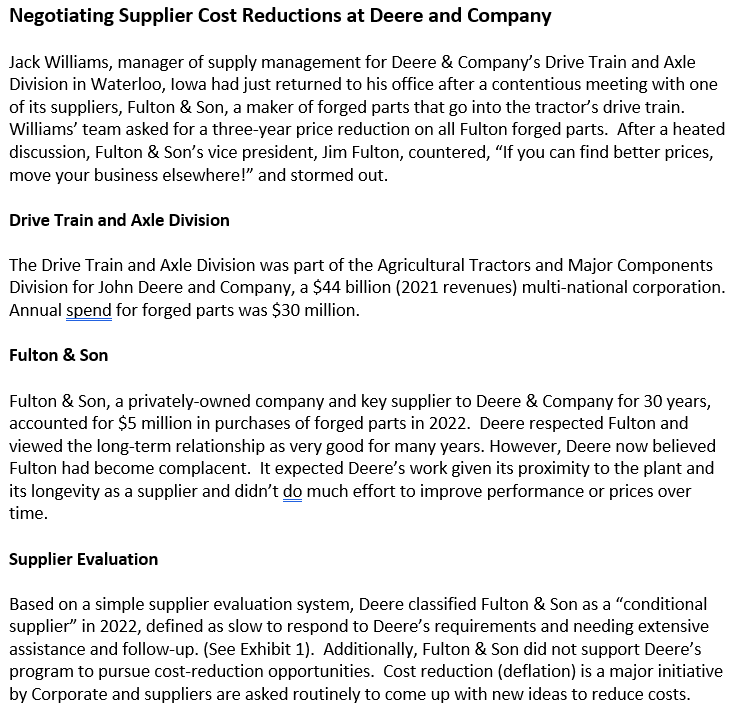
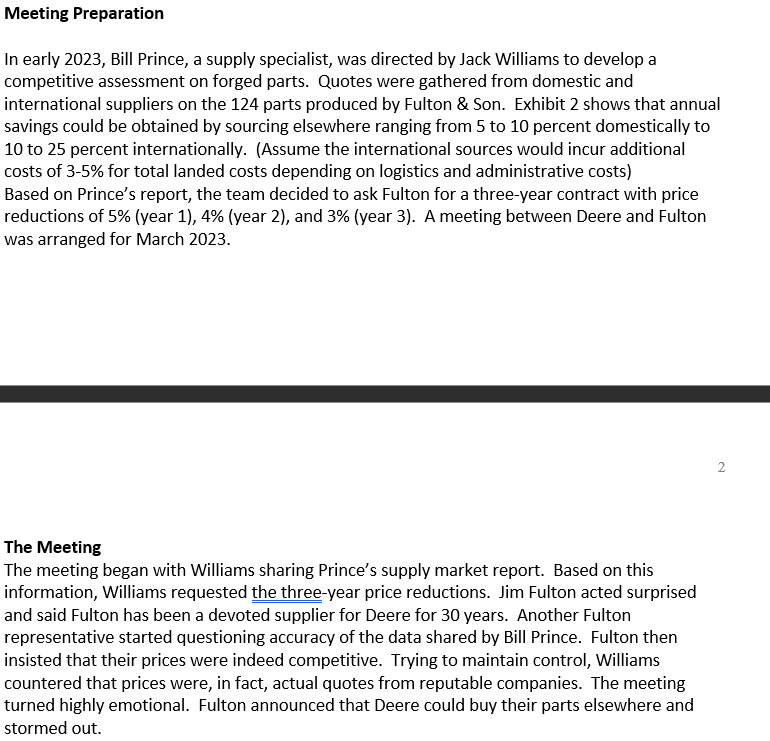
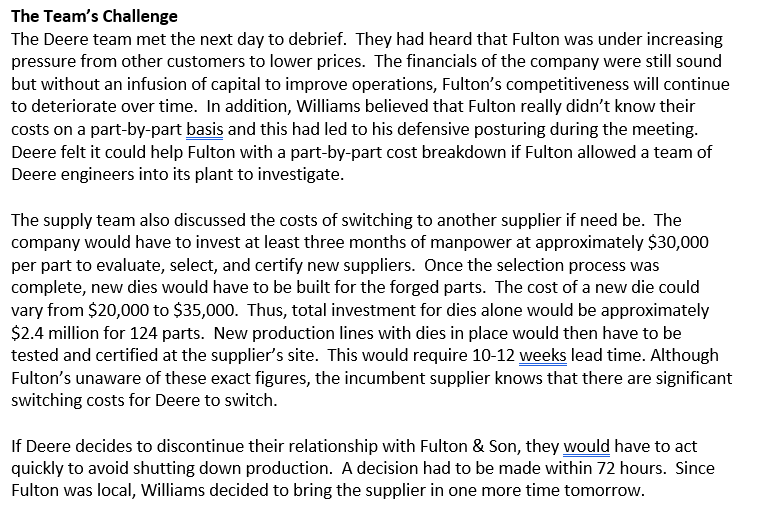
Negotiating Supplier Cost Reductions at Deere and Company Jack Williams, manager of supply management for Deere \& Company's Drive Train and Axle Division in Waterloo, lowa had just returned to his office after a contentious meeting with one of its suppliers, Fulton \& Son, a maker of forged parts that go into the tractor's drive train. Williams' team asked for a three-year price reduction on all Fulton forged parts. After a heated discussion, Fulton \& Son's vice president, Jim Fulton, countered, "If you can find better prices, move your business elsewhere!" and stormed out. Drive Train and Axle Division The Drive Train and Axle Division was part of the Agricultural Tractors and Major Components Division for John Deere and Company, a \$44 billion (2021 revenues) multi-national corporation. Annual spend for forged parts was $30 million. Fulton \& Son Fulton \& Son, a privately-owned company and key supplier to Deere \& Company for 30 years, accounted for $5 million in purchases of forged parts in 2022. Deere respected Fulton and viewed the long-term relationship as very good for many years. However, Deere now believed Fulton had become complacent. It expected Deere's work given its proximity to the plant and its longevity as a supplier and didn't do much effort to improve performance or prices over time. Supplier Evaluation Based on a simple supplier evaluation system, Deere classified Fulton \& Son as a "conditional supplier" in 2022, defined as slow to respond to Deere's requirements and needing extensive assistance and follow-up. (See Exhibit 1). Additionally, Fulton \& Son did not support Deere's program to pursue cost-reduction opportunities. Cost reduction (deflation) is a major initiative by Corporate and suppliers are asked routinely to come up with new ideas to reduce costs. In early 2023, Bill Prince, a supply specialist, was directed by Jack Williams to develop a competitive assessment on forged parts. Quotes were gathered from domestic and international suppliers on the 124 parts produced by Fulton \& Son. Exhibit 2 shows that annual savings could be obtained by sourcing elsewhere ranging from 5 to 10 percent domestically to 10 to 25 percent internationally. (Assume the international sources would incur additional costs of 3-5\% for total landed costs depending on logistics and administrative costs) Based on Prince's report, the team decided to ask Fulton for a three-year contract with price reductions of 5% (year 1), 4\% (year 2), and 3% (year 3 ). A meeting between Deere and Fulton was arranged for March 2023. The Meeting The meeting began with Williams sharing Prince's supply market report. Based on this information, Williams requested the three-year price reductions. Jim Fulton acted surprised and said Fulton has been a devoted supplier for Deere for 30 years. Another Fulton representative started questioning accuracy of the data shared by Bill Prince. Fulton then insisted that their prices were indeed competitive. Trying to maintain control, Williams countered that prices were, in fact, actual quotes from reputable companies. The meeting turned highly emotional. Fulton announced that Deere could buy their parts elsewhere and stormed out. The Team's Challenge The Deere team met the next day to debrief. They had heard that Fulton was under increasing pressure from other customers to lower prices. The financials of the company were still sound but without an infusion of capital to improve operations, Fulton's competitiveness will continue to deteriorate over time. In addition, Williams believed that Fulton really didn't know their costs on a part-by-part basis and this had led to his defensive posturing during the meeting. Deere felt it could help Fulton with a part-by-part cost breakdown if Fulton allowed a team of Deere engineers into its plant to investigate. The supply team also discussed the costs of switching to another supplier if need be. The company would have to invest at least three months of manpower at approximately $30,000 per part to evaluate, select, and certify new suppliers. Once the selection process was complete, new dies would have to be built for the forged parts. The cost of a new die could vary from $20,000 to $35,000. Thus, total investment for dies alone would be approximately $2.4 million for 124 parts. New production lines with dies in place would then have to be tested and certified at the supplier's site. This would require 10-12 weeks lead time. Although Fulton's unaware of these exact figures, the incumbent supplier knows that there are significant switching costs for Deere to switch. If Deere decides to discontinue their relationship with Fulton \& Son, they would have to act quickly to avoid shutting down production. A decision had to be made within 72 hours. Since Fulton was local, Williams decided to bring the supplier in one more time tomorrow
Step by Step Solution
There are 3 Steps involved in it

Get step-by-step solutions from verified subject matter experts