



Question: show all steps For any given atmospheric chemical process, either thermodynamic or kinetic control is possible, with the latter being frequently the case. Therefore, thermodynamic
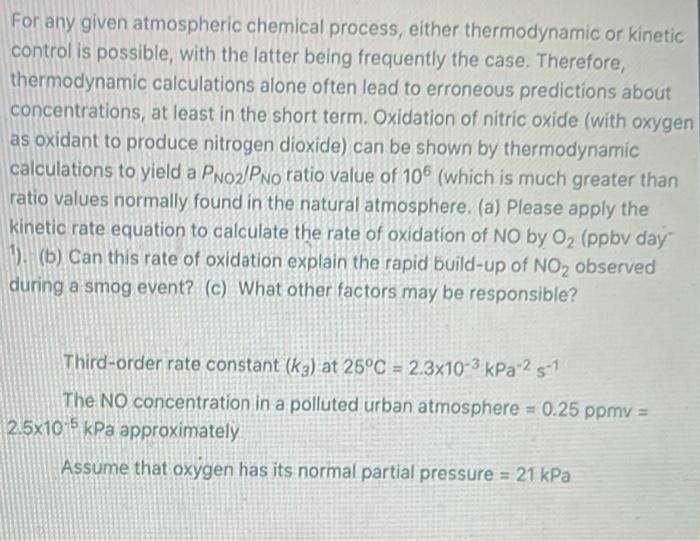
For any given atmospheric chemical process, either thermodynamic or kinetic control is possible, with the latter being frequently the case. Therefore, thermodynamic calculations alone often lead to erroneous predictions about concentrations, at least in the short term. Oxidation of nitric oxide (with oxygen as oxidant to produce nitrogen dioxide) can be shown by thermodynamic calculations to yield a PNOJ Pno ratio value of 106 (which is much greater than ratio values normally found in the natural atmosphere. (a) Please apply the kinetic rate equation to calculate the rate of oxidation of NO by Oz (ppby day 1). (b) Can this rate of oxidation explain the rapid build-up of NO2 observed during a smog event? (c) What other factors may be responsible? Third-order rate constant (kg) at 25C = 2.3x10⁻³ kPa 2 s-1 The NO concentration in a polluted urban atmosphere = 0.25 ppmy = 25x10-5 kPa approximately Assume that oxygen has its normal partial pressure = 21 kPa
Step by Step Solution
There are 3 Steps involved in it

Get step-by-step solutions from verified subject matter experts