



Question: Show all units and calculations Partial Pressure, Partial Pressure Ratio, Molar fractions, Water Vapor-to-Air Pound Mole and Pound Mass Ratios. In an ideal gas, each
Show all units and calculations
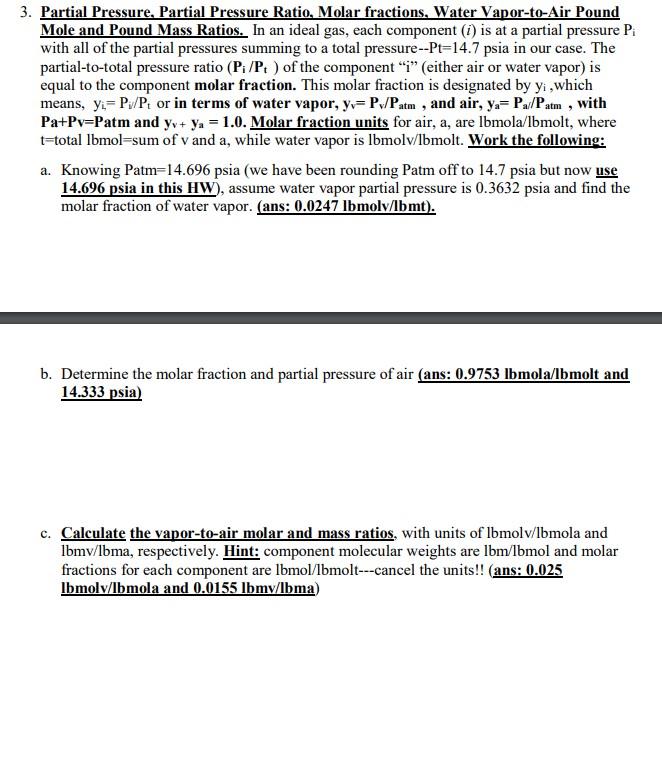
Partial Pressure, Partial Pressure Ratio, Molar fractions, Water Vapor-to-Air Pound Mole and Pound Mass Ratios. In an ideal gas, each component (i) is at a partial pressure Pi with all of the partial pressures summing to a total pressure-- Pt=14.7psia in our case. The partial-to-total pressure ratio (Pi/Pt) of the component " i " (either air or water vapor) is equal to the component molar fraction. This molar fraction is designated by yi, which means, yi=Pi/Pt or in terms of water vapor, yv=Pv/Patm, and air, ya=Pa/Patm, with Pa+Pv=Patm and yv+ya=1.0. Molar fraction units for air, a, are lbmola/lbmolt, where t= total lbmol=sum of v and a, while water vapor is lbmolv/lbmolt. Work the following: a. Knowing Patm=14.696 psia (we have been rounding Patm off to 14.7 psia but now use 14.696 psia in this HW), assume water vapor partial pressure is 0.3632psia and find the molar fraction of water vapor. (ans: 0.0247lbmolv/lbmt). b. Determine the molar fraction and partial pressure of air (ans: 0.9753lbmola/lbmoltand 14.333 psia) c. Calculate the vapor-to-air molar and mass ratios, with units of lbmolv/lbmola and lbmv/lbma, respectively. Hint: component molecular weights are lbm/lbmol and molar fractions for each component are lbmol/lbmoltcanceltheunits!!(ans:0.025 lbmolv/llbmola and 0.0155lbmv/lbma)
Step by Step Solution
There are 3 Steps involved in it

Get step-by-step solutions from verified subject matter experts