







Question: Show full work and steps Problem 3 . Let G = ( V , E , w ) be a weighted graph, where w :
Show full work and steps Problem Let be a weighted graph, where : is the weight function. By a
cut CsubV we refer to the partition of vertices into and The sum of the weights of the edges
in crossing between and in is denoted by
of if the following holds:
and
for every cut it holds
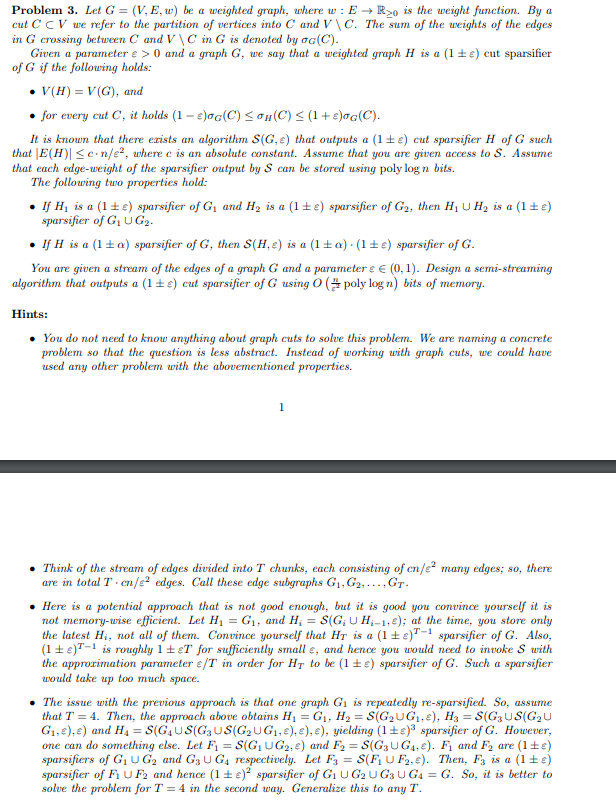
It is known that there exists an algorithm that outputs a cut sparsifier of such
that where is an absolute constant. Assume that you are given access to Assume
that each edgeweight of the sparsifier output by can be stored using poly bits.
The following two properties hold:
sparsifier of
If is a sparsifier of then is a sparsifier of
You are given a stream of the edges of a graph and a parameter Design a semistreaming
algorithm that outputs a cut sparsifier of using poly : bits of memory.
Hints:
You do not need to know anything about graph cuts to solve this problem. We are naming a concrete
problem so that the question is less abstract Instead of working with graph cuts, we could have
used any other problem with the abovementioned properties.
Think of the stream of edges divided into chunk, each consisting of many edges; so there
are in total edges. Call these edge subyraphs dots,
Here is a potential approach that is not good enough, but it is good you convince yourself it is
not memorywise efficient. Let and ; at the time, you store only
the latest not all of them. Convince yourself that is a sparsifier of Also,
is roughly for sufficiently small and hence you would need to invoke with
the approximation parameter in order for to be sparsifier of Such a sparsifier
would take up too much space.
The issue with the previous approach is that one graph is repeatedly resparsified. So assume
that Then, the approach above obtains
: and yielding sparsifier of However,
one can do something else. Let and and are
sparsifiers of and respectively. Let Then, is
sparsifier of
Step by Step Solution
There are 3 Steps involved in it
1 Expert Approved Answer
Step: 1 Unlock

Question Has Been Solved by an Expert!
Get step-by-step solutions from verified subject matter experts
Step: 2 Unlock
Step: 3 Unlock
 Study Help