







Question: Show m e the steps along side the formulas you used and then asnwer this i n a table that has the same colour and
Show the steps along side the formulas you used and then asnwer this a table that has the same colour and format. here the task Background
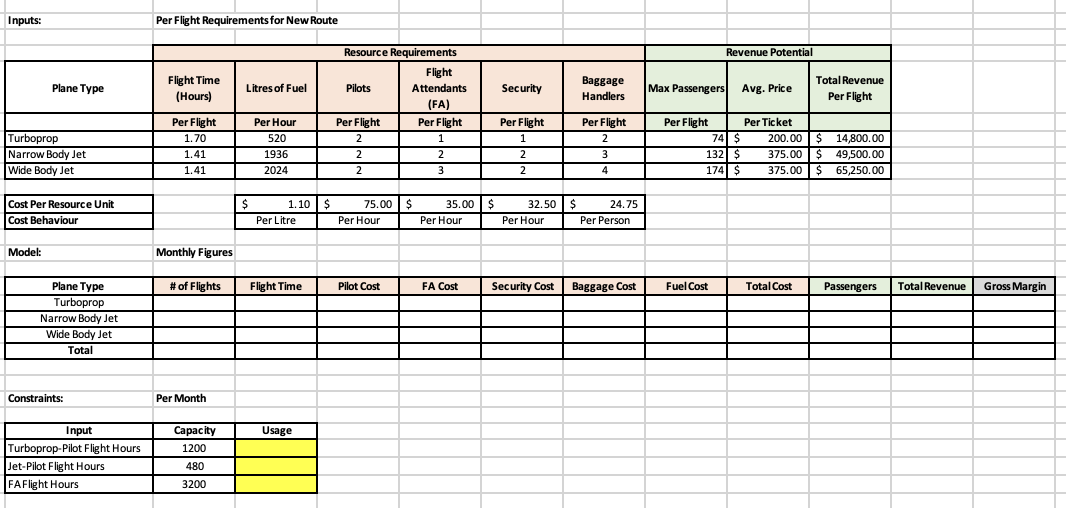
IF has a mixed fleet of aircrafts that it uses on its routes: turboprop propeller planes, narrowbody jet
engine planes, and widebody jet engine planes.
Each type of plane has different resource requirements, as well seats to hold passengers. For example, the
turboprop planes are smaller and slower, resulting in less fuel being consumed each flight, but it can only carry
passengers. In contrast, the largest of planes, the widebody jets, travel almost faster than turboprops
while in the air and carry passengers, but consume four times as much fuel per flight!
IF tracks the following items when analyzing the performance of a route: time for each flight which includes
time to take off, fly, and land; the amount of fuel used during the flight; the number of personnel involved
in the flight including pilots, flight attendants FA security guards, and baggage handlers; the maximum
number of passengers per flight; and the ticket price for the flight.
Given the resource requirements and revenue potential for each type of plane, along with constraints on specific
resources, your task is to determine the optimal mix of planes to cover the demand for a new route that IFs
management team is considering.
Tasks
In the RPLANEMIX worksheet, enter formulas to calculate the following:
Total Revenue Per Flight, which is Passenger Per Flight multiplied by Average Ticket Price, for each
plane type.
Individual and Total Costs for each type of resource Pilots FAs, Security, Baggage, Fuel for a month.
Each of these will be a combination of the number of flights, multiplied by the amount of each
resource used per flight, then multiplied by the dollar cost rate per unit of each resource. Note that
the cost of a resource depends on its cost behaviour; for example, the cost of a pilot is based on how
many hours they have flown, while the cost of baggage handlers is based on how many of them were
needed for that flight.
Number of Passengers flown, the Total Revenue earned, and Gross Margin ie Total Revenue less
Total Costs for each plane type and in total.
Number of Turboprop Pilot, Jet Pilot, and FA hours used in the month. Each of these are combination of
the number of each personnel type used on a given flight, multiplied by the number of hours
flown, with consideration to plane type.
Using the Solver Addin provided by Microsoft, configure Solver to maximize Total Gross Margin by adjusting
the number of flights per plane type in a month, respecting the following constraints: there cannot be any
partial flights, and flight hours for pilots and FAs must not exceed the stated capacities.
Step by Step Solution
There are 3 Steps involved in it
1 Expert Approved Answer
Step: 1 Unlock

Question Has Been Solved by an Expert!
Get step-by-step solutions from verified subject matter experts
Step: 2 Unlock
Step: 3 Unlock
 Study Help