







Question: Show work Consider the weighted digraph V={0, 1, 2, 3, 4, 5 }, E={ [0,1:2], [0,3:1), (1,3:3), (1,4:10], [2,0:4], [2,5:5), (3,2:2], [3,4:2), (3,5:8), (3,6:4], [4,6:6),
Show work
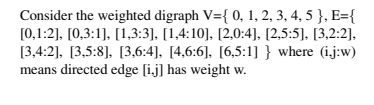
![}, E={ [0,1:2], [0,3:1), (1,3:3), (1,4:10], [2,0:4], [2,5:5), (3,2:2], [3,4:2), (3,5:8), (3,6:4],](https://dsd5zvtm8ll6.cloudfront.net/si.experts.images/questions/2024/09/66f51863df28c_59566f518637db9a.jpg)
![[4,6:6), (6,5:1] } where (i.j:w) means directed edge [i,j] has weight w.](https://dsd5zvtm8ll6.cloudfront.net/si.experts.images/questions/2024/09/66f518649781d_59666f518641a17a.jpg)
Consider the weighted digraph V={0, 1, 2, 3, 4, 5 }, E={ [0,1:2], [0,3:1), (1,3:3), (1,4:10], [2,0:4], [2,5:5), (3,2:2], [3,4:2), (3,5:8), (3,6:4], [4,6:6), (6,5:1] } where (i.j:w) means directed edge [i,j] has weight w. 4 2 N 5 3 3 8 4 10 6 6 Apply Dijkstra's algorithm to determine the distance from vertex 1 to all other vertices. Process the lowest numbered vertex first in case of a tie. Show your work by creating a table similar to the one shown for distances from vertex 0. V 0 1 2 3 4 5 6 V 0 1 2 3 4 5 6 Init 000 Init 0 0 0 0 2 1 0 1 2 3 3 9 5 1 2 3 3 9 5 2 418 8 81 w 8 8 8 8 u 8 8 5 3 3 8 5 3 4 8 5 4 5 6 5 distance(0) = { 0 2 3 1 3 6 5 } distance(1) = la Problem 2 Repeat Problem 1 this time assuming that the graph is undirected. That is V={0, 1, 2, 3, 4, 5), E={(0,1:2), (0,3:1), (1,3:3), (1,4:10), (2,0:4), (2,5:5), (3,2:2), (3,4:2), (3,5:8), (3,6:4), (4,6:6), 6,5:1)}. 1 2 3 5 6 V 0 Init 0 3 6 +18 8 81 +18 8 8 u 00 V 0 1 2 Init 0 0 00 8 8 18 + 00 18 8 0 2 1 00 1 2 3 9 5 1 5 5 2 3 3 9 2 3 8 3 3 5 5 4 8 4 5 6 5 distance(0) = {0 2 3 1 3 6 5} distance(1) = Consider the weighted digraph V={0, 1, 2, 3, 4, 5 }, E={ [0,1:2], [0,3:1), (1,3:3), (1,4:10], [2,0:4], [2,5:5), (3,2:2], [3,4:2), (3,5:8), (3,6:4], [4,6:6), (6,5:1] } where (i.j:w) means directed edge [i,j] has weight w. 4 2 N 5 3 3 8 4 10 6 6 Apply Dijkstra's algorithm to determine the distance from vertex 1 to all other vertices. Process the lowest numbered vertex first in case of a tie. Show your work by creating a table similar to the one shown for distances from vertex 0. V 0 1 2 3 4 5 6 V 0 1 2 3 4 5 6 Init 000 Init 0 0 0 0 2 1 0 1 2 3 3 9 5 1 2 3 3 9 5 2 418 8 81 w 8 8 8 8 u 8 8 5 3 3 8 5 3 4 8 5 4 5 6 5 distance(0) = { 0 2 3 1 3 6 5 } distance(1) = la Problem 2 Repeat Problem 1 this time assuming that the graph is undirected. That is V={0, 1, 2, 3, 4, 5), E={(0,1:2), (0,3:1), (1,3:3), (1,4:10), (2,0:4), (2,5:5), (3,2:2), (3,4:2), (3,5:8), (3,6:4), (4,6:6), 6,5:1)}. 1 2 3 5 6 V 0 Init 0 3 6 +18 8 81 +18 8 8 u 00 V 0 1 2 Init 0 0 00 8 8 18 + 00 18 8 0 2 1 00 1 2 3 9 5 1 5 5 2 3 3 9 2 3 8 3 3 5 5 4 8 4 5 6 5 distance(0) = {0 2 3 1 3 6 5} distance(1) =
Step by Step Solution
There are 3 Steps involved in it

Get step-by-step solutions from verified subject matter experts
 Study Help