







Question: SHOW WORK ... NO WORK NO POINTS AVERAGE ANNUAL RETURNS, ARITHMETIC AVERAGES & STANDARD DEVIATIONS Here are the total returns for the S&P500 for the
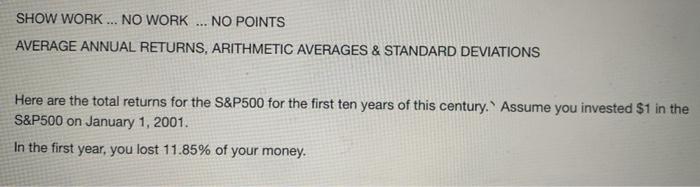
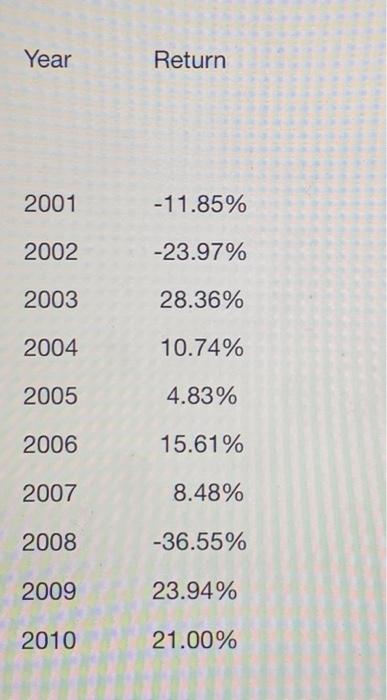
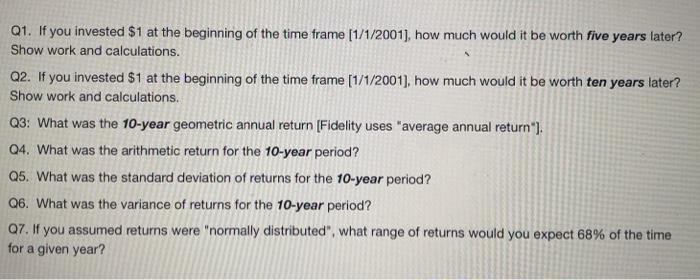
SHOW WORK ... NO WORK NO POINTS AVERAGE ANNUAL RETURNS, ARITHMETIC AVERAGES & STANDARD DEVIATIONS Here are the total returns for the S&P500 for the first ten years of this century. Assume you invested $1 in the S&P500 on January 1, 2001. In the first year, you lost 11.85% of your money. Year Return 2001 -11.85% 2002 -23.97% 2003 28.36% 2004 10.74% 2005 4.83% 2006 15.61% 2007 8.48% 2008 -36.55% 2009 23.94% 2010 21.00% Q1. If you invested $1 at the beginning of the time frame (1/1/2001), how much would it be worth five years later? Show work and calculations. Q2. If you invested $1 at the beginning of the time frame (1/1/2001), how much would it be worth ten years later? Show work and calculations. Q3: What was the 10-year geometric annual return (Fidelity uses "average annual return"). Q4. What was the arithmetic return for the 10-year period? Q5. What was the standard deviation of returns for the 10-year period? Q6. What was the variance of returns for the 10-year period? 07. If you assumed returns were "normally distributed", what range of returns would you expect 68% of the time for a given year
Step by Step Solution
There are 3 Steps involved in it

Get step-by-step solutions from verified subject matter experts
 Study Help