







Question: Show work please Consider an M/M/1 queue system with 60% utilization of resources. The provided information is sufficient to say that on average 1.5 customers


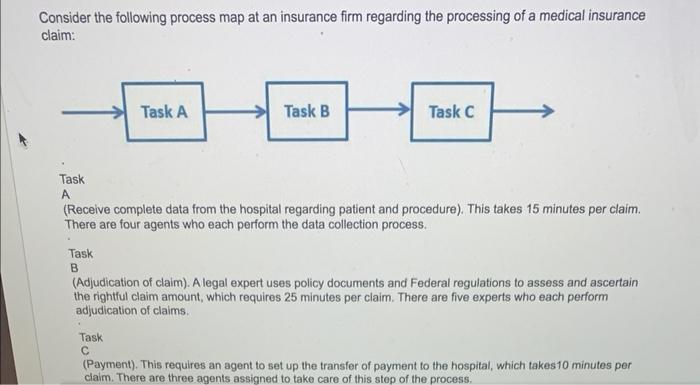
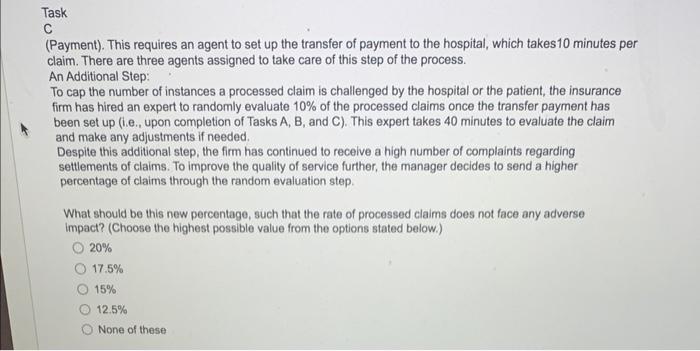
Consider an M/M/1 queue system with 60% utilization of resources. The provided information is sufficient to say that on average 1.5 customers will be in the system. True False Consider an M/M/1 queue system with 60% utilization of resources. If the utilization halves (i.e., becomes 30% instead of 60% ), the average wait time for customers in the queue will also decrease by half. True False Consider the following process map at an insurance firm regarding the processing of a medical insurance claim: Task A (Receive complete data from the hospital regarding patient and procedure). This takes 15 minutes per claim. There are four agents who each perform the data collection process. Task B (Adjudication of claim). A legal expert uses policy documents and Federal regulations to assess and ascertain the rightful claim amount, which requires 25 minutes per claim. There are five experts who each perform adjudication of claims. Task C (Payment). This requires an agent to set up the transfer of payment to the hospital, which takes10 minutes per claim. There are three agents assigned to take care of this step of the process. C (Payment). This requires an agent to set up the transfer of payment to the hospital, which takes10 minutes per claim. There are three agents assigned to take care of this step of the process. An Additional Step: To cap the number of instances a processed claim is challenged by the hospital or the patient, the insurance firm has hired an expert to randomly evaluate 10% of the processed claims once the transfer payment has been set up (i.e., upon completion of Tasks A, B, and C). This expert takes 40 minutes to evaluate the claim and make any adjustments if needed. Despite this additional step, the firm has continued to receive a high number of complaints regarding settlements of claims. To improve the quality of service further, the manager decides to send a higher percentage of claims through the random evaluation step. What should be this new percentage, such that the rate of processed claims does not face any adverse impact? (Choose the highest possible value from the options stated below.) 20% 17.5% 15% 12.5% None of these Say, a retail firm has 4 check-out counters to serve customers waiting in a common queue. Assume Poisson arrival of customers at a rate of 100 per hour. The firm's servers (one at each counter) are trained to serve on average 40 customers per hour. Assume exponential service times. Consider that a server is paid $12 per hour, and dissatisfaction with each waiting customer is valued at $16 per hour. Also, assume that the retail firm has an 8-hour working day. The service operations manager decides to add one more counter/server in the check-out system described above. Upon this change, how much additional \$ does the firm save, or how much additional \$ does the firm lose? Note that L-Q table is available in BlackBoard under "Course Material." (If money is saved - enter your answer as a positive value) (If money is lost - enter your answer as a negative value)
Step by Step Solution
There are 3 Steps involved in it

Get step-by-step solutions from verified subject matter experts
 Study Help