







Question: Shown to the right are two functions. The dashed graph, in red, is the parent function p(x). The vertical intercept of p(x) is (0. 5).
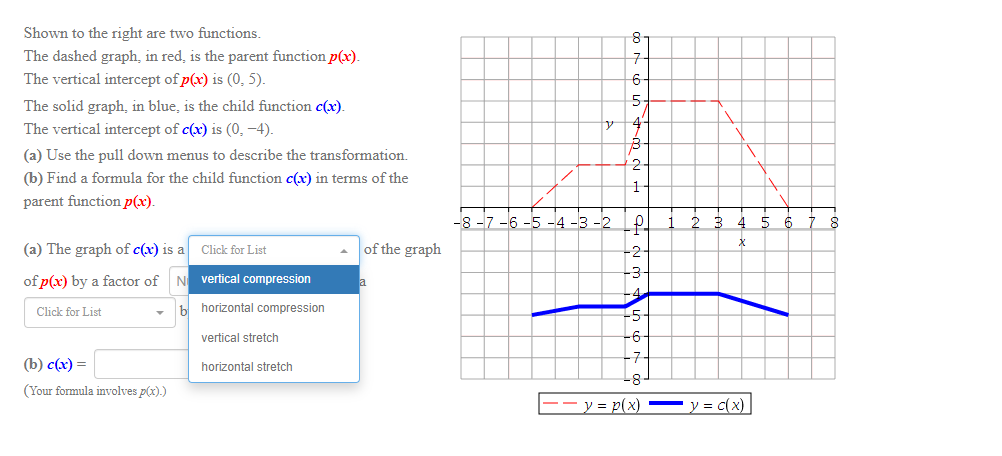
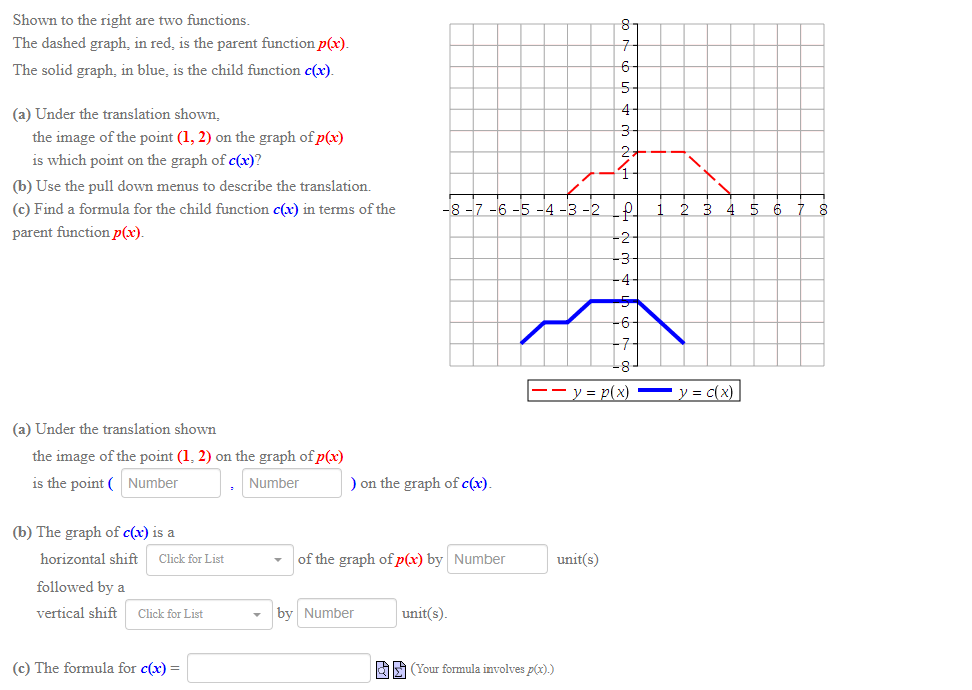
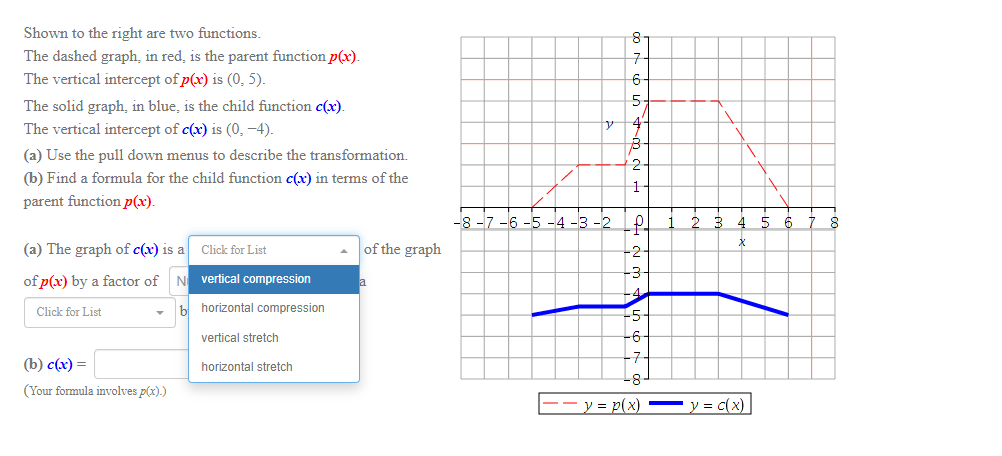
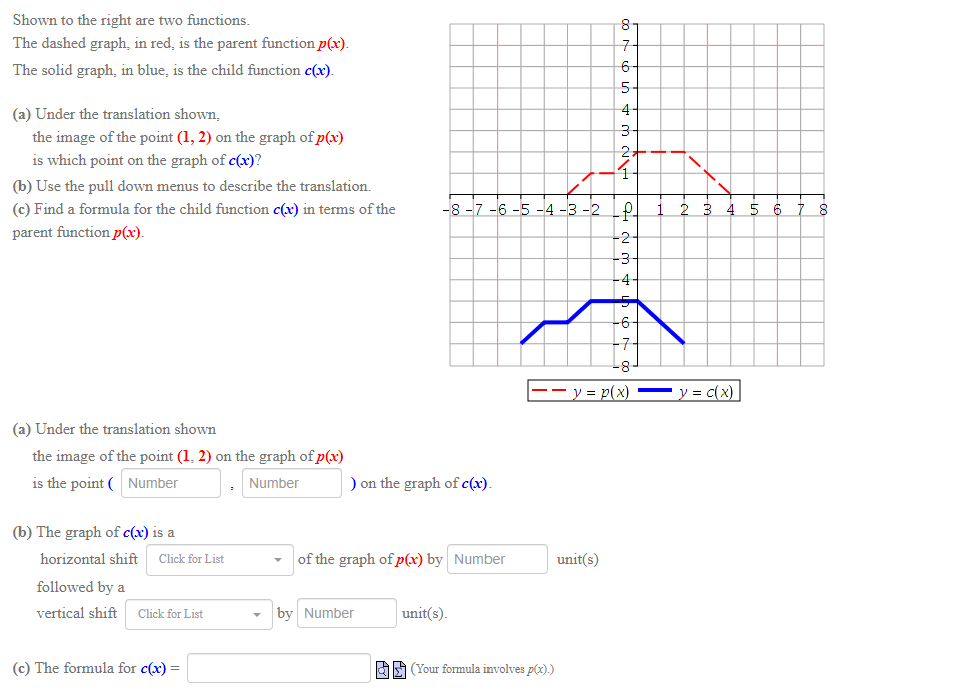
Shown to the right are two functions. The dashed graph, in red, is the parent function p(x). The vertical intercept of p(x) is (0. 5). The solid graph, in blue, is the child function c(x). The vertical intercept of c(x) is (0, -4). (a) Use the pull down menus to describe the transformation. (b) Find a formula for the child function c(x) in terms of the parent function p(x). -8-7 -6-5 -4-3-2 1 2 3 4 5 6 78 (a) The graph of c(x) is a Click for List of the graph of p(x) by a factor of N vertical compression a Click for List b horizontal compression vertical stretch (b) c(x) = horizontal stretch (Your formula involves p(x).) - -y = p(x) =y = c(x)Shown to the right are two functions. The dashed graph, in red, is the parent function p(x). The solid graph, in blue, is the child function c(x). (a) Under the translation shown, the image of the point (1, 2) on the graph of p(x) FUND MNWAUG TOO is which point on the graph of c(x)? (b) Use the pull down menus to describe the translation. (c) Find a formula for the child function c(x) in terms of the -8 -7 -6-5-4-3-2 1 2 3 4 5 6 7 8 parent function p(x). - -y= p(x) =y = c(x) (a) Under the translation shown the image of the point (1, 2) on the graph of p(x) is the point ( Number Number ) on the graph of c(x). (b) The graph of c(x) is a horizontal shift Click for List of the graph of p(x) by Number unit(s) followed by a vertical shift Click for List by Number unit(s)- (c) The formula for c(x) = (Your formula involves p(x).)
Step by Step Solution
There are 3 Steps involved in it

Get step-by-step solutions from verified subject matter experts
 Study Help