



Question: SHRM CASE - Carter Cleaning Centres Jennifer Carter graduated from State University in June 201 2 and after considering several job offers, decided to do
SHRM CASE - Carter Cleaning Centres
Jennifer Carter graduated from State University in June 2012 and after considering several job offers, decided to do what she always planned to do go into business with her father, Jack Carter. Jack Carter opened his first Laundromat in 2000 and his second in 2003. The main attraction of these coin laundry businesses for him was that they were capital-rather than labour intensive. Thus,once the investment in machinery was made, the stores could be run with just one unskilled attendant and none of the labour problems one normally expects from being in the retail service business.
The attractiveness of operating with virtually no skilled labour withstanding, Jack had decided by 2007 to expand the services in each of his stores to include the dry cleaning and pressing of clothes. He embarked, in other words on a strategy of related diversification by adding new services that were related to and consistent with his existing coin laundry activities. He added these for several reasons. He wanted to better utilize the unused space in the rather large stores he currently had under lease. Furthermore, he was, as he put it, tired of sending out the dry cleaning and pressing work that came in from our coin laundry clients to a dry cleaner 5 miles away, who then took most of what should have been our profits. To reflect the new, expanded line of services, he renamed each of his two stores Carter Cleaning Centresand was sufficiently satisfied with their performance to open four more of the same type of stores over the next 5 years. Each store had its own on-site manager and, on average, about seven employees and annual revenues of about $500,000. It was this 6-store chain that Jennifer joined after graduating.
Her understanding with her father was that she would serve as a trouble-shooter/consultant to the elder Carter with the aim of both learning the business and bringing to it modern management concepts and techniques for solving the businesss problems and facilitating its growth. Below are some of the issues Jennifer will need to pay attention to in her new role.
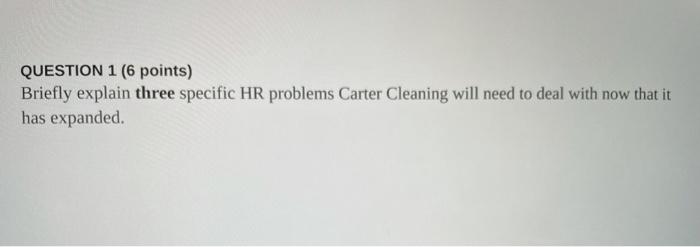
One of the first problems Jennifer faced at her fathers Carter Cleaning Centres concerned the inadequacies of the firms current HR management practise and procedures. In one of her visits to one of the stores, two women in one of her stores privately confided her that their managers were making unwelcome sexual advances toward them, and one claimed he had threatened to fire her unless she socialized with him after hours.
Two other critical problems facing the company are employee turnover and employee honesty. Jennifer and her father sorely need to implement practices that will reduce the rate of employee turnover. Of even greater concern to Jennifer is the need to institute practices to screen out those employees who may be predisposed to steal from the company. If there is a way to do this through employee testing and screening techniques, Jennifer would like to know about this because of the management time and money that are now being wasted by the never-ending need to recruit and hire new employees.
Like virtually all other HR related activities at Carter Cleaning Centres, the company currently has no organized approach to interviewing job candidates. Store managers, who do almost all the hiring, have a few of their own favourite questions that they ask. But in absence of any guidance from top management, they all admit their interview performance leaves something to be desired. Similarly, Jack Carter himself is admittedly most comfortable dealing with what he calls the nuts and bolts machinery aspect of his business and has never felt particularly comfortable having to interview management or other job applicants. Jennifer is sure that this lack of formal interviewing practices, procedures, and training account for some of the employee turnover and theft problems. Therefore, she wants to do something to improve her companys batting average in this important area.
Jennifer believes that implementing orientation and training programs would help to ensure that employees know how to do their jobs the right way. She explained to her father the importance of having an orientation/onboarding process in place at all the cleaning centres. She also sits down with her father to plan a rational training process for new and existing employees. She gets her father to agree to using the ADDIE training process. Both Jennifer and her father believe that it is only when employees understand the organizations culture and the right way to do their jobs that there is any hope their jobs will be accomplished the way the Carters want them to be accomplished.
Furthermore, after spending several weeks on the job, Jennifer was surprised to discover that her father had not formally evaluated any employees performance for all the years that he had owned the business. Jack contended that he gave his employees positive feedback for jobs well done and criticisms if they did not do their work. This informal feedback notwithstanding, Jennifer believes that a more formal appraisal approach is required. She believes that there are criteria such as quality, quantity, attendance, and punctuality that should be evaluated periodically even if the workers are paid on piece rate. She also believes that managers need to have a list of quality standards for matters such as store cleanliness, efficiency, safety, and adherence to budget on which they know they are formally evaluated.
Step by Step Solution
There are 3 Steps involved in it

Get step-by-step solutions from verified subject matter experts