







Question: Simple Harmonic Motion and Waves 1: 0, 12A 2: no 3: 14.2 s 4: 2 cycles, 4.39 J, 13.2 J, 4.39 m/s2x 5: 22.5 s,
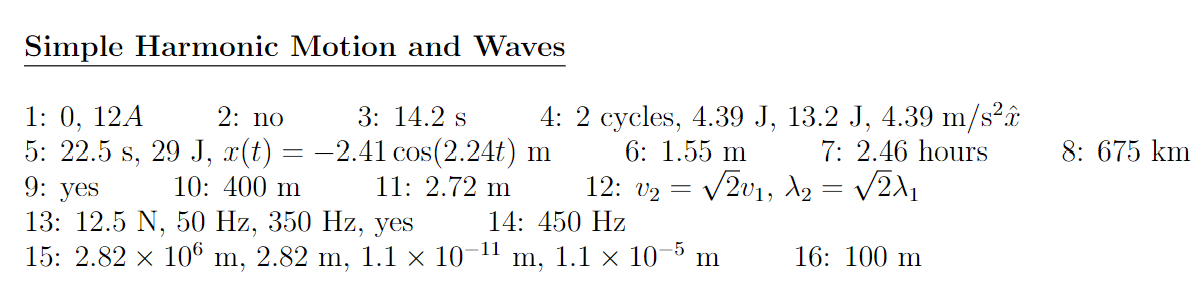
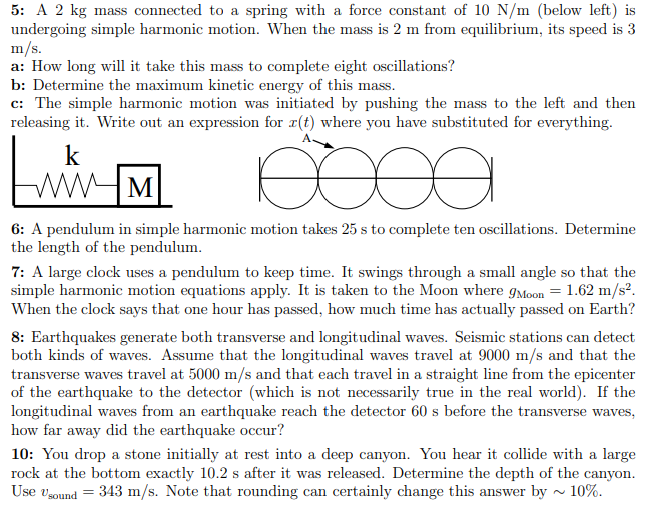
Simple Harmonic Motion and Waves 1: 0, 12A 2: no 3: 14.2 s 4: 2 cycles, 4.39 J, 13.2 J, 4.39 m/s2x 5: 22.5 s, 29 J, x(t) = -2.41 cos(2.24t) m 6: 1.55 m 7: 2.46 hours 8: 675 km 9: yes 10: 400 m 11: 2.72 m 12: V2 = V201, 12 = V2x1 13: 12.5 N, 50 Hz, 350 Hz, yes 14: 450 Hz 15: 2.82 x 10 m, 2.82 m, 1.1 x 10 m, 1.1 x 10 m 16: 100 m5: A 2 kg mass connected to a spring with a force constant of 10 N/m (below left) is undergoing simple harmonic motion. When the mass is 2 m from equilibrium, its speed is 3 m/s. a: How long will it take this mass to complete eight oscillations? b: Determine the maximum kinetic energy of this mass. c: The simple harmonic motion was initiated by pushing the mass to the left and then releasing it. Write out an expression for r(t) where you have substituted for everything. k M 6: A pendulum in simple harmonic motion takes 25 s to complete ten oscillations. Determine the length of the pendulum. 7: A large clock uses a pendulum to keep time. It swings through a small angle so that the simple harmonic motion equations apply. It is taken to the Moon where 9Moon = 1.62 m/s2. When the clock says that one hour has passed, how much time has actually passed on Earth? 8: Earthquakes generate both transverse and longitudinal waves. Seismic stations can detect both kinds of waves. Assume that the longitudinal waves travel at 9000 m/s and that the transverse waves travel at 5000 m/s and that each travel in a straight line from the epicenter of the earthquake to the detector (which is not necessarily true in the real world). If the longitudinal waves from an earthquake reach the detector 60 s before the transverse waves, how far away did the earthquake occur? 10: You drop a stone initially at rest into a deep canyon. You hear it collide with a large rock at the bottom exactly 10.2 s after it was released. Determine the depth of the canyon. Use "sound = 343 m/s. Note that rounding can certainly change this answer by ~ 10%
Step by Step Solution
There are 3 Steps involved in it

Get step-by-step solutions from verified subject matter experts
 Study Help