







Question: Simulation Techniques and Models Question Operations Managements / Computer Science Question Just Question 1 is attached. Will thumbs up for knowledgeable answer! A grocery store
Simulation Techniques and Models Question
Operations Managements / Computer Science Question
Just Question 1 is attached.
Will thumbs up for knowledgeable answer!
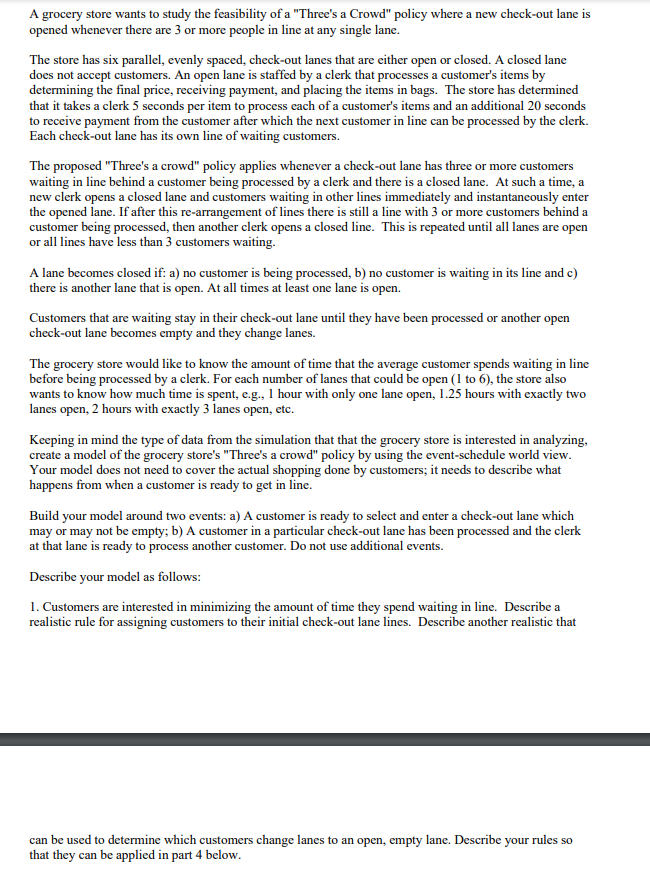
A grocery store wants to study the feasibility of a "Three's a Crowd" policy where a new check-out lane is opened whenever there are 3 or more people in line at any single lane. The store has six parallel, evenly spaced, check-out lanes that are either open or closed. A closed lane does not accept customers. An open lane is staffed by a clerk that processes a customer's items by determining the final price, receiving payment, and placing the items in bags. The store has determined that it takes a clerk 5 seconds per item to process each of a customer's items and an additional 20 seconds to receive payment from the customer after which the next customer in line can be processed by the clerk. Each check-out lane has its own line of waiting customers. The proposed "Three's a crowd" policy applies whenever a check-out lane has three or more customers waiting in line behind a customer being processed by a clerk and there is a closed lane. At such a time, a new clerk opens a closed lane and customers waiting in other lines immediately and instantaneously enter the opened lane. If after this re-arrangement of lines there is still a line with 3 or more customers behind a customer being processed, then another clerk opens a closed line. This is repeated until all lanes are open or all lines have less than 3 customers waiting. A lane becomes closed if: a) no customer is being processed, b) no customer is waiting in its line and c) there is another lane that is open. At all times at least one lane is open. Customers that are waiting stay in their check-out lane until they have been processed or another open check-out lane becomes empty and they change lanes. The grocery store would like to know the amount of time that the average customer spends waiting in line before being processed by a clerk. For each number of lanes that could be open (1 to 6), the store also wants to know how much time is spent, e.g., 1 hour with only one lane open, 1.25 hours with exactly two lanes open, 2 hours with exactly 3 lanes open, etc. Keeping in mind the type of data from the simulation that that the grocery store is interested in analyzing, create a model of the grocery store's "Three's a crowd" policy by using the event-schedule world view. Your model does not need to cover the actual shopping done by customers; it needs to describe what happens from when a customer is ready to get in line. Build your model around two events: a) A customer is ready to select and enter a check-out lane which may or may not be empty; b) A customer in a particular check-out lane has been processed and the clerk at that lane is ready to process another customer. Do not use additional events. Describe your model as follows: 1. Customers are interested in minimizing the amount of time they spend waiting in line. Describe a realistic rule for assigning customers to their initial check-out lane lines. Describe another realistic that can be used to determine which customers change lanes to an open, empty lane. Describe your rules so that they can be applied in part 4 below. A grocery store wants to study the feasibility of a "Three's a Crowd" policy where a new check-out lane is opened whenever there are 3 or more people in line at any single lane. The store has six parallel, evenly spaced, check-out lanes that are either open or closed. A closed lane does not accept customers. An open lane is staffed by a clerk that processes a customer's items by determining the final price, receiving payment, and placing the items in bags. The store has determined that it takes a clerk 5 seconds per item to process each of a customer's items and an additional 20 seconds to receive payment from the customer after which the next customer in line can be processed by the clerk. Each check-out lane has its own line of waiting customers. The proposed "Three's a crowd" policy applies whenever a check-out lane has three or more customers waiting in line behind a customer being processed by a clerk and there is a closed lane. At such a time, a new clerk opens a closed lane and customers waiting in other lines immediately and instantaneously enter the opened lane. If after this re-arrangement of lines there is still a line with 3 or more customers behind a customer being processed, then another clerk opens a closed line. This is repeated until all lanes are open or all lines have less than 3 customers waiting. A lane becomes closed if: a) no customer is being processed, b) no customer is waiting in its line and c) there is another lane that is open. At all times at least one lane is open. Customers that are waiting stay in their check-out lane until they have been processed or another open check-out lane becomes empty and they change lanes. The grocery store would like to know the amount of time that the average customer spends waiting in line before being processed by a clerk. For each number of lanes that could be open (1 to 6), the store also wants to know how much time is spent, e.g., 1 hour with only one lane open, 1.25 hours with exactly two lanes open, 2 hours with exactly 3 lanes open, etc. Keeping in mind the type of data from the simulation that that the grocery store is interested in analyzing, create a model of the grocery store's "Three's a crowd" policy by using the event-schedule world view. Your model does not need to cover the actual shopping done by customers; it needs to describe what happens from when a customer is ready to get in line. Build your model around two events: a) A customer is ready to select and enter a check-out lane which may or may not be empty; b) A customer in a particular check-out lane has been processed and the clerk at that lane is ready to process another customer. Do not use additional events. Describe your model as follows: 1. Customers are interested in minimizing the amount of time they spend waiting in line. Describe a realistic rule for assigning customers to their initial check-out lane lines. Describe another realistic that can be used to determine which customers change lanes to an open, empty lane. Describe your rules so that they can be applied in part 4 belowStep by Step Solution
There are 3 Steps involved in it
1 Expert Approved Answer
Step: 1 Unlock

Question Has Been Solved by an Expert!
Get step-by-step solutions from verified subject matter experts
Step: 2 Unlock
Step: 3 Unlock
 Study Help