







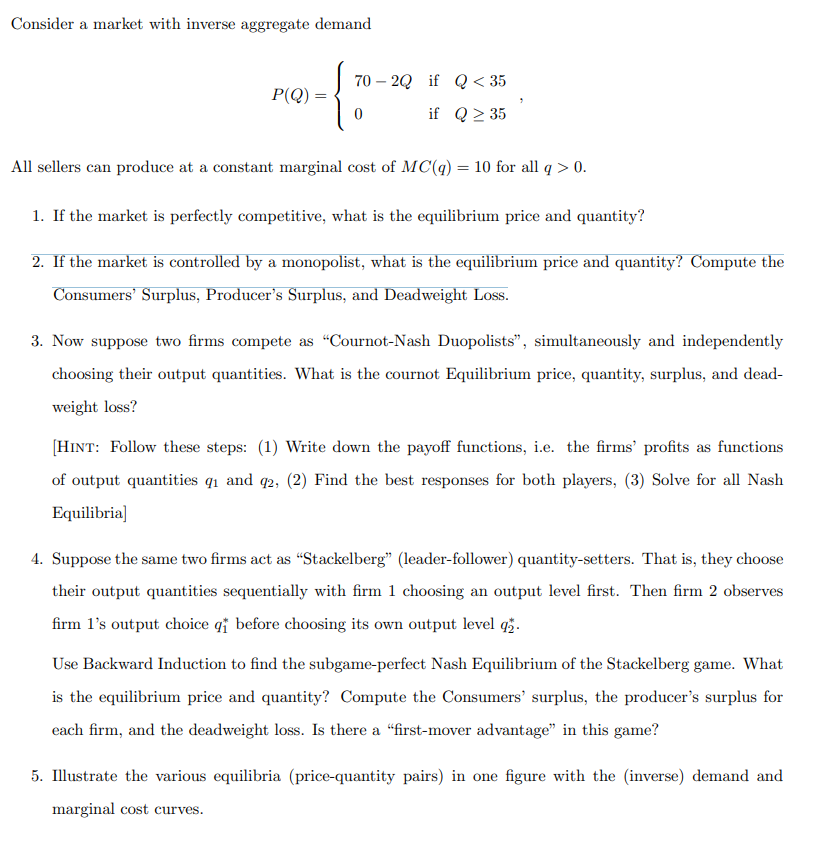
Question: Simultaneous vs. Sequential Move Quantity Setting Games Consider a market with inverse aggregate demand 70 - 2Q if Q 35 All sellers can produce at
Simultaneous vs. Sequential Move Quantity Setting Games
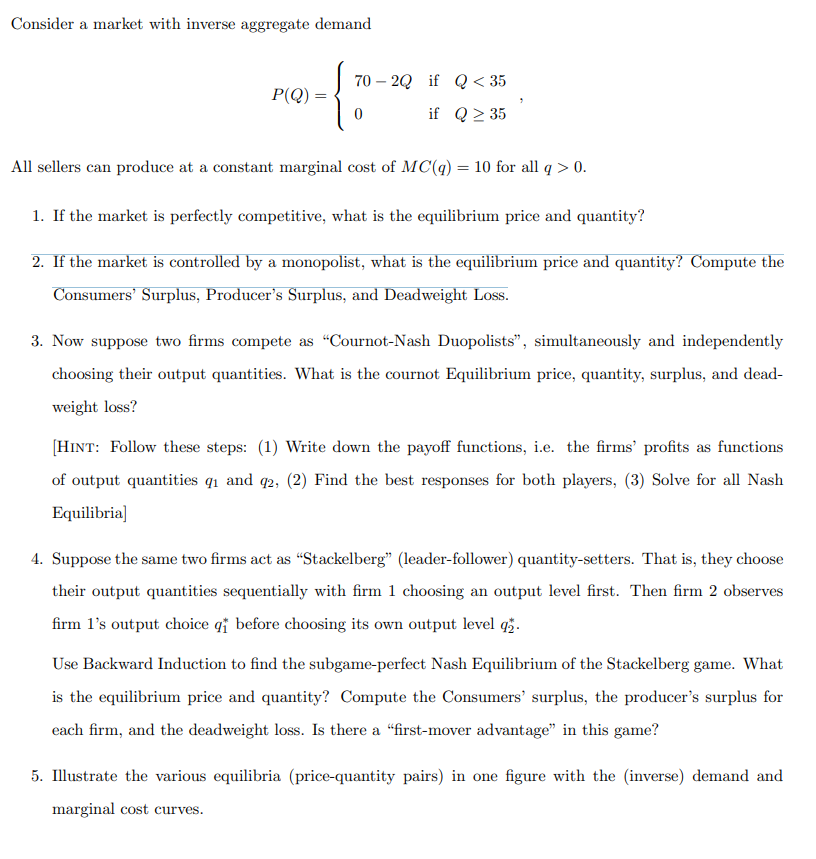
Consider a market with inverse aggregate demand 70 - 2Q if Q 35 All sellers can produce at a constant marginal cost of MC(q) = 10 for all q > 0. 1. If the market is perfectly competitive, what is the equilibrium price and quantity? 2. If the market is controlled by a monopolist, what is the equilibrium price and quantity? Compute the Consumers' Surplus, Producer's Surplus, and Deadweight Loss. 3. Now suppose two firms compete as "Cournot-Nash Duopolists", simultaneously and independently choosing their output quantities. What is the cournot Equilibrium price, quantity, surplus, and dead- weight loss? [HINT: Follow these steps: (1) Write down the payoff functions, i.e. the firms' profits as functions of output quantities q1 and q2, (2) Find the best responses for both players, (3) Solve for all Nash Equilibria] 4. Suppose the same two firms act as "Stackelberg" (leader-follower) quantity-setters. That is, they choose their output quantities sequentially with firm 1 choosing an output level first. Then firm 2 observes firm 1's output choice of before choosing its own output level q2. Use Backward Induction to find the subgame-perfect Nash Equilibrium of the Stackelberg game. What is the equilibrium price and quantity? Compute the Consumers' surplus, the producer's surplus for each firm, and the deadweight loss. Is there a "first-mover advantage" in this game? 5. Illustrate the various equilibria (price-quantity pairs) in one figure with the (inverse) demand and marginal cost curves
Step by Step Solution
There are 3 Steps involved in it

Get step-by-step solutions from verified subject matter experts
 Study Help