







Question: So as we have seen, multiple functions can have the same derivative, therefore a single derivative can have multiple antiderivatives. In fact, a single derivative
So as we have seen, multiple functions can have the same derivative, therefore a single derivative can have multiple antiderivatives. In fact, a single derivative has infinitely many antiderivatives. We have seen that
This is what is known as the general antiderivative. When we are given a point on that is when we can solve for and find the unique antiderivative meeting those criteria.
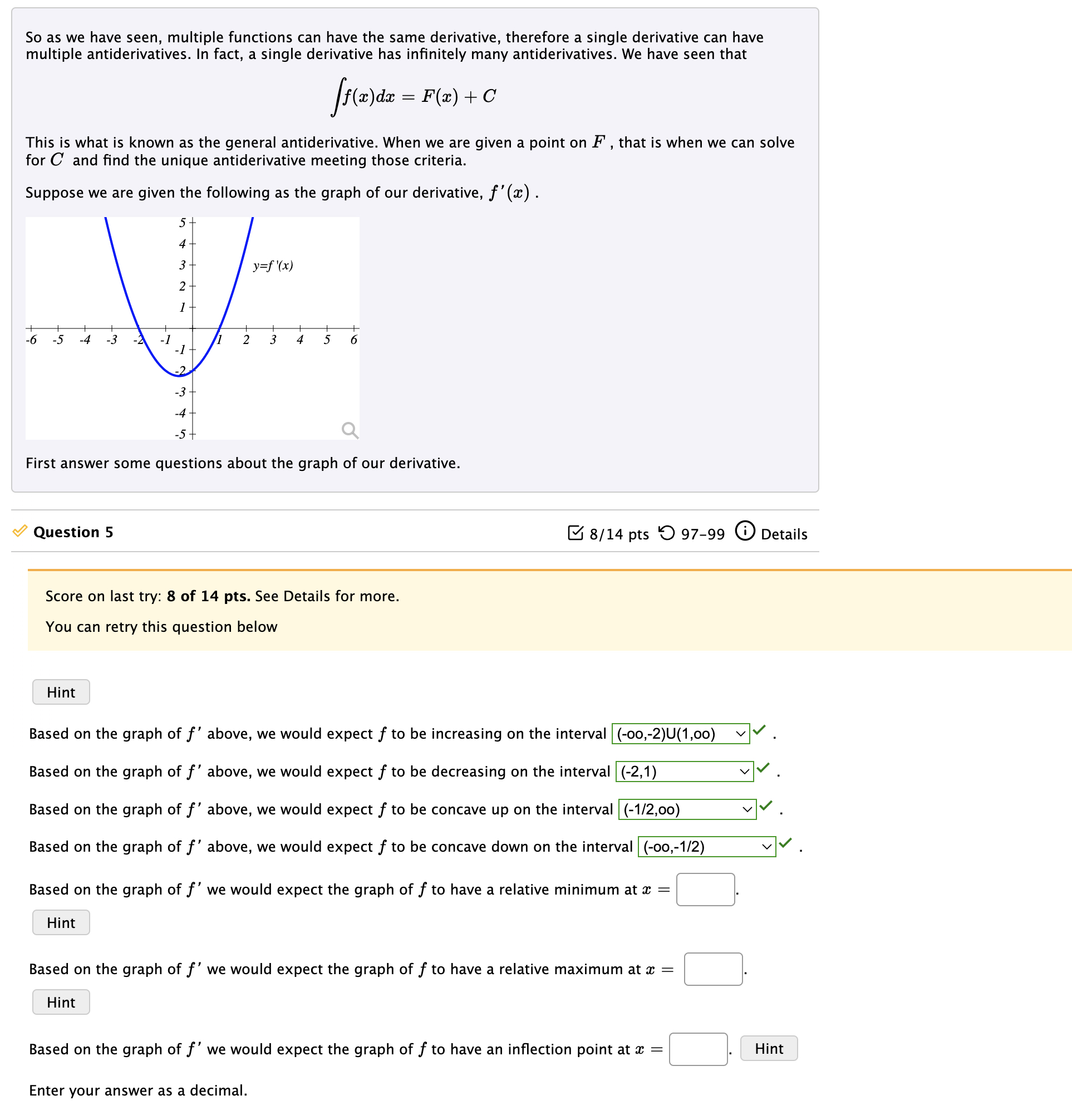
Suppose we are given the following as the graph of our derivative,
First answer some questions about the graph of our derivative.
Question
pts
Details
Score on last try: of pts See Details for more.
You can retry this question below
Based on the graph of above, we would expect to be increasing on the interval
Based on the graph of above, we would expect to be decreasing on the interval
Based on the graph of above, we would expect to be concave up on the interval
Based on the graph of above, we would expect to be concave down on the interval
Based on the graph of we would expect the graph of to have a relative minimum at
Based on the graph of we would expect the graph of to have a relative maximum at
Based on the graph of we would expect the graph of to have an inflection point at
Enter your answer as a decimal.
Step by Step Solution
There are 3 Steps involved in it
1 Expert Approved Answer
Step: 1 Unlock

Question Has Been Solved by an Expert!
Get step-by-step solutions from verified subject matter experts
Step: 2 Unlock
Step: 3 Unlock
 Study Help