







Question: Social Network Analysis & Cybersecurity Risks Question 2. The friendship paradox is the phenomenon that most people have fewer friends than their friends have, on
Social Network Analysis & Cybersecurity Risks Question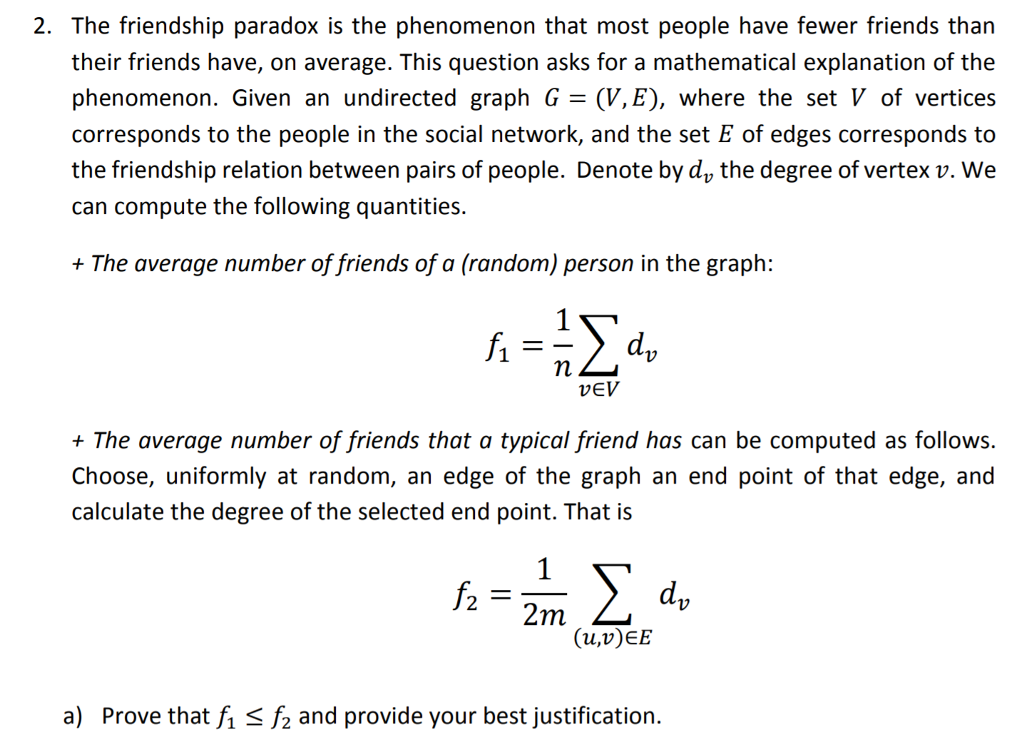
2. The friendship paradox is the phenomenon that most people have fewer friends than their friends have, on average. This question asks for a mathematical explanation of the phenomenon. Given an undirected graph G=(V,E), where the set V of vertices corresponds to the people in the social network, and the set E of edges corresponds to the friendship relation between pairs of people. Denote by dy the degree of vertex v. We can compute the following quantities. +The average number of friends of a (random) person in the graph dv VEV + The average number of friends that a typical friend has can be computed as follows. Choose, uniformly at random, an edge of the graph an end point of that edge, and calculate the degree of the selected end point. That is l.y (u,v)EE a) Prove that fi S f2 and provide your best justification
Step by Step Solution
There are 3 Steps involved in it

Get step-by-step solutions from verified subject matter experts
 Study Help