







Question: Solution A has a dye molecule that is colorless when it is deprotonated. When a functional group on the dye becomes protonated, the dye turns
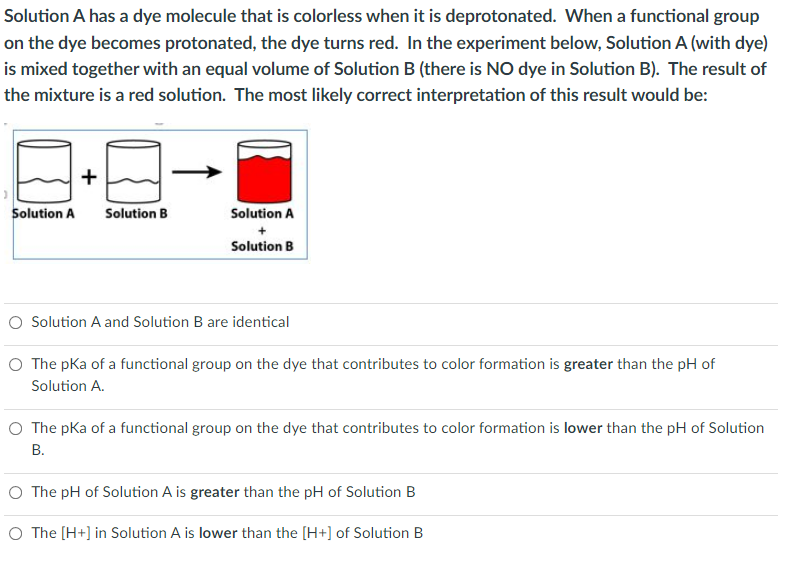
Solution A has a dye molecule that is colorless when it is deprotonated. When a functional group on the dye becomes protonated, the dye turns red. In the experiment below, Solution A (with dye) is mixed together with an equal volume of Solution B (there is NO dye in Solution B). The result of the mixture is a red solution. The most likely correct interpretation of this result would be: + Solution A Solution B Solution A Solution B O Solution A and Solution B are identical The pka of a functional group on the dye that contributes to color formation is greater than the pH of Solution A. The pka of a functional group on the dye that contributes to color formation is lower than the pH of Solution B. The pH of Solution A is greater than the pH of Solution B The (H+) in Solution A is lower than the [H+] of Solution B
Step by Step Solution
There are 3 Steps involved in it

Get step-by-step solutions from verified subject matter experts
 Study Help