







Question: SOLUTION In this example, we will relate current to the actual flow of electrons in a real device. One of the circuits in a small
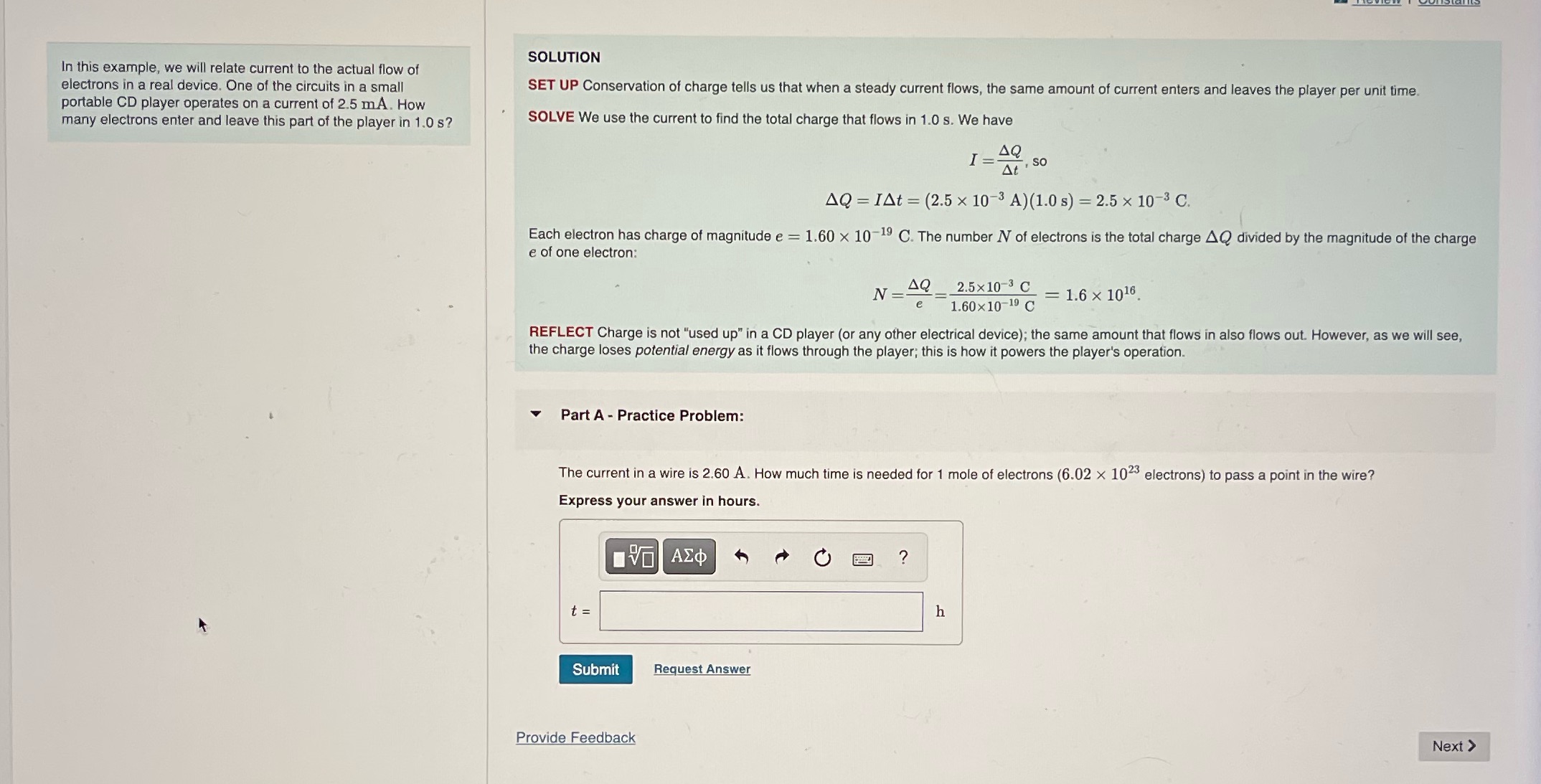
SOLUTION In this example, we will relate current to the actual flow of electrons in a real device. One of the circuits in a small SET UP Conservation of charge tells us that when a steady current flows, the same amount of current enters and leaves the player per unit time. portable CD player operates on a current of 2.5 mA. How many electrons enter and leave this part of the player in 1.0 s? SOLVE We use the current to find the total charge that flows in 1.0 s. We have AQ At : So AQ = IAt = (2.5 x 10⁻³ A) (1.0 s) = 2.5 x 10⁻³ C. Each electron has charge of magnitude e = 1.60 x 10 19 C. The number /V of electrons is the total charge AQ divided by the magnitude of the charge e of one electron: N- 4Q 2.5x10 C _ 1.6 X 10¹⁶. 1.60x10⁻¹⁹ C REFLECT Charge is not "used up" in a CD player (or any other electrical device); the same amount that flows in also flows out. However, as we will see, the charge loses potential energy as it flows through the player; this is how it powers the player's operation. Part A - Practice Problem: The current in a wire is 2.60 A. How much time is needed for 1 mole of electrons (6.02 x 10" electrons) to pass a point in the wire? Express your answer in hours. AEd FOE ? t= h K Submit Request Answer Provide Feedback Next >
Step by Step Solution
There are 3 Steps involved in it

Get step-by-step solutions from verified subject matter experts
 Study Help