







Question: Solution must be written in Haskell. Solution can't use functions that are not included in Prelude. 3. convert, sumGrades, and organize - 238 You are
Solution must be written in Haskell. Solution can't use functions that are not included in Prelude.
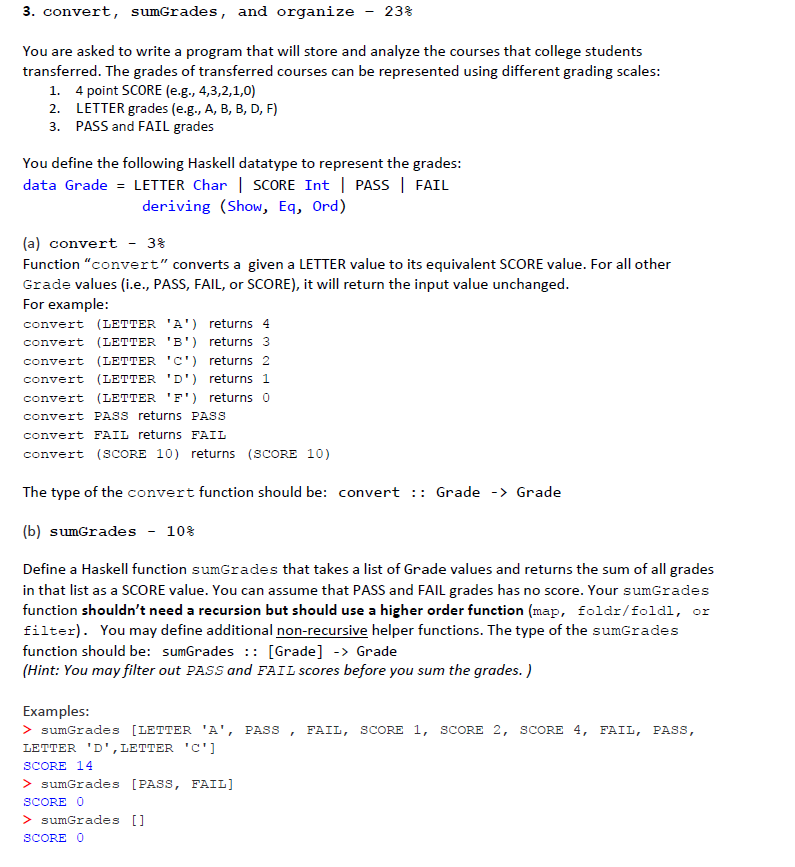
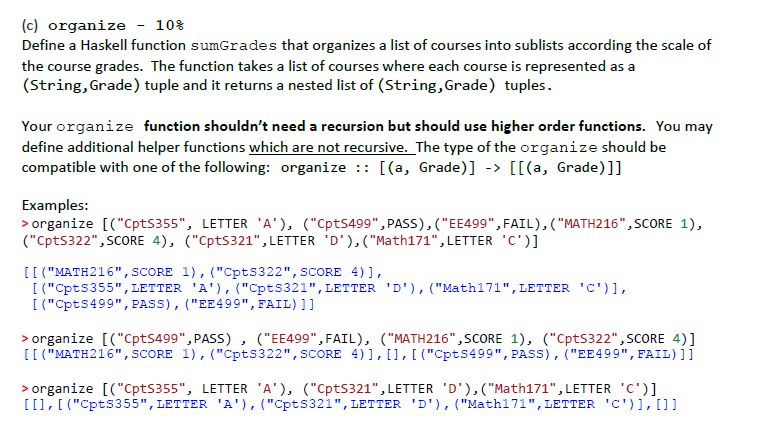
3. convert, sumGrades, and organize - 238 You are asked to write a program that will store and analyze the courses that college students transferred. The grades of transferred courses can be represented using different grading scales: 1. 4 point SCORE (e.g., 4,3,2,1,0) 2. LETTER grades (e.g., A, B, B, D, F) 3. PASS and FAIL grades You define the following Haskell datatype to represent the grades: data Grade = LETTER Char | SCORE Int | PASS | FAIL deriving (Show, Eq, Ord) (a) convert 38 Function "convert" converts a given a LETTER value to its equivalent SCORE value. For all other Grade values (i.e., PASS, FAIL, or SCORE), it will return the input value unchanged. For example: convert (LETTER 'A') returns 4 convert (LETTER 'B') returns 3 convert (LETTER 'C') returns 2 (LETTER 'D') returns 1 convert (LETTER 'F') returns 0 convert PASS returns PASS convert FAIL returns FAIL convert (SCORE 10) returns (SCORE 10) convert The type of the convert function should be convert :: Grade -> Grade (b) sumGrades - 10% Define a Haskell function sumGrades that takes a list of Grade values and returns the sum of all grades in that list as a SCORE value. You can assume that PASS and FAIL grades has no score. Your sumGrades function shouldn't need a recursion but should use a higher order function (map, foldr/foldi, or filter). You may define additional non-recursive helper functions. The type of the sumGrades function should be: sumGrades :: [Grade) -> Grade (Hint: You may filter out PASS and FAIL scores before you sum the grades.) Examples: > sumGrades (LETTER 'A', PASS , FAIL, SCORE 1, SCORE 2, SCORE 4, FAIL, PASS, LETTER 'D', LETTER 'C'] SCORE 14 > sumGrades [PASS, FAIL] SCORE 0 > sumGrades [] SCORE 0 (c) organize 10% Define a Haskell function sumGrades that organizes a list of courses into sublists according the scale of the course grades. The function takes a list of courses where each course is represented as a (String, Grade) tuple and it returns a nested list of (String, Grade) tuples. Your organize function shouldn't need a recursion but should use higher order functions. You may define additional helper functions which are not recursive. The type of the organize should be compatible with one of the following: organize :: [(a, Grade)] -> [[(a, Grade)]] Examples: > organize [("Cpt5355", LETTER 'A'), ("Cpt5499",PASS), ("EE499",FAIL), ("MATH216", SCORE 1), ("Cpts322", SCORE 4), ("Cpts321", LETTER 'D'), ("Math171", LETTER 'C')] [[ ("MATH216", SCORE 1), ("Cpts322", SCORE 4)], [("Cpts355", LETTER 'A'), ("Cpts321", LETTER 'D'), ("Math171", LETTER 'C')], [("Cpts499", PASS), ("EE 499", FAIL)]] > organize [("Cpts499", PASS), ("EE499",FAIL), ("MATH216", SCORE 1), ("Cpts322", SCORE 4)] [[ ("MATH216", SCORE 1), ("Cpts322", SCORE 4)], [], [("Cpts499", PASS), ("EE499", FAIL)]] > organize [("Cpts355", LETTER 'A'), ("Cpts321", LETTER 'D'), ("Math171", LETTER 'C')] [[], [("Cpts355", LETTER 'A'), ("Cpts321", LETTER 'D'), ("Math171", LETTER 'C')],[1] 3. convert, sumGrades, and organize - 238 You are asked to write a program that will store and analyze the courses that college students transferred. The grades of transferred courses can be represented using different grading scales: 1. 4 point SCORE (e.g., 4,3,2,1,0) 2. LETTER grades (e.g., A, B, B, D, F) 3. PASS and FAIL grades You define the following Haskell datatype to represent the grades: data Grade = LETTER Char | SCORE Int | PASS | FAIL deriving (Show, Eq, Ord) (a) convert 38 Function "convert" converts a given a LETTER value to its equivalent SCORE value. For all other Grade values (i.e., PASS, FAIL, or SCORE), it will return the input value unchanged. For example: convert (LETTER 'A') returns 4 convert (LETTER 'B') returns 3 convert (LETTER 'C') returns 2 (LETTER 'D') returns 1 convert (LETTER 'F') returns 0 convert PASS returns PASS convert FAIL returns FAIL convert (SCORE 10) returns (SCORE 10) convert The type of the convert function should be convert :: Grade -> Grade (b) sumGrades - 10% Define a Haskell function sumGrades that takes a list of Grade values and returns the sum of all grades in that list as a SCORE value. You can assume that PASS and FAIL grades has no score. Your sumGrades function shouldn't need a recursion but should use a higher order function (map, foldr/foldi, or filter). You may define additional non-recursive helper functions. The type of the sumGrades function should be: sumGrades :: [Grade) -> Grade (Hint: You may filter out PASS and FAIL scores before you sum the grades.) Examples: > sumGrades (LETTER 'A', PASS , FAIL, SCORE 1, SCORE 2, SCORE 4, FAIL, PASS, LETTER 'D', LETTER 'C'] SCORE 14 > sumGrades [PASS, FAIL] SCORE 0 > sumGrades [] SCORE 0 (c) organize 10% Define a Haskell function sumGrades that organizes a list of courses into sublists according the scale of the course grades. The function takes a list of courses where each course is represented as a (String, Grade) tuple and it returns a nested list of (String, Grade) tuples. Your organize function shouldn't need a recursion but should use higher order functions. You may define additional helper functions which are not recursive. The type of the organize should be compatible with one of the following: organize :: [(a, Grade)] -> [[(a, Grade)]] Examples: > organize [("Cpt5355", LETTER 'A'), ("Cpt5499",PASS), ("EE499",FAIL), ("MATH216", SCORE 1), ("Cpts322", SCORE 4), ("Cpts321", LETTER 'D'), ("Math171", LETTER 'C')] [[ ("MATH216", SCORE 1), ("Cpts322", SCORE 4)], [("Cpts355", LETTER 'A'), ("Cpts321", LETTER 'D'), ("Math171", LETTER 'C')], [("Cpts499", PASS), ("EE 499", FAIL)]] > organize [("Cpts499", PASS), ("EE499",FAIL), ("MATH216", SCORE 1), ("Cpts322", SCORE 4)] [[ ("MATH216", SCORE 1), ("Cpts322", SCORE 4)], [], [("Cpts499", PASS), ("EE499", FAIL)]] > organize [("Cpts355", LETTER 'A'), ("Cpts321", LETTER 'D'), ("Math171", LETTER 'C')] [[], [("Cpts355", LETTER 'A'), ("Cpts321", LETTER 'D'), ("Math171", LETTER 'C')],[1]
Step by Step Solution
There are 3 Steps involved in it

Get step-by-step solutions from verified subject matter experts
 Study Help