







Question: solve 1,2 and 3 please 1. What attributes does a good wavefunction have? Draw graphs showing each attribute and briefly explain in words what the
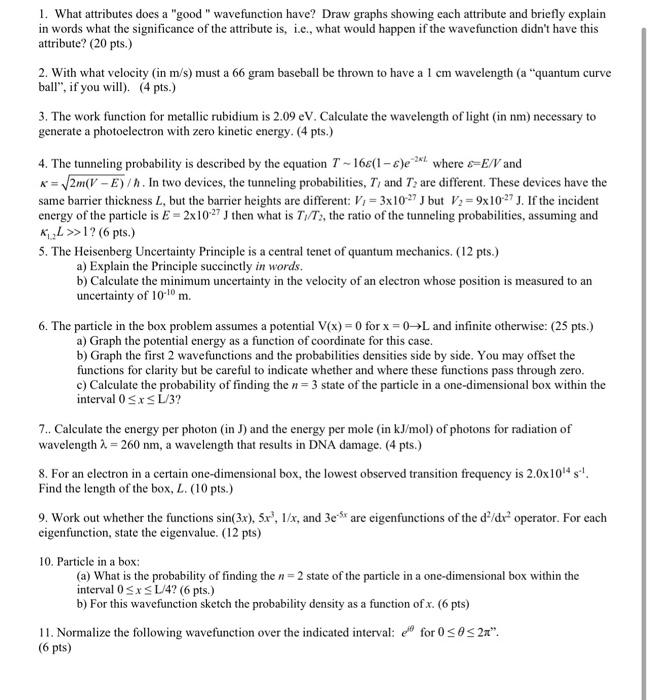
1. What attributes does a "good" wavefunction have? Draw graphs showing each attribute and briefly explain in words what the significance of the attribute is, i.e., what would happen if the wavefunction didn't have this attribute? (20 pts.) 2. With what velocity (in m/s) must a 66 gram baseball be thrown to have a 1 cm wavelength (a quantum curve ball", if you will). (4 pts.) 3. The work function for metallic rubidium is 2.09 eV. Calculate the wavelength of light (in nm) necessary to generate a photoelectron with zero kinetic energy. (4 pts.) 4. The tunneling probability is described by the equation 7 - 16(1- )e 24 where o=E/V and * = 2m(V-E). In two devices, the tunneling probabilities, T, and T, are different. These devices have the same barrier thickness L, but the barrier heights are different: Vi = 3x1027 J but V2 =9x10-??J. If the incident energy of the particle is E = 2x10-27 ) then what is T/T, the ratio of the tunneling probabilities, assuming and KUL>>12 (6 pts.) 5. The Heisenberg Uncertainty Principle is a central tenet of quantum mechanics. (12 pts.) a) Explain the Principle succinctly in words. b) Calculate the minimum uncertainty in the velocity of an electron whose position is measured to an uncertainty of 100 m. 6. The particle in the box problem assumes a potential V(x) = 0 for x=0L and infinite otherwise: (25 pts.) a) Graph the potential energy as a function of coordinate for this case. b) Graph the first 2 wavefunctions and the probabilities densities side by side. You may offset the functions for clarity but be careful to indicate whether and where these functions pass through zero. c) Calculate the probability of finding the n= 3 state of the particle in a one-dimensional box within the interval 0 SXSL/3? 7. Calculate the energy per photon (in D) and the energy per mole (in kJ/mol) of photons for radiation of wavelength 2. = 260 nm, a wavelength that results in DNA damage. (4 pts.) 8. For an electron in a certain one-dimensional box, the lowest observed transition frequency is 2.0x10's! Find the length of the box, L. (10 pts.) 9. Work out whether the functions sin(3x), 5x", 1/x, and 3es are eigenfunctions of the d/dr' operator. For each eigenfunction, state the eigenvalue. (12 pts) 10. Particle in a box: (a) What is the probability of finding the n=2 state of the particle in a one-dimensional box within the interval 0 SXL/4? (6 pts.) b) For this wavefunction sketch the probability density as a function of x. (6 pts) 11. Normalize the following wavefunction over the indicated interval: er for OO
Step by Step Solution
There are 3 Steps involved in it

Get step-by-step solutions from verified subject matter experts
 Study Help