







Question: Solve a partition problem using dynamic programming use n positive integers sum of each subsequence is the same. For example, if the input were (10,
Solve a partition problem using dynamic programming use n positive integers sum of each subsequence is the same. For example, if the input were (10, 20, 30, 40, 40, 50, 80), with a total of m = 270, the three m/3 = 90 subsequences could be (10, 80), (20, 30, 40), and (40, 50). If the input were (20, 20, 30, 50), then no solution is possible even though the values yield a sum (m = 120) divisible by 3 (m/3 = 40). This is a two-dimensional DP situation. if a solution exists then the output is:( please give a code example of how to print the output. I did get everything like sum=270 and sum/3=90. Then if the function returns true or false. I want to see how to save the subarray's each time and then print the output table accordingly). Please read the question carefully the post your solution. Please don't google and post an online solution of the problem. 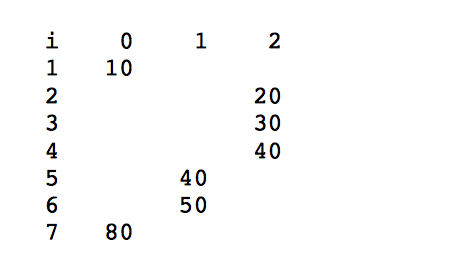
2 2 000 1 0 5 0 1 1 1 2 3 4 5 6 7
Step by Step Solution
There are 3 Steps involved in it

Get step-by-step solutions from verified subject matter experts
 Study Help