Question: Solve A-D using Excel/ Solver add in for accurate answers. Problem 3-13 (Algorithmic) Quality Air Conditioning manufactures three home air conditioners: an economy model, a
Solve A-D using Excel/ Solver add in for accurate answers.
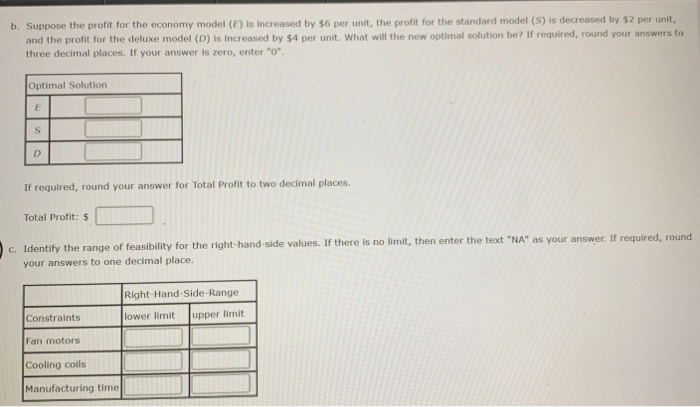
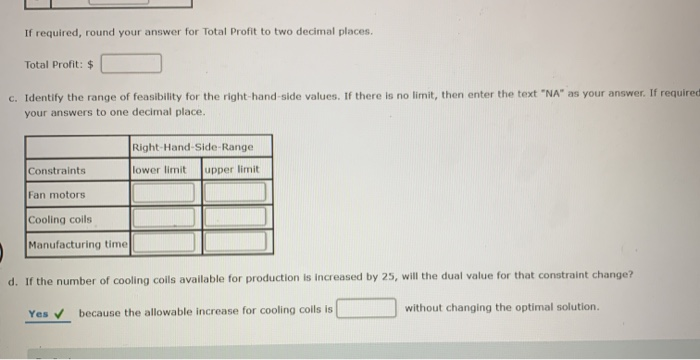
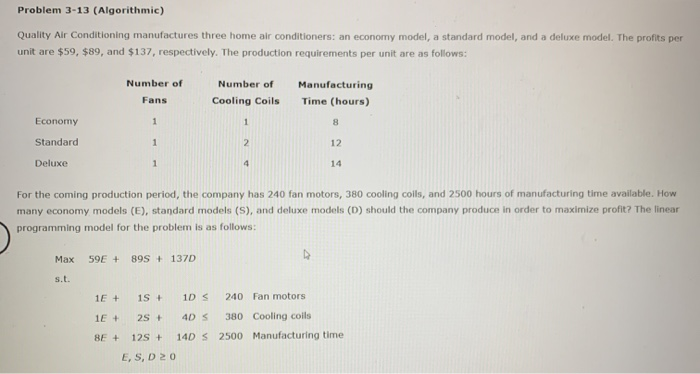
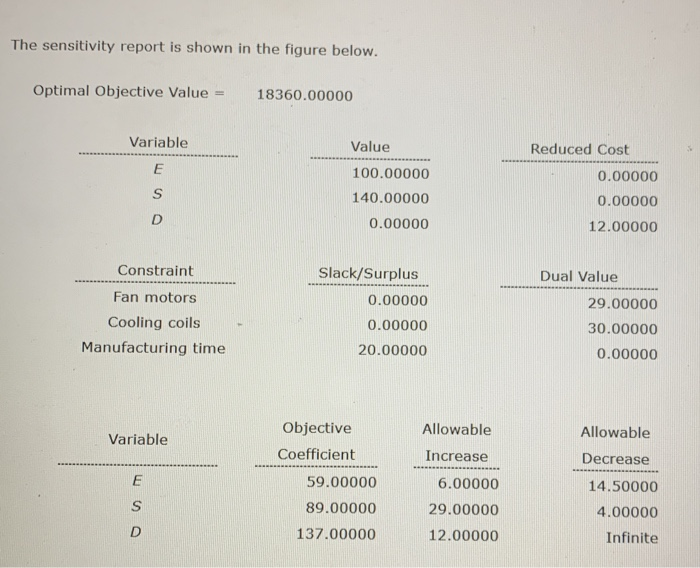
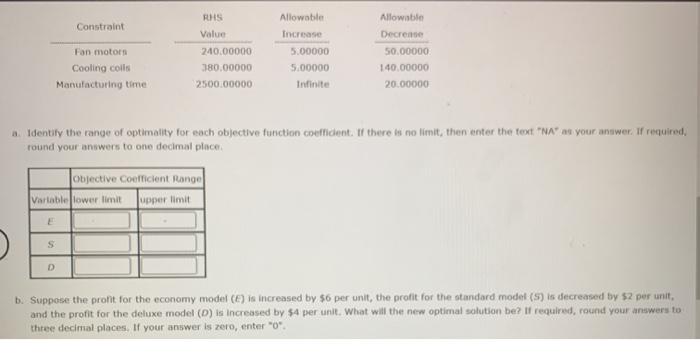
Problem 3-13 (Algorithmic) Quality Air Conditioning manufactures three home air conditioners: an economy model, a standard model, and a deluxe model. The profits per unit are $59, $89, and $137, respectively. The production requirements per unit are as follows: Number of Number of Cooling Coils Manufacturing Time (hours) Fans Economy Standard Deluxe For the coming production period, the company has 240 fan motors, 380 cooling coils, and 2500 hours of manufacturing time available. How many economy models (E), standard models (S), and deluxe models (D) should the company produce in order to maximize profit? The linear programming model for the problem is as follows: Max 59E + 895 + 137D s.t. 1E + 15 + 10 S 1E + 25 + 40 S 8E + 12 + 14D S E,S, D20 240 Fan motors 380 Cooling coils 2500 Manufacturing time The sensitivity report is shown in the figure below. Optimal Objective Value = 18360.00000 Variable Value 100.00000 140.00000 0.00000 Reduced Cost 0.00000 0.00000 12.00000 Constraint Fan motors Cooling coils Manufacturing time Slack/Surplus 0.00000 0.00000 20.00000 Dual Value 29.00000 30.00000 0.00000 Variable Objective Coefficient 59.00000 89.00000 137.00000 Allowable Increase 6.00000 29.00000 12.00000 Allowable Decrease 14.50000 4.00000 Infinite RHS Constraint Value Fan motors Allowable Increase 5.00000 5.00000 Infinite 240.00000 380.00000 2500.00000 Allowable Decrease 50.00000 140.00000 20.00000 Cooling coils Manufacturing time a. Identify the range of optimality for each objective function coefficient. If there is no limit, then enter the text "NA" as your answer. If required, round your answers to one decimal place. Objective Coefficient Range Variable lower limit upper limit b. Suppose the profit for the economy model (E) is increased by $6 per unit, the profit for the standard model (S) is decreased by $2 per unit, and the profit for the deluxe model (D) is increased by $4 per unit. What will the new optimal solution be? If required, round your answers to three decimal places. If your answer is zero, enter "o". b. Suppose the profit for the economy model () is increased by $6 per unit, the profit for the standard model (S) is decreased by $2 per unit, and the profit for the deluxe model (D) is increased by $4 per unit. What will the new optimal solution be? If required, round your answers to three decimal places. If your answer is zero, enter "0". Optimal Solution If required, round your answer for Total Profit to two decimal places. Total Profit: $ C. Identify the range of feasibility for the right-hand-side values. If there is no limit, then enter the text "NA" as your answer. If required, round your answers to one decimal place. Right-Hand-Side-Range Constraints lower limit upper limit Fan motors Cooling coils Manufacturing time If required, round your answer for Total Profit to two decimal places. Total Profit: $ c. Identify the range of feasibility for the right-hand side values. If there is no limit, then enter the text "NA" as your answer. If required your answers to one decimal place. Right-Hand-Side-Range lower limit upper limit Constraints Fan motors Cooling coils Manufacturing time d. If the number of cooling coils available for production is increased by 25, will the dual value for that constraint change? Yes because the allowable increase for cooling coils is without changing the optimal solution









 Study Help