







Question: solve all parts A store faces a random weekly demand for a single item it sells. Each week customers are equally likely to demand 0,
solve all parts
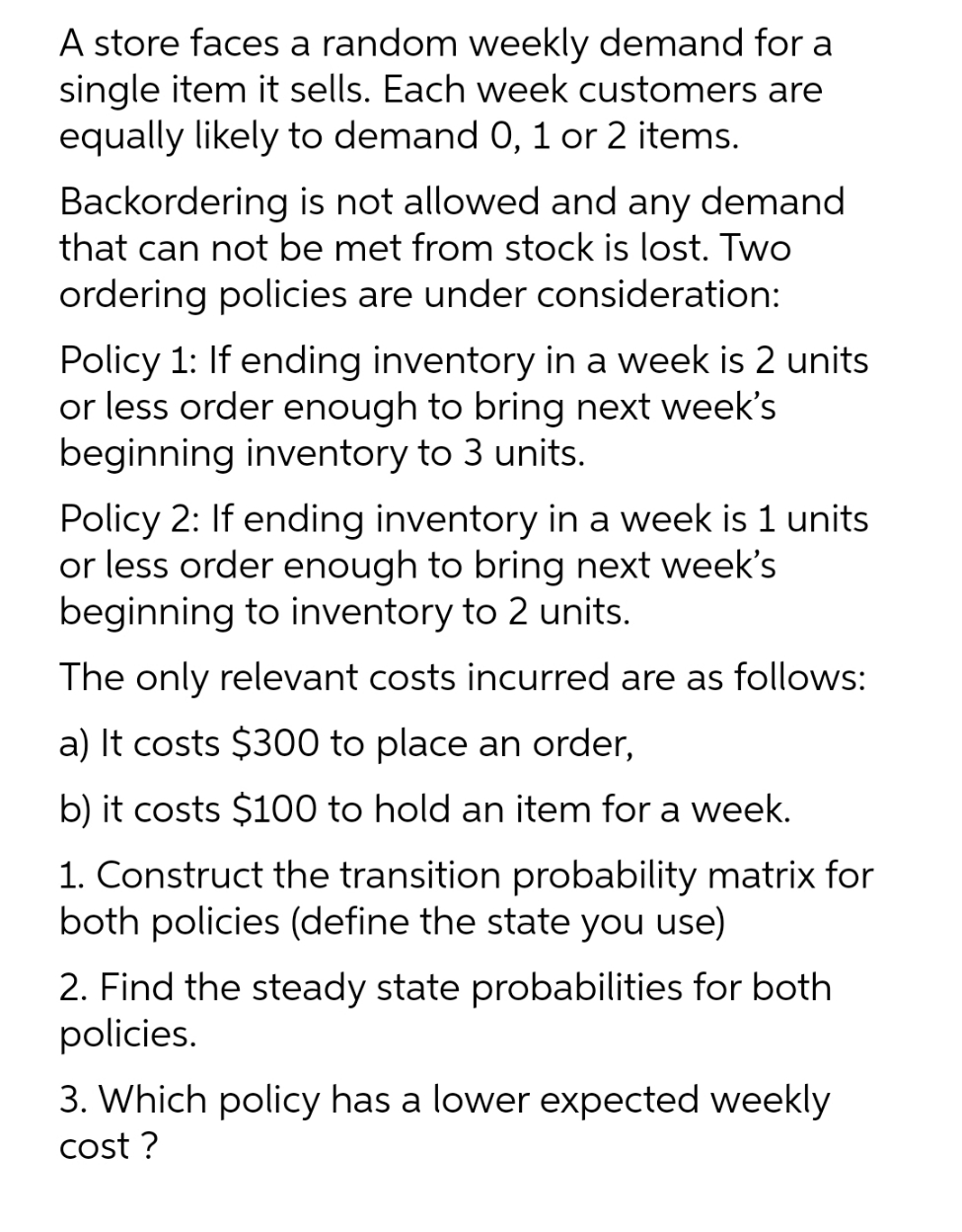
A store faces a random weekly demand for a single item it sells. Each week customers are equally likely to demand 0, 1 or 2 items. Backordering is not allowed and any demand that can not be met from stock is lost. Two ordering policies are under consideration: Policy 1: If ending inventory in a week is 2 units or less order enough to bring next week's beginning inventory to 3 units. Policy 2: If ending inventory in a week is 1 units or less order enough to bring next week's beginning to inventory to 2 units. The only relevant costs incurred are as follows: a) It costs $300 to place an order, b) it costs $100 to hold an item for a week. 1. Construct the transition probability matrix for both policies (define the state you use) 2. Find the steady state probabilities for both policies. 3. Which policy has a lower expected weekly cost
Step by Step Solution
There are 3 Steps involved in it

Get step-by-step solutions from verified subject matter experts
 Study Help