







Question: solve example 2 only Module 6 - Layout Decisions (Lesson: Assembly-Line Balancing) Read pages 393-396 Developing a precedence diagram for an assembly line Cycle time
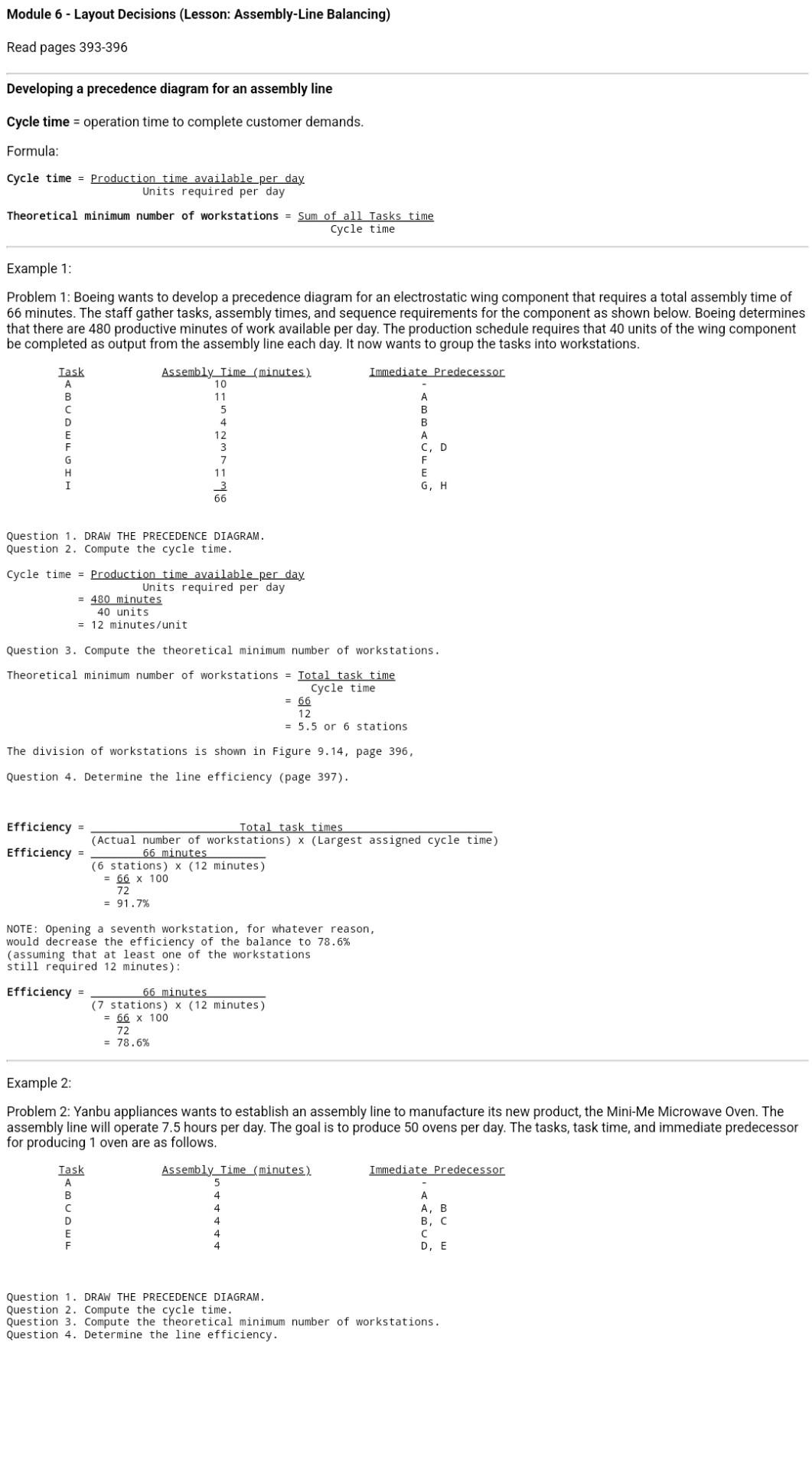
solve example 2 only
Module 6 - Layout Decisions (Lesson: Assembly-Line Balancing) Read pages 393-396 Developing a precedence diagram for an assembly line Cycle time = operation time to complete customer demands. Formula: Cycle time = Production time available per day. Units required per day Theoretical minimum number of workstations = Sum of all Tasks time Cycle time Example 1: Problem 1: Boeing wants to develop a precedence diagram for an electrostatic wing component that requires a total assembly time of 66 minutes. The staff gather tasks, assembly times, and sequence requirements for the component as shown below. Boeing determines that there are 480 productive minutes of work available per day. The production schedule requires that 40 units of the wing component be completed as output from the assembly line each day. It now wants to group the tasks into workstations. Task Immediate Predecessor B Assembly_Time_(minutes.) 10 11 5 4 12 3 7 11 A B B C D F E G H G 66 Question 1. DRAW THE PRECEDENCE DIAGRAM. Question 2. Compute the cycle time. Cycle time = Production time available per day Units required per day = 480 minutes 40 units = 12 minutes/unit Question 3. Compute the theoretical minimum number of workstations. Theoretical minimum number of workstations = Total task time Cycle time = 66 12 = 5.5 or 6 stations The division of workstations is shown in Figure 9.14, page 396, Question 4. Determine the line efficiency (page 397). Efficiency = Efficiency = Total task times (Actual number of workstations) x (Largest assigned cycle time) 66 minutes (6 stations) X (12 minutes) = 66 x 100 72 = 91.7% NOTE: Opening a seventh workstation, for whatever reason, would decrease the efficiency of the balance to 78.6% (assuming that at least one of the workstations still required 12 minutes) Efficiency = 66 minutes (7 stations) X (12 minutes) = 66 X 100 72 = 78.6% Example 2: Problem 2: Yanbu appliances wants to establish an assembly line to manufacture its new product, the Mini-Me Microwave Oven. The assembly line will operate 7.5 hours per day. The goal is to produce 50 ovens per day. The tasks, task time, and immediate predecessor for producing 1 oven are as follows. Task Immediate Predecessor Assembly Time (minutes). 5 4 4 4 4 4 A A, B B, C F D, E Question 1. DRAW THE PRECEDENCE DIAGRAM. Question 2. Compute the cycle time. Question 3. Compute the theoretical minimum number of workstations. Question 4. Determine the line efficiencyStep by Step Solution
There are 3 Steps involved in it
1 Expert Approved Answer
Step: 1 Unlock

Question Has Been Solved by an Expert!
Get step-by-step solutions from verified subject matter experts
Step: 2 Unlock
Step: 3 Unlock
 Study Help