







Question: solve in 25 mins i will give thumb up. write final answers at end of solution separately Let's see how bad risks drive good risks
solve in 25 mins i will give thumb up. write final answers at end of solution separately
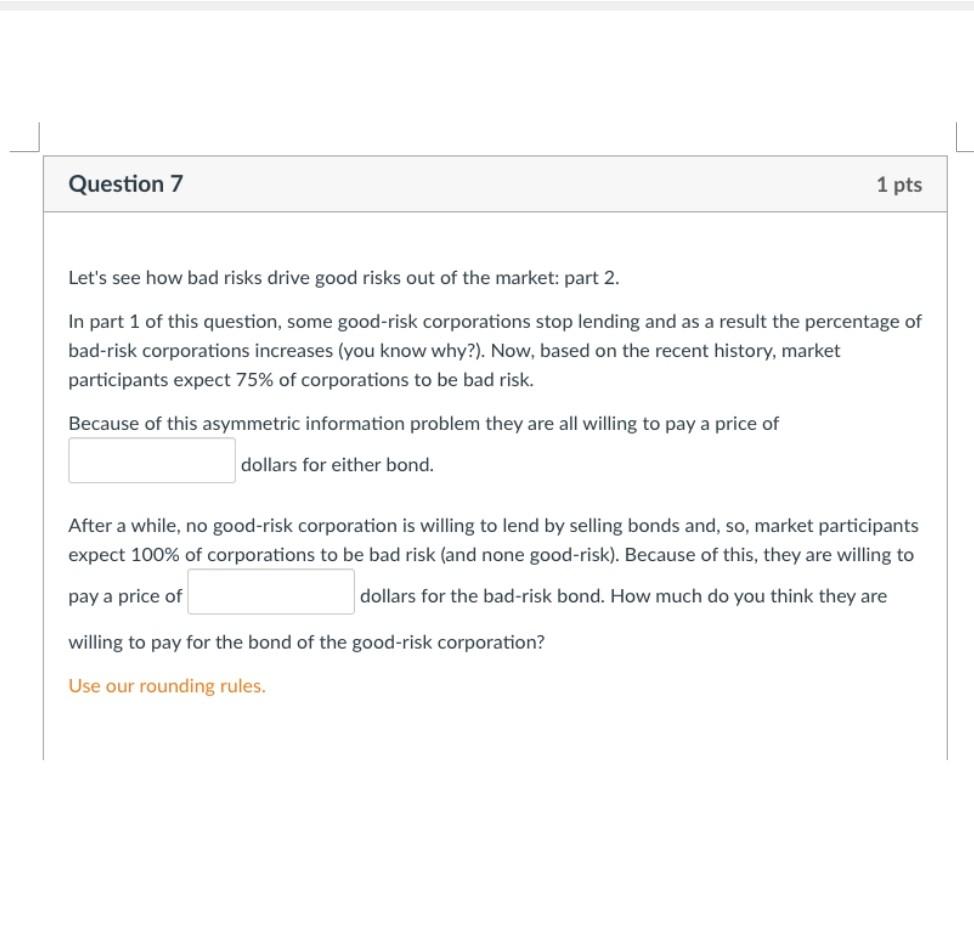
Let's see how bad risks drive good risks out of the market: part 2. In part 1 of this question, some good-risk corporations stop lending and as a result the percentage of bad-risk corporations increases (you know why?). Now, based on the recent history, market participants expect 75% of corporations to be bad risk. Because of this asymmetric information problem they are all willing to pay a price of dollars for either bond. After a while, no good-risk corporation is willing to lend by selling bonds and, so, market participants expect 100% of corporations to be bad risk (and none good-risk). Because of this, they are willing to pay a price of dollars for the bad-risk bond. How much do you think they are willing to pay for the bond of the good-risk corporation? Use our rounding rules. Let's see how bad risks drive good risks out of the market: part 2. In part 1 of this question, some good-risk corporations stop lending and as a result the percentage of bad-risk corporations increases (you know why?). Now, based on the recent history, market participants expect 75% of corporations to be bad risk. Because of this asymmetric information problem they are all willing to pay a price of dollars for either bond. After a while, no good-risk corporation is willing to lend by selling bonds and, so, market participants expect 100% of corporations to be bad risk (and none good-risk). Because of this, they are willing to pay a price of dollars for the bad-risk bond. How much do you think they are willing to pay for the bond of the good-risk corporation? Use our rounding rules
Step by Step Solution
There are 3 Steps involved in it

Get step-by-step solutions from verified subject matter experts
 Study Help