







Question: Solve in C langauge Solve Programming project P-48 Programming Projects Programming Problems 9.28 Assume that a system has a 32-bit virtual address with a 4-KB
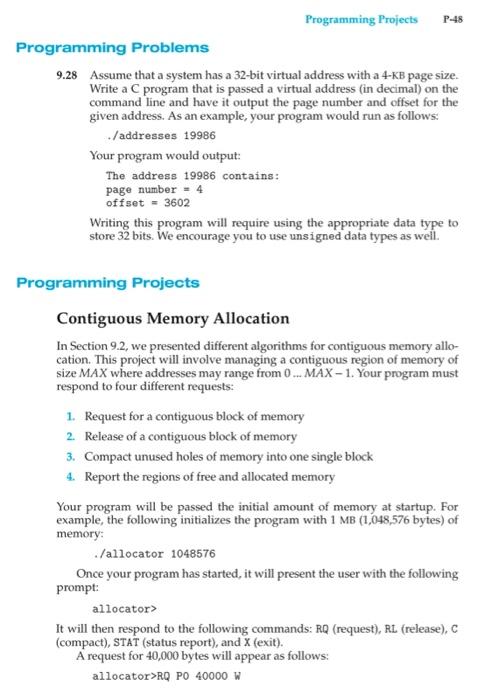
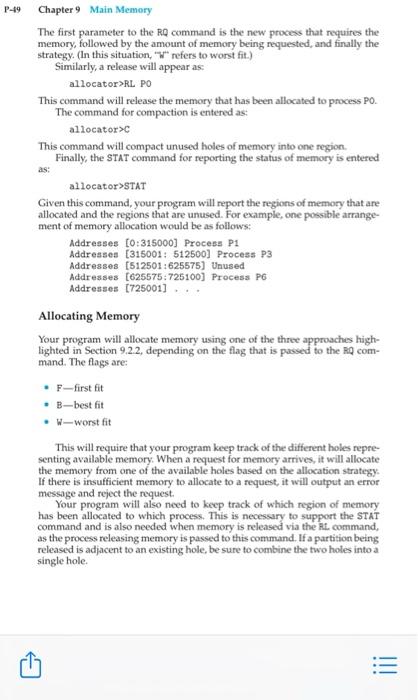
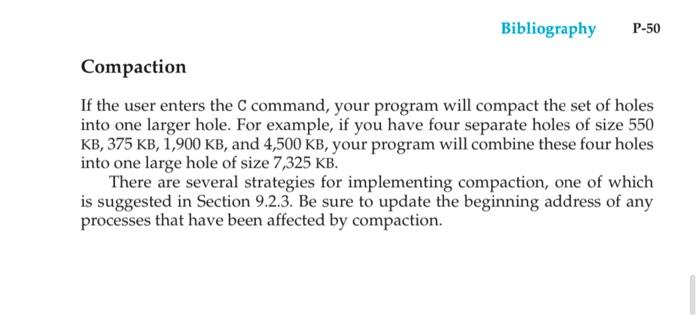
P-48 Programming Projects Programming Problems 9.28 Assume that a system has a 32-bit virtual address with a 4-KB page size. Write a C program that is passed a virtual address (in decimal) on the command line and have it output the page number and offset for the given address. As an example, your program would run as follows: ./addresses 19986 Your program would output: The address 19986 contains: page number = 4 offset - 3602 Writing this program will require using the appropriate data type to store 32 bits. We encourage you to use unsigned data types as well Programming Projects Contiguous Memory Allocation In Section 9.2, we presented different algorithms for contiguous memory allo- cation. This project will involve managing a contiguous region of memory of size MAX where addresses may range from 0. MAX - 1. Your program must respond to four different requests: 1. Request for a contiguous block of memory 2. Release of a contiguous block of memory 3. Compact unused holes of memory into one single block 4. Report the regions of free and allocated memory Your program will be passed the initial amount of memory at startup. For example, the following initializes the program with 1 MB (1,048,576 bytes) of memory: ./allocator 1048576 Once your program has started, it will present the user with the following prompt: allocator> It will then respond to the following commands: RQ (request), RL (release), C (compact), STAT (status report), and X (exit). A request for 40,000 bytes will appear as follows: allocator>RQ PO 40000 W P-49 Chapter 9 Main Memory The first parameter to the RQ command is the new process that requires the memory, followed by the amount of memory being requested, and finally the strategy. (In this situation, refers to worst fit.) Similarly, a release will appear as allocator>RL PO This command will release the memory that has been allocated to process PO. The command for compaction is entered as allocator> This command will compact unused holes of memory into one region. Finally, the STAT command for reporting the status of memory is entered allocator>STAT Given this command, your program will report the regions of memory that are allocated and the regions that are unused. For example, one possible arrange ment of memory allocation would be as follows: Addresses (0:315000) Process P1 Addresses (315001: 512500) Process P3 Addresses [512501: 625575) Unused Addresses (625575:725100] Process PG Addresses (725001] as: Allocating Memory Your program will allocate memory using one of the three approaches high- lighted in Section 9.2.2, depending on the flag that is passed to the com- mand. The flags are: F-first fit B-best fit W-worst fit This will require that your program keep track of the different holes repre- senting available memory When a request for memory arrives, it will allocate the memory from one of the available holes based on the allocation strategy If there is insufficient memory to allocate to a request, it will output an error message and reject the request. Your program will also need to keep track of which region of memory has been allocated to which process. This is necessary to support the STAT command and is also needed when memory is released via the RL. command, as the process releasing memory is passed to this command. If a partition being released is adjacent to an existing hole, be sure to combine the two holes into a single hole III Bibliography P-50 Compaction If the user enters the command, your program will compact the set of holes into one larger hole. For example, if you have four separate holes of size 550 KB, 375 KB, 1,900 KB, and 4,500 KB, your program will combine these four holes into one large hole of size 7,325 KB. There are several strategies for implementing compaction, one of which is suggested in Section 9.2.3. Be sure to update the beginning address of any processes that have been affected by compaction
Step by Step Solution
There are 3 Steps involved in it

Get step-by-step solutions from verified subject matter experts
 Study Help