







Question: solve in details please Question 2 (20 points) Consider the Mortensen-Pissarides model in continuous time. Labor force is normal- ized to 1, but here there
solve in details please
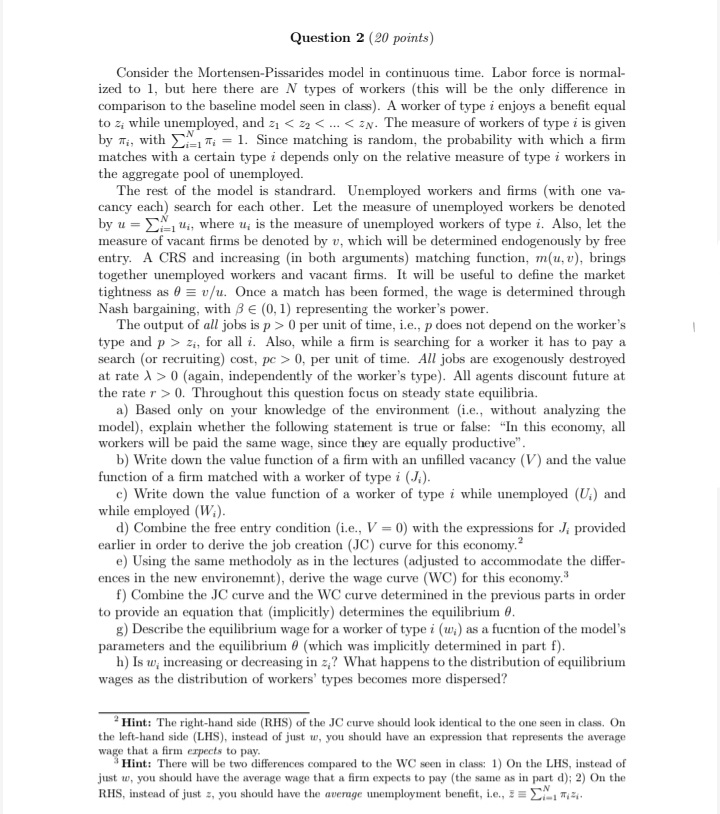
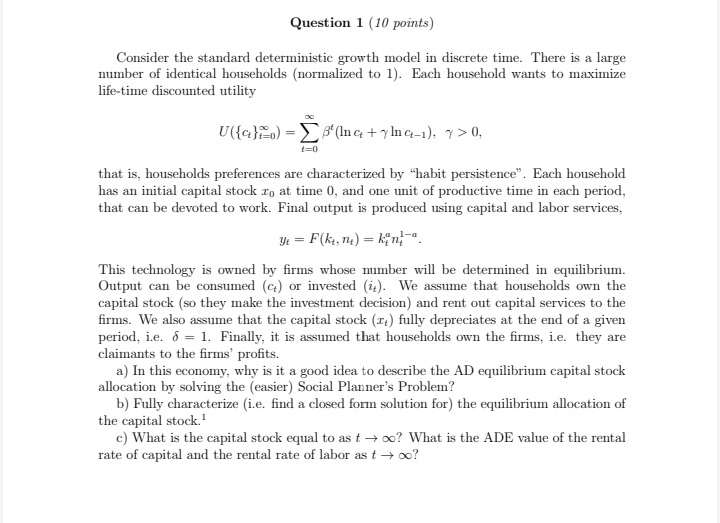
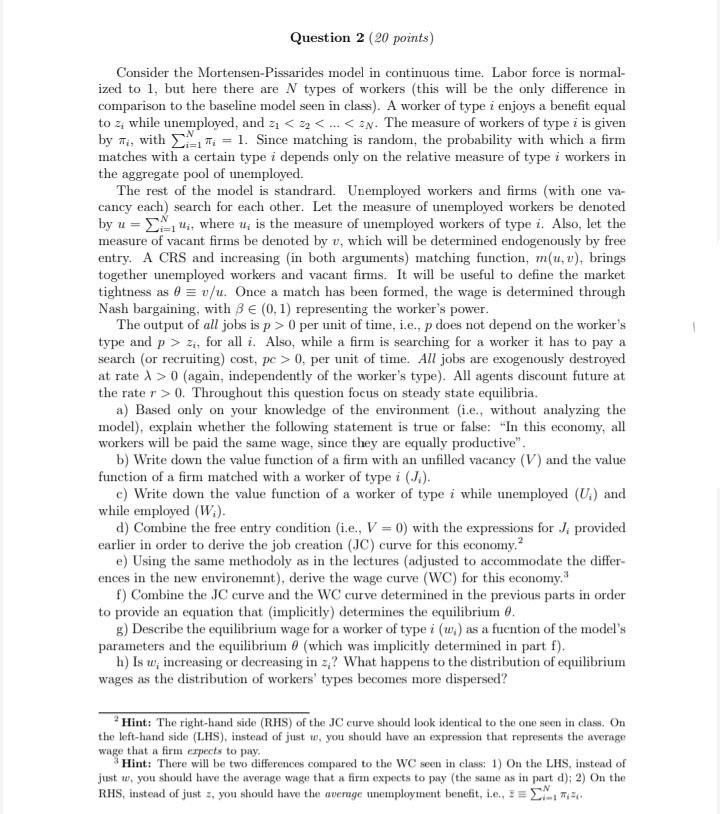
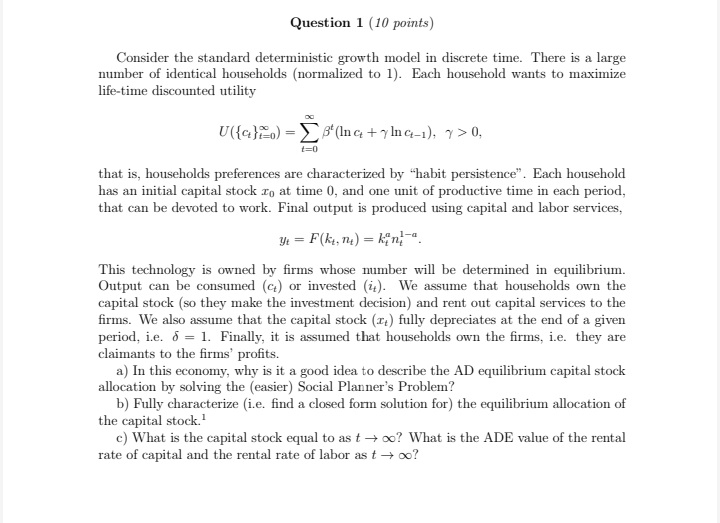
Question 2 (20 points) Consider the Mortensen-Pissarides model in continuous time. Labor force is normal- ized to 1, but here there are N types of workers (this will be the only difference in comparison to the baseline model seen in class). A worker of type i enjoys a benefit equal to z; while unemployed, and z1 0 per unit of time, i.e., p does not depend on the worker's type and p > z;, for all i. Also, while a firm is searching for a worker it has to pay a search (or recruiting) cost, pc > 0, per unit of time. All jobs are exogenously destroyed at rate > > 0 (again, independently of the worker's type). All agents discount future at the rate r > 0. Throughout this question focus on steady state equilibria. a) Based only on your knowledge of the environment (i.e., without analyzing the model), explain whether the following statement is true or false: "In this economy, all workers will be paid the same wage, since they are equally productive" b) Write down the value function of a firm with an unfilled vacancy (V) and the value function of a firm matched with a worker of type i (J;). c) Write down the value function of a worker of type i while unemployed (U;) and while employed (W;). d) Combine the free entry condition (i.e., V = 0) with the expressions for J, provided earlier in order to derive the job creation (JC) curve for this economy." e) Using the same methodoly as in the lectures (adjusted to accommodate the differ- ences in the new environemnt), derive the wage curve (WC) for this economy. f) Combine the JC curve and the WC curve determined in the previous parts in order to provide an equation that (implicitly) determines the equilibrium 0 g) Describe the equilibrium wage for a worker of type i (w;) as a fucntion of the model's parameters and the equilibrium # (which was implicitly determined in part f). h) Is w, increasing or decreasing in z,? What happens to the distribution of equilibrium wages as the distribution of workers' types becomes more dispersed? Hint: The right-hand side (RHS) of the JC curve should look identical to the one seen in class. On the left-hand side (LHS), instead of just w, you should have an expression that represents the average wage that a firm expects to pay. Hint: There will be two differences compared to the WC seen in class: 1) On the LHS, instead of just w, you should have the average wage that a firm expects to pay (the same as in part d); 2) On the RHS, instead of just z, you should have the average unemployment benefit, Le. =)_ma.Question 1 (In? paints] Consider the standard deterministic growth model in discrete time. There is. a large number of identical households (normalized to 1]. Each household wants to maximize life-time discounted utility.r \"Maa! = Z'nq + "flue1L ".r i=- 01 that is, households preferences are characterized by \"habit persistence". Each household has an initial capital stock In at time i}, and one unit of productive time in each period, that can he devoted to work. Final output is produced using capital and labor senl'ioas, y: = Ham} = hint\"- This technology is owned by rms whose number 1will be determined in equilibrium. Output can be consumed IE1) or invested {it}. We assume that households m the capital stock (so the},r make the investment decision} and rent out capital services to the rms. We also as'esume that the capital stock {1"} full}.r depreciate; at the end of a given period, i.e. ii = 1. Finally, it is assumed that households own the rms, i_e. they are claimants to the rms' prots. a} In this economy why.r is it a good idea to describe the AD equilibrium capital stock allocation by solving the [easier] Social Plan ner's Problem? b] Full},r characterize [i.e. End a clashed form solution for] the equilibrium allocation of the capital stock] c] 1What is the capital stock equal to as it > is]? What is the ADE 1.-'alue of the rental rate of capital and the rental rate of labor as it > one
Step by Step Solution
There are 3 Steps involved in it

Get step-by-step solutions from verified subject matter experts
 Study Help