







Question: solve it using python code 2. Derive the coefficients of the discrete analogue of the fourier series when N = 4 for the sawtooth function,
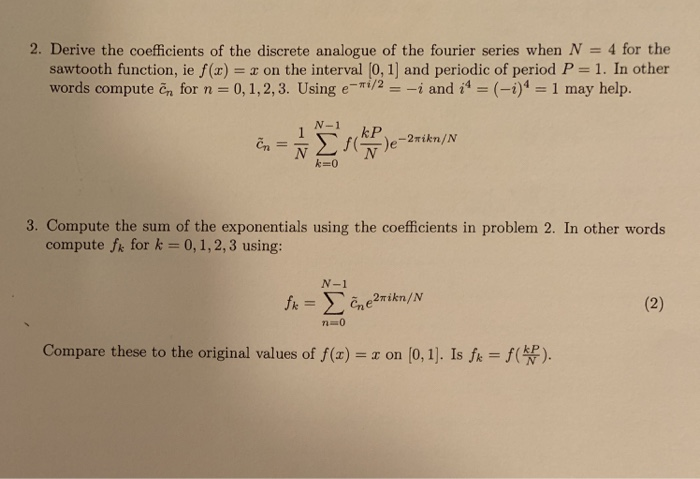
2. Derive the coefficients of the discrete analogue of the fourier series when N = 4 for the sawtooth function, ie f(x) = x on the interval (0, 1) and periodic of period P = 1. In other words compute C for n=0,1,2,3. Using e-*i/2 = -i and i` = (-i)* = 1 may help. = r ) e-Erikn/N 3. Compute the sum of the exponentials using the coefficients in problem 2. In other words compute fk for k=0,1,2,3 using: ft = N-1 Ce2wikn/N n=0 (2) Compare these to the original values of f(2)= x on (0,1). Is fk = f(*). 2. Derive the coefficients of the discrete analogue of the fourier series when N = 4 for the sawtooth function, ie f(x) = x on the interval (0, 1) and periodic of period P = 1. In other words compute C for n=0,1,2,3. Using e-*i/2 = -i and i` = (-i)* = 1 may help. = r ) e-Erikn/N 3. Compute the sum of the exponentials using the coefficients in problem 2. In other words compute fk for k=0,1,2,3 using: ft = N-1 Ce2wikn/N n=0 (2) Compare these to the original values of f(2)= x on (0,1). Is fk = f(*)
Step by Step Solution
There are 3 Steps involved in it

Get step-by-step solutions from verified subject matter experts
 Study Help