



Question: solve number 1-4 read the simulstion then answer 1-4 pls PRACTITIONER DIAGNOSTIC FORM 1. Who is the client? a. Who has the most influence in
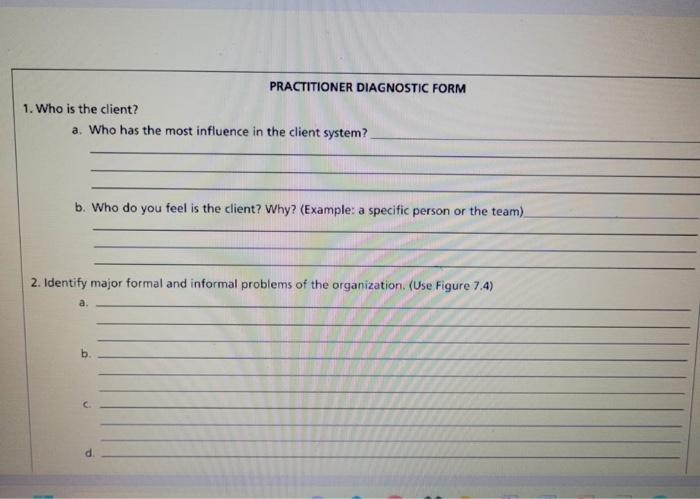
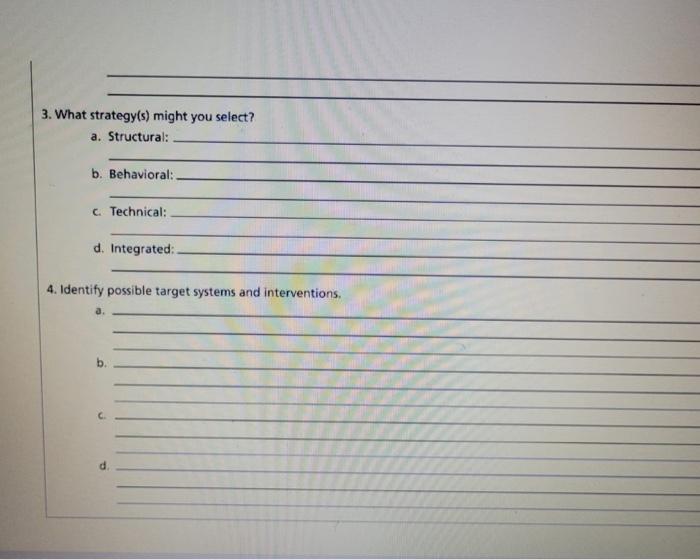
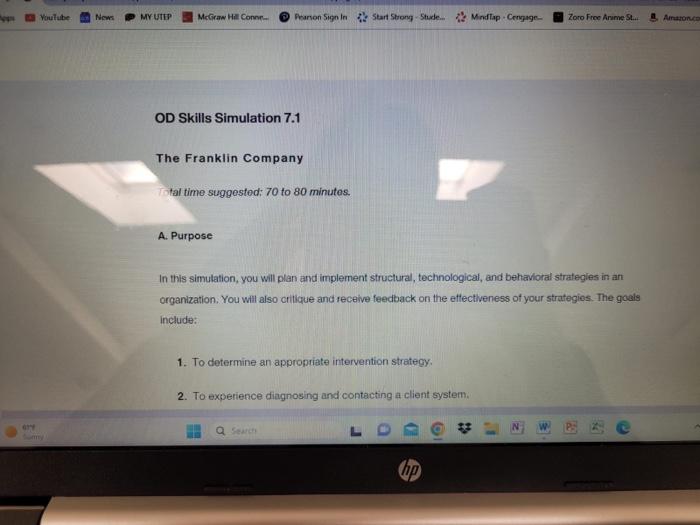
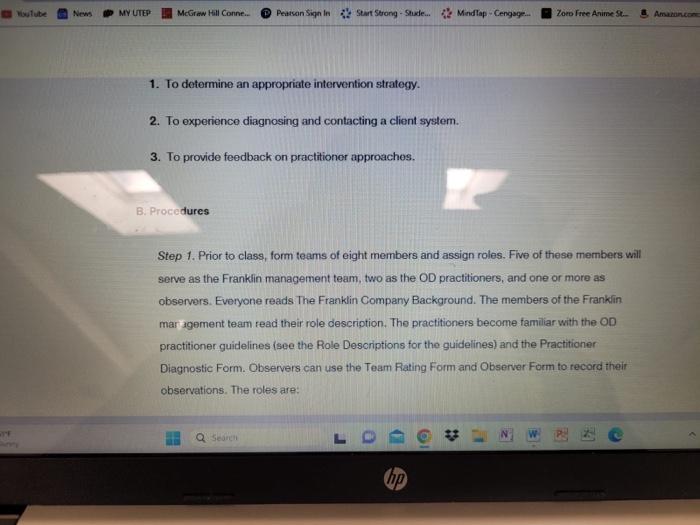
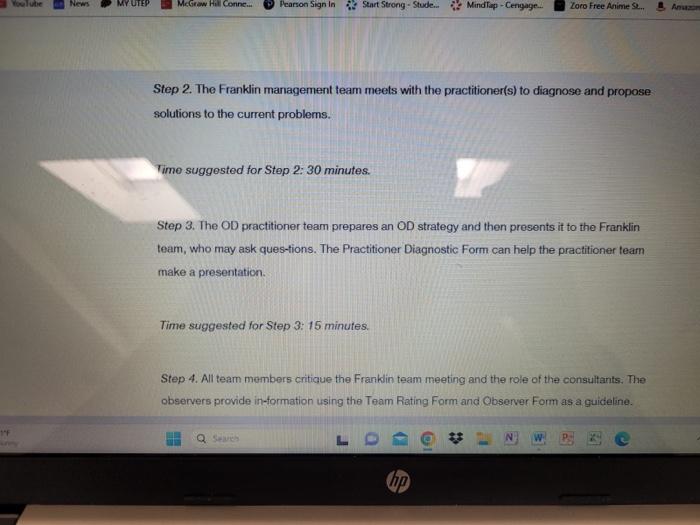
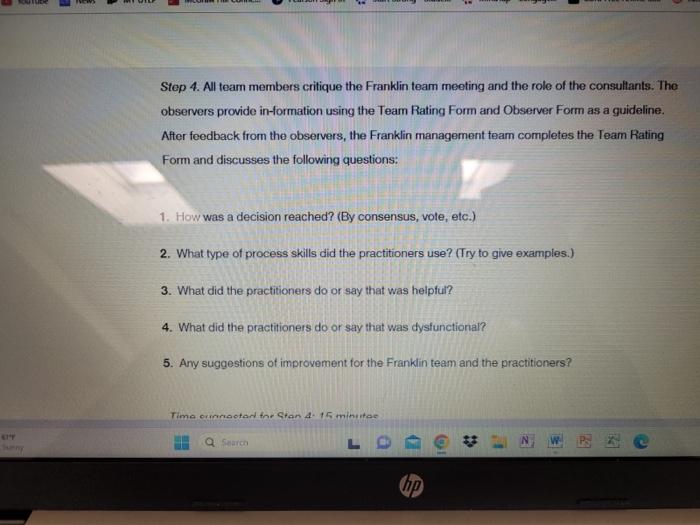
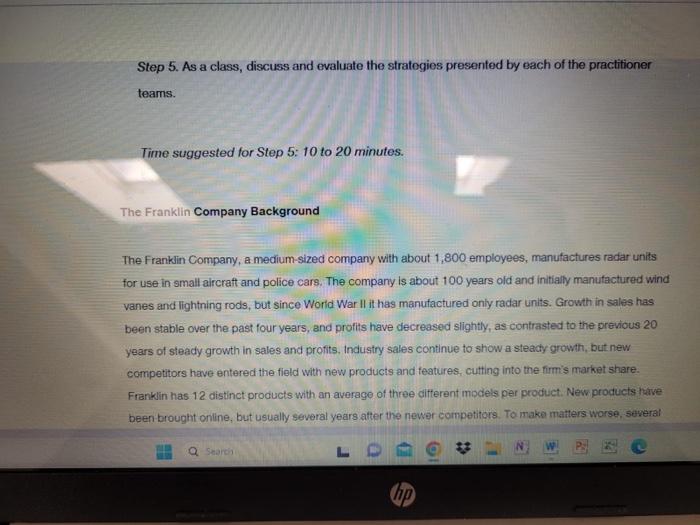
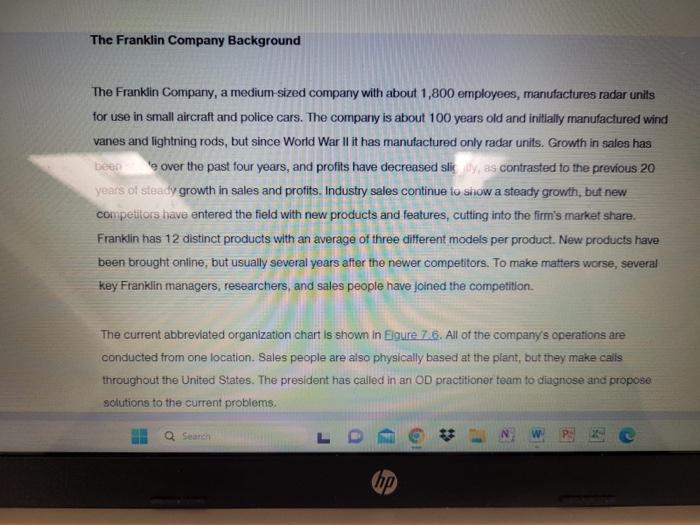
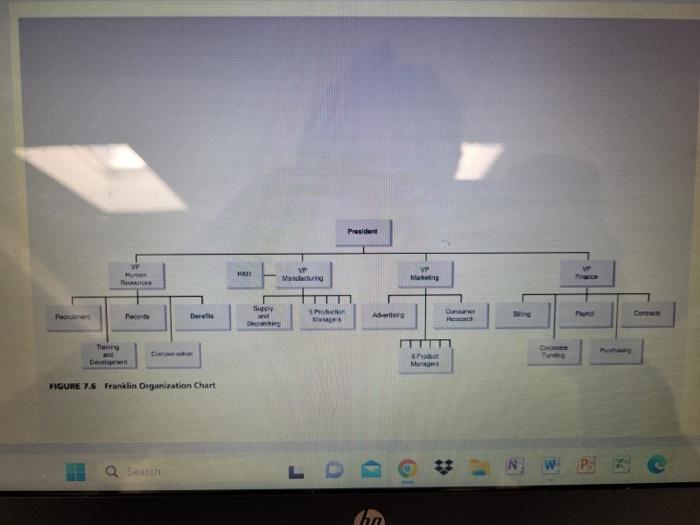
PRACTITIONER DIAGNOSTIC FORM 1. Who is the client? a. Who has the most influence in the client system? b. Who do you feel is the client? Why? (Example: a specific person or the team) 3. What strategy(s) might you select? a. Structural: b. Behavioral: c. Technical: d. Integrated: 4. Identify possible target systems and interventions. a. b. C. d. A. Purpose In this simulation, you will plan and implement structural, technological, and behavioral strategles in an organization. You will also critique and receive feedback on the ettectiveness of your strategies. The goals include: 1. To determine an appropriate intervention strategy. 2. To experience diagnosing and contacting a client system. 1. To determine an appropriate intervention strategy. 2. To experience diagnosing and contacting a client system. 3. To provide feedback on practitioner approaches. B. Procedures Step 1. Prior to class, form teams of eight members and assign roles. Five of these mernbers will serve as the Franklin management team, two as the OD practitioners, and one or more as observers. Everyone reads The Franklin Company Background. The members of the Franklin. mar agement team read their role description. The practitioners become familiar with the OD practitioner guidelines (see the Role Descriptions for the guidelines) and the Practitioner Diagnostic Form. Observers can use the Team Fating Form and Observer Form to record their observations. The roles are: Step 2. The Franklin management team meets with the practitioner(s) to diagnose and propose solutions to the current problems. Time suggested for Step 2: 30 minutes. Step 3. The OD practitioner team prepares an OD strategy and then presents it to the Franklin team, who may ask ques-tions. The Practitioner Diagnostic Form can help the practitioner team make a presentation. Time suggested for Step 3:15 minutes. Step 4. All team members critique the Franklin team meeting and the role of the consultants. The observers provide in-formation using the Team Rating Form and Observer Form as a guideline. Step 4. All team members critique the Franklin team meeting and the role of the consultants. The observers provide in-formation using the Team Rating Form and Observer Form as a guideline. After feedback from the observers, the Franklin management team completes the Team Rating Form and discusses the following questions: 1. How was a decision reached? (By consensus, vote, etc.) 2. What type of process skills did the practitioners use? (Try to give examples.) 3. What did the practitioners do or say that was helpful? 4. What did the practitioners do or say that was dysfunctional? 5. Any suggestions of improvement for the Franklin team and the practitioners? Time ermnootar far stan 4.15 minutee. Step 5. As a class, discuss and evaluate the strategies presented by each of the practitioner teams. Time suggested for Step 5: 10 to 20 minutes. The Franklin Company Background The Frankin Company, a medium-sized company with about 1,800 employees, manufactures radar units for use in small aircraft and police cars. The company is about 100 years old and initially manufactured wind vanes and lightning rods, but since World War Il it has manufactured only radar units. Growth in sales has been stable over the past four years, and profits have decreased slightly, as contrasted to the previous 20 years of steady growth in sales and profits, Industry sales continue to show a steady growth, but new competitors have entered the field with new products and features, cutting into the firm's market share. Franklin has 12 distinct products with an average of three difterent models per product. New products have been brought online, but usually several years atter the newer competitors. To make matters worse, several The Franklin Company Background The Franklin Company, a medium-sized company with about 1,800 employees, manufactures radar unils for use in small aircraft and police cars. The company is about 100 years old and initially manufactured wind vanes and lightning rods, but since World War II it has manufactured only radar units. Growth in sales has So over the past four years, and profits have decreased sliis ily, as contrasted to the previous 20 years of staady growth in sales and profits. Industry sales continue lo show a steady growth, but new competitors have entered the field with new products and features, cutting into the firm's market share. Franklin has 12 distinct products with an average of three different models per product. New products have been brought online, but usually several years after the newer competitors. To make matters worse, several key Franklin managers, researchers, and sales people have joined the competition. The current abbreviated organization chart is shown in Eloure 7.6. All of the company's operations are conducted from one location. Sales people are also physically based at the plant, but they make calls throughout the United States. The president has called in an OD practitioner team to diagnose and propose solutions to the current problems
Step by Step Solution
There are 3 Steps involved in it

Get step-by-step solutions from verified subject matter experts