







Question: Solve Part-(C) only when you Know otherwise skip it for others!!! The enzyme-catalyzed reaction AB is to be carried out under steady-state conditions with the
Solve Part-(C) only when you Know otherwise skip it for others!!!
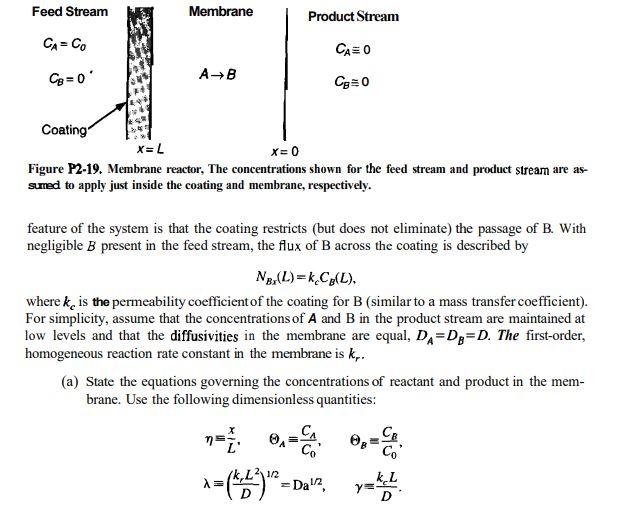
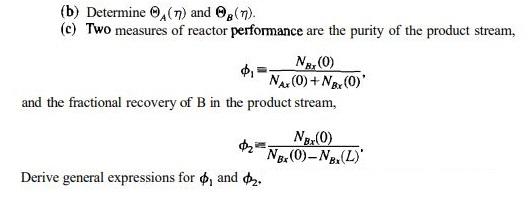
The enzyme-catalyzed reaction AB is to be carried out under steady-state conditions with the enzyme immobilized in a membrane. The membrane has two purposes: to prevent loss of the expensive enzyme, and to help separate any residual reactant from the product. Consider the arrangement shown in Fig. 12-19. One surface of the membrane (at x=L) has a thin coating that permits rapid diffusion of A from the feed stream to the membrane, such that C.(D=C. A key Figure P2-18. Vessel wall with a heater Inside Outside n he T. T. Feed Stream Membrane Product Stream CA = Co CA=0 Cg = 0 AB Cg=0 Coating x=L x = 0 Figure 12-19. Membrane reactor, The concentrations shown for the feed stream and product stream are as- sumed to apply just inside the coating and membrane, respectively. feature of the system is that the coating restricts (but does not eliminate the passage of B. With negligible B present in the feed stream, the Aux of B across the coating is described by NB.(L)=k.C(L). where ke is the permeability coefficient of the coating for B (similar to a mass transfer coefficient). For simplicity, assume that the concentrations of A and B in the product stream are maintained at low levels and that the diffusivities in the membrane are equal, DA=Dg=D. The first-order, homogeneous reaction rate constant in the membrane is k.. (a) State the equations governing the concentrations of reactant and product in the mem- brane. Use the following dimensionless quantities: Co . Co 112 = Da'2 X= ( yake (b) Determine A(n) and g(n). (c) Two measures of reactor performance are the purity of the product stream, , N. (0) NA (0)+Na (0) and the fractional recovery of B in the product stream, Ng (0) , NB:(0)-NR.(L) Derive general expressions for , and dy, The enzyme-catalyzed reaction AB is to be carried out under steady-state conditions with the enzyme immobilized in a membrane. The membrane has two purposes: to prevent loss of the expensive enzyme, and to help separate any residual reactant from the product. Consider the arrangement shown in Fig. 12-19. One surface of the membrane (at x=L) has a thin coating that permits rapid diffusion of A from the feed stream to the membrane, such that C.(D=C. A key Figure P2-18. Vessel wall with a heater Inside Outside n he T. T. Feed Stream Membrane Product Stream CA = Co CA=0 Cg = 0 AB Cg=0 Coating x=L x = 0 Figure 12-19. Membrane reactor, The concentrations shown for the feed stream and product stream are as- sumed to apply just inside the coating and membrane, respectively. feature of the system is that the coating restricts (but does not eliminate the passage of B. With negligible B present in the feed stream, the Aux of B across the coating is described by NB.(L)=k.C(L). where ke is the permeability coefficient of the coating for B (similar to a mass transfer coefficient). For simplicity, assume that the concentrations of A and B in the product stream are maintained at low levels and that the diffusivities in the membrane are equal, DA=Dg=D. The first-order, homogeneous reaction rate constant in the membrane is k.. (a) State the equations governing the concentrations of reactant and product in the mem- brane. Use the following dimensionless quantities: Co . Co 112 = Da'2 X= ( yake (b) Determine A(n) and g(n). (c) Two measures of reactor performance are the purity of the product stream, , N. (0) NA (0)+Na (0) and the fractional recovery of B in the product stream, Ng (0) , NB:(0)-NR.(L) Derive general expressions for , and dy
Step by Step Solution
There are 3 Steps involved in it

Get step-by-step solutions from verified subject matter experts
 Study Help