







Question: Solve problem 1.16 from the book Ordinary differential equations and Dynamical systems by the author Gerald Teschl . You need to use implicit theorem or
Solve problem 1.16 from the book Ordinary differential equations and Dynamical systems by the author Gerald Teschl . You need to use implicit theorem or inverse function theorem of Differential equations.
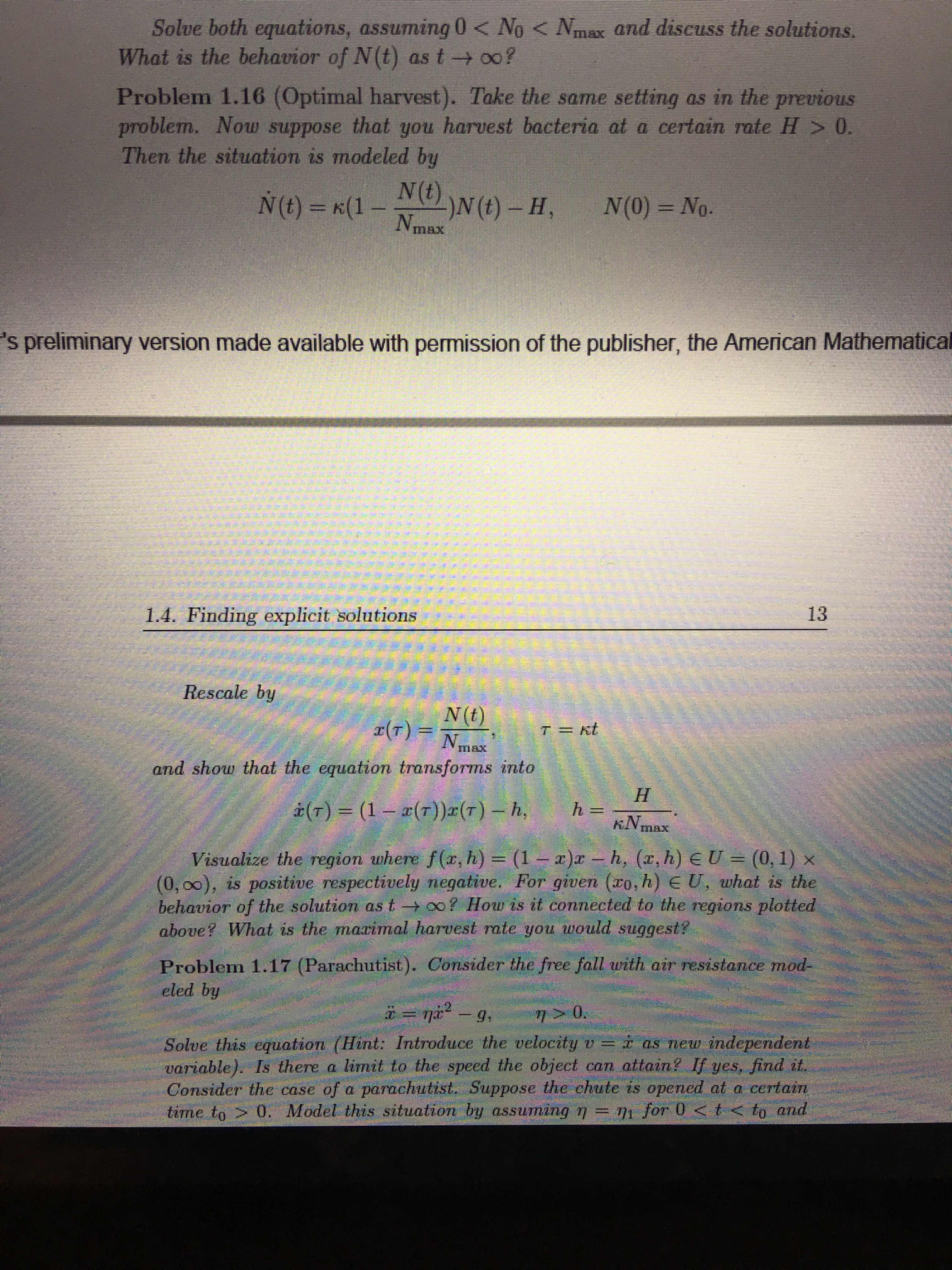
Solve both equations, assuming 0 0. Then the situation is modeled by N(t) = k(1 _ _(t) Nmax -)N (t) - H, N(0) = No. s preliminary version made available with permission of the publisher, the American Mathematica 1.4. Finding explicit solutions 13 Rescale by I( T) = N(t) Nmax T = kt and show that the equation transforms into i(T) = (1 - x(T))x(T) - h, h = H KNmax Visualize the region where f(x, h) = (1 -x)x - h, (x, h) e U = (0, 1) x (0, oo), is positive respectively negative. For given (ro, h) E U, what is the behavior of the solution as t - co? How is it connected to the regions plotted above? What is the maximal harvest rate you would suggest? Problem 1.17 (Parachutist). Consider the free fall with air resistance mod- eled by i = na -g. Solve this equation (Hint: Introduce the velocity v = i as new independent variable). Is there a limit to the speed the object can attain? If yes, find it. Consider the case of a parachutist. Suppose the chute is opened at a certain time to > 0. Model this situation by assuming n = 1 for 0
Step by Step Solution
There are 3 Steps involved in it

Get step-by-step solutions from verified subject matter experts
 Study Help