





Question: solve Problem 4. In this problem, we explore the concept of parametric surfaces. A surface is a 2-dimensional object, and thus two independent parameters are

solve
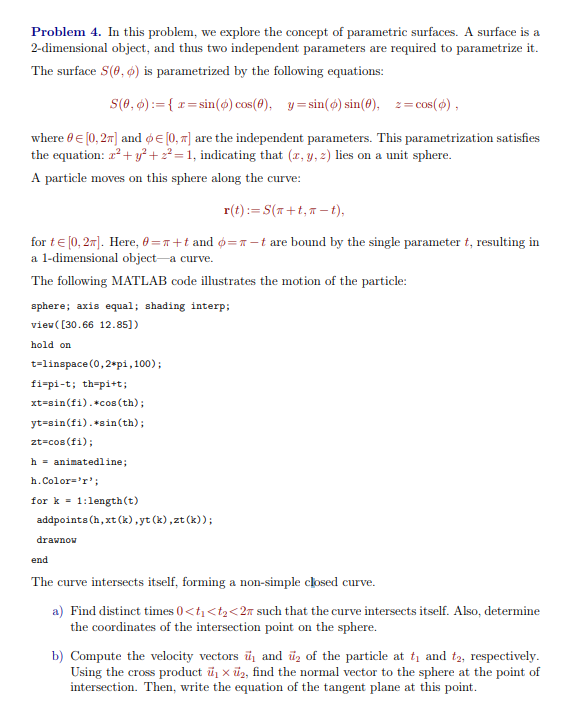
solve Problem 4. In this problem, we explore the
Problem 4. In this problem, we explore the concept of parametric surfaces. A surface is a 2-dimensional object, and thus two independent parameters are required to parametrizat The surface S(0, () is parametrizationwing equations: S(0, $) := { x=sin($) cos(0), y= sin() sin(0), = =cos($), where c [0, 2x] and e [0, x] are the independent parameters. This parametrization satisfies the equation: 2' + y' + 23=1, indicating that (x, y, 2) lies on a unit sphere. A particle moves on this sphere along the curve: r(t) := S( att, x - 1), for te [0, 2x]. Here, 0=* +t and =* -t are bound by the single parameter t, resulting in a 1-dimensional object-a curve. The following MATLAB code illustrates the motion of the particle: sphere; axis equal; shading interp; view ( [30. 66 12.85]) hold on t=linspace (0, 2*pi , 100) ; fi=pi-t; th=pitt; xt=sin(fi) .*com(th); yt=sin(fi) .*ain(th) ; zt=cos(fi) ; h = animatedline; h. Color='r'; for k = 1:length(t) addpoints (h, xt (k) , yt (k) , zt(k)); drawnow end The curve intersects itself, forming a non-simple closed curve. a) Find distinct times 0

Step by Step Solution

There are 3 Steps involved in it

1 Expert Approved Answer
Step: 1 Unlock blur-text-image

Question Has Been Solved by an Expert!

Get step-by-step solutions from verified subject matter experts

Step: 2 Unlock
Step: 3 Unlock

Students Have Also Explored These Related Law Questions!