







Question: solve problem 5 . 1 IS 5 . 1 Referring to Prob. 2 . 1 8 , use the FOVE method to a . Estimate
solve problem
IS
Referring to Prob. use the FOVE method to
a Estimate the mean and variance of the total drawdown at the observation point and to compare the result with that from part b of Prob.
b Estimate the covariance of the drawdowns from the two production wells
c Would the inclusion of ndorder terms in the Taylor expansion improve the estimation of the mean of the total drawdown?
The wellknown Thiem equation can be used to compute the drawdown in a confined and homogeneous aquifer as
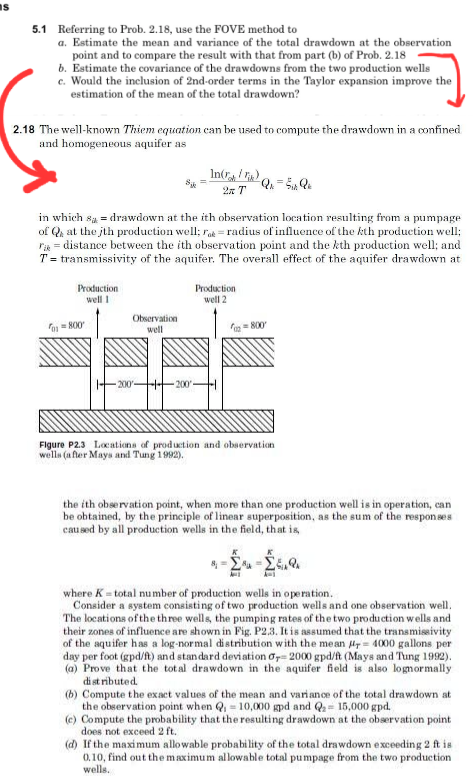
in which drawdown at the ith observation location resulting from a pumpage of at the th production well; radius of inlluence of the th production well; distance between the th observation point and the th production well; and transmissivity of the aquifer. The overall effect of the aquifer drawdown at
the ith observation point, when more than one production well is in operation, can be obtained, by the principle of linear superposition, as the sum of the responses caused by all production wells in the field, that is
where total number of production wells in operation.
Consider a system consisting of two production wells and one observation well. The locations of the three wells, the pumping rates of the two production wells and their zones of influence are shown in Fig. P It is assumed that the transmissivity of the aquifer has a lognormal distribution with the mean gallons per a Prove that the total drawdown in the aquifer field is also lognormally distributed.
b Compute the exact values of the mean and variance of the total drawdown at the observation point when and
c Compute the probability that the resulting drawdown at the observation point does not exceed
d If the maximum allowable probability of the total drawdown exceeding is find out the maximum allowable total pumpage from the two production wells.
Hydrosystems Engineering
Uncertainty Analysis
YeouKoung Tung,
Step by Step Solution
There are 3 Steps involved in it
1 Expert Approved Answer
Step: 1 Unlock

Question Has Been Solved by an Expert!
Get step-by-step solutions from verified subject matter experts
Step: 2 Unlock
Step: 3 Unlock
 Study Help