





Question: solve the case study questions 1. Do you believe that bullfighting is an ethically wrong practice or a justifiable cultural event? Explain your reasoning. 2.

solve the case study questions
1. Do you believe that bullfighting is an ethically wrong practice or a justifiable cultural event? Explain your reasoning.
2. In what ways might ethnocentrism affect your perspective on bullfighting? How would your opinion differ if you were raised in a different culture?
3. Do you agree that the death of the bull in the ring is more humane than the death of animals in a slaughterhouse? Why or why not? What ethical concerns are raised by both situations?
4. Can humans justify killing animals for food or entertainment purpose? Elaborate on the principles of humane ethics and survival.
5. Suggest ways to prevent animal torture.
solve the case study questions 1. Do you believe
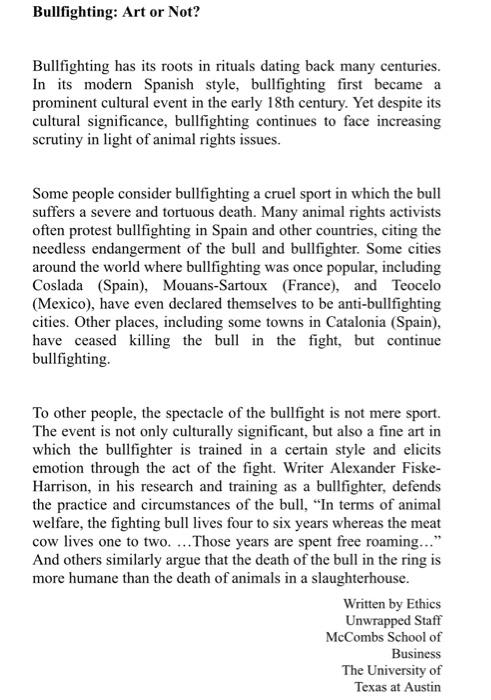
Bullfighting: Art or Not? Bullfighting has its roots in rituals dating back many centuries. In its modern Spanish style, bullfighting first became a prominent cultural event in the early 18th century. Yet despite its cultural significance, bullfighting continues to face increasing scrutiny in light of animal rights issues. Some people consider bullfighting a cruel sport in which the bull suffers a severe and tortuous death. Many animal rights activists often protest bullfighting in Spain and other countries, citing the needless endangerment of the bull and bullfighter. Some cities around the world where bullfighting was once popular, including Coslada (Spain), Mouans-Sartoux (France), and Teocelo (Mexico), have even declared themselves to be anti-bullfighting cities. Other places, including some towns in Catalonia (Spain), have ceased killing the bull in the fight, but continue bullfighting. To other people, the spectacle of the bullfight is not mere sport. The event is not only culturally significant, but also a fine art in which the bullfighter is trained in a certain style and elicits emotion through the act of the fight. Writer Alexander Fiske- Harrison, in his research and training as a bullfighter, defends the practice and circumstances of the bull, "In terms of animal welfare, the fighting bull lives four to six years whereas the meat cow lives one to two... Those years are spent free roaming..." And others similarly argue that the death of the bull in the ring is more humane than the death of animals in a slaughterhouse. Written by Ethics Unwrapped Staff McCombs School of Business The University of Texas at Austin

Step by Step Solution

There are 3 Steps involved in it

1 Expert Approved Answer
Step: 1 Unlock blur-text-image

Question Has Been Solved by an Expert!

Get step-by-step solutions from verified subject matter experts

Step: 2 Unlock
Step: 3 Unlock

Students Have Also Explored These Related General Management Questions!