Question: - Solve the case Study Questions: Clarify and describe the problems of the NHS Choose and Book System. What management, organization, and technology factors were
-Solve the case Study Questions:
- Clarify and describe the problems of the NHS Choose and Book System. What management, organization, and technology factors were responsible for those problems?
- To what extent was Choose and Book a failure? Explain your answer.
- What was the economic and social impact of Choose and Book?
- Describe the steps that should have been taken to make Choose and Book more successful.
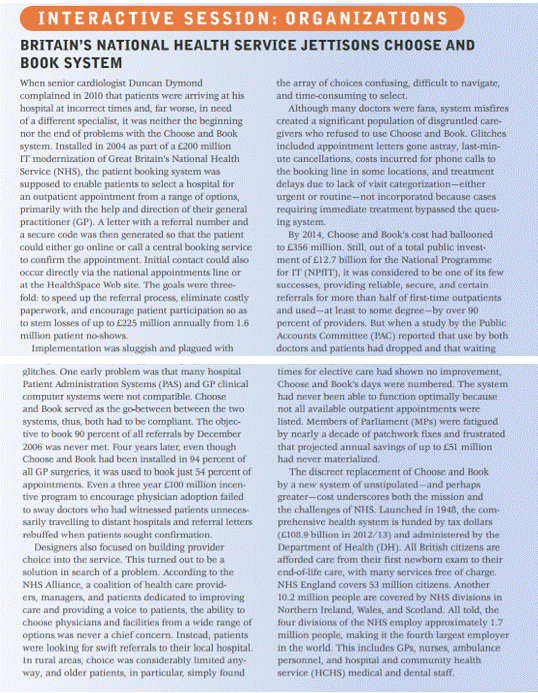
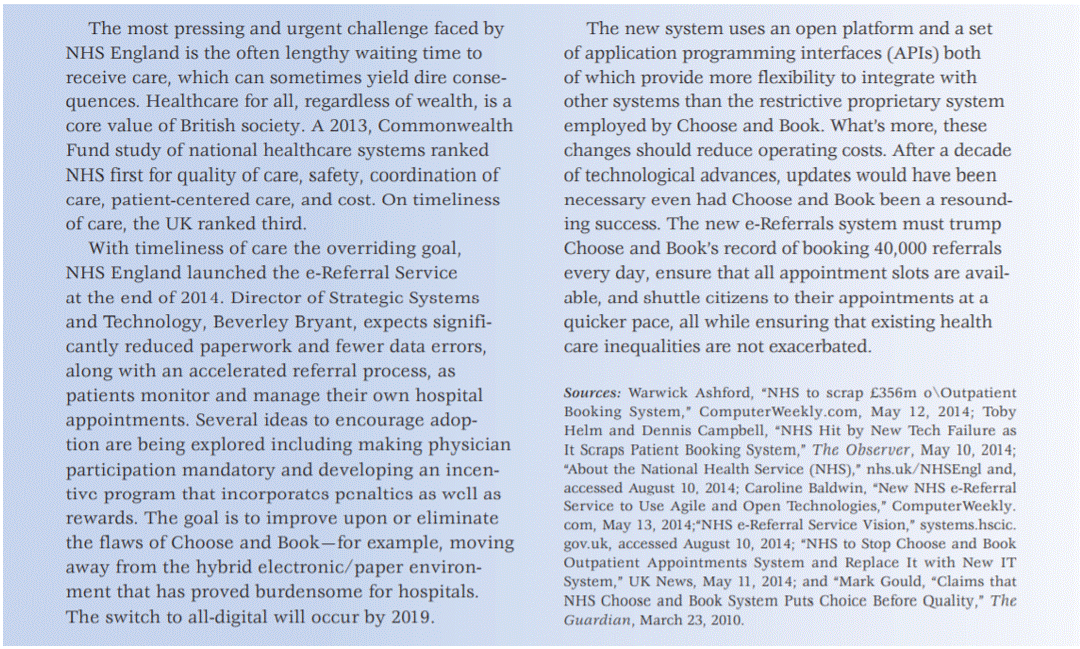
INTERACTIVE SESSION: ORGANIZATIONS BRITAIN'S NATIONAL HEALTH SERVICE JETTISONS CHOOSE AND BOOK SYSTEM When senior cardiologist Duncan Dymond the array of choices confusing difficult to navigate, complained in 2010 that patients were arriving at his and time-consuming to select. hospital at incorrect times and, far worse, in nood Although many doctors were fans, system misfires of a different specialist, it was neither the beginning created a significant population of disgruntled care- nor the end of problems with the Choose and Book givers who refused to use Choose and Book. Glitches system. Installed in 2004 as part of a 200 million included appointment letters gone astray, last-min- IT modernization of Great Britain's National Health ute cancellations, costs incurred for phone calls to Service (NHS), the patient booking system was the booking line in some locations, and treatment supposed to enable patients to select a hospital for delays due to lack of visit categorization-either an outpatient appointment from a range of options, urgent or routine - not incorporated because cases primarily with the help and direction of their gencral requiring immediate treatment bypassed the queu- practitioner (GP). A letter with a referral number and ing system a secure code was then generated so that the patient By 2014, Choose and Book's cost had ballooned could either go online or call a central booking service to 356 million. Still, out of a total public invest- to confirm the appointment. Initial contact could also ment of 12.7 billion for the National Programme occur directly via the national appointments line or for IT (NPAIT), it was considered to be one of its few at the HealthSpace Web site. The goals were three- successes, providing reliable, secure, and certain fold: to speed up the referral process, eliminate costly referrals for more than half of first-time outpatients paperwork, and encourage patient participation so as and used-at least to some degree -by over 90 to stem losses of up to 225 million annually from 1.6 percent of providers. But when a study by the Public million patient no-shows. Accounts Committee (PAC) reported that use by both Implementation was sluggish and plagued with doctors and patients had dropped and that waiting glitches. One early problem was that many hospital Patient Administration Systems (PAS) and GP clinical computer systems were not compatible. Choose and Book served as the go-between between the two systems, thus, both had to be compliant. The objec- tive to book 90 percent of all referrals by December 2006 was never met. Four years later, even though Choose and Book had been installed in 94 percent of all GP surgerics, it was used to book just 54 percent of appointments. Even a three year 100 million incen tive program to encourage physician adoption failed to sway doctors who had witnessed patients unneces sarily travelling to distant hospitals and referral letters rebuffed when patients sought confirmation Designers also focused on building provider choice into the service. This turned out to be a solution in search of a problem. According to the NHS Alliance, a coalition of health care provid- ers, managers, and patients dedicated to improving care and providing a voice to patients, the ability to choose physicians and facilities from a wide range of options was never a chief concern. Instead, patients were looking for swift referrals to their local hospital. In rural areas, choice was considerably limited any way, and older patients, in particular, simply found times for elective care had shown no improvement, Choose and Book's days were numbered. The system had never been able to function optimally because not all available outpatient appointments were listed. Members of Parliament (MPS) were fatigued by nearly a decade of patchwork fixes and frustrated that projected annual savings of up to 51 million had never materialized. The discreet replacement of Choose and Book by a new system of unstipulated and perhaps greater-cost underscores both the mission and the challenges of NHS Launched in 1948, the com- prehensive health system is funded by tax dollars (C108.9 billion in 2012/13) and administered by the Department of Health (DH). All British citizens are afforded care from their first newborn exam to their end-of-life care, with many services free of charge. NHS England covers 53 million citizens. Another 10.2 million people are covered by NHS divisions in Northern Ireland, Wales, and Scotland. All told, the four divisions of the NHS employ approximately 1.7 million people, making it the fourth largest employer in the world. This includes GPs, nurses ambulance personnel, and hospital and community health service (HCHS) medical and dental staff The most pressing and urgent challenge faced by NHS England is the often lengthy waiting time to receive care, which can sometimes yield dire conse- quences. Healthcare for all, regardless of wealth, is a core value of British society. A 2013, Commonwealth Fund study of national healthcare systems ranked NHS first for quality of care, safety, coordination of care, patient-centered care, and cost. On timeliness of care, the UK ranked third. With timeliness of care the overriding goal, NHS England launched the e-Referral Service at the end of 2014. Director of Strategic Systems and Technology, Beverley Bryant, expects signifi- cantly reduced paperwork and fewer data errors, along with an accelerated referral process, as patients monitor and manage their own hospital appointments. Several ideas to encourage adop- tion are being explored including making physician participation mandatory and developing an incen- tive program that incorporates penaltics as well as rewards. The goal is to improve upon or eliminate the flaws of Choose and Book--for example, moving away from the hybrid electronic/paper environ- ment that has proved burdensome for hospitals. The switch to all-digital will occur by 2019. The new system uses an open platform and a set of application programming interfaces (APIS) both of which provide more flexibility to integrate with other systems than the restrictive proprietary system employed by Choose and Book. What's more, these changes should reduce operating costs. After a decade of technological advances, updates would have been necessary even had choose and Book been a resound- ing success. The new e-Referrals system must trump Choose and Book's record of booking 40,000 referrals every day, ensure that all appointment slots are avail- able, and shuttle citizens to their appointments at a quicker pace, all while ensuring that existing health care inequalities are not exacerbated. Sources: Warwick Ashford, "NHS to scrap 356m o Outpatient Booking System," Computer Weekly.com, May 12, 2014; Toby Helm and Dennis Campbell, "NHS Hit by New Tech Failure as It Scraps Patient Booking System," The Observer, May 10, 2014; "About the National Health Service (NHS),' nhs.uk/NHSEngl and, accessed August 10, 2014; Caroline Baldwin, "New NHS e-Referral Service to Use Agile and Open Technologies," ComputerWeekly. com, May 13, 2014;"NHS e-Referral Service Vision," systems.hscic. gov.uk, accessed August 10, 2014; "NHS to Stop Choose and Book Outpatient Appointments System and Replace it with New IT System," UK News, May 11, 2014; and "Mark Gould, "Claims that NHS Choose and Book System Puts Choice Before Quality," The Guardian, March 23, 2010









 Study Help