







Question: Solve the following problem both graphically and by hand via the Simplex method. Recently engineers have become involved in the area known as waste minimization.
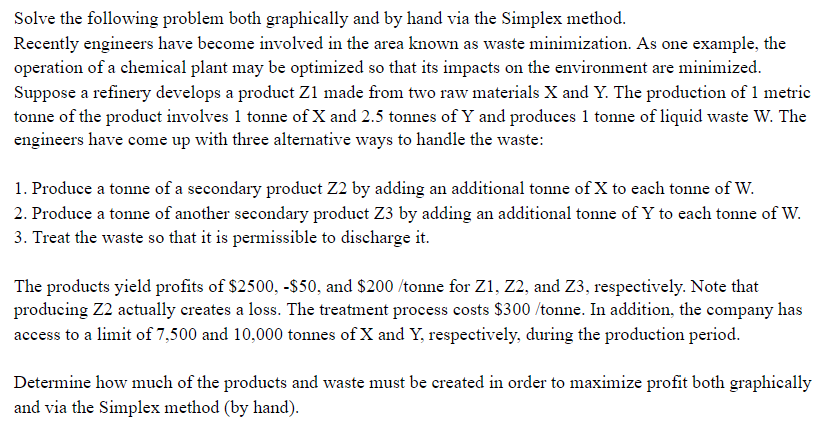
Solve the following problem both graphically and by hand via the Simplex method. Recently engineers have become involved in the area known as waste minimization. As one example, the operation of a chemical plant may be optimized so that its impacts on the environment are minimized. Suppose a refinery develops a product Zi made from two raw materials X and Y. The production of 1 metric tonne of the product involves 1 tonne of X and 2.5 tonnes of Y and produces 1 tonne of liquid waste W. The engineers have come up with three alternative ways to handle the waste: 1. Produce a tonne of a secondary product Z2 by adding an additional tonne of X to each tonne of W. 2. Produce a tonne of another secondary product Z3 by adding an additional tonne of Y to each tonne of W. 3. Treat the waste so that it is permissible to discharge it. The products yield profits of $2500,-$50, and $200 /tonne for Z1, Z2, and Z3, respectively. Note that producing Z2 actually creates a loss. The treatment process costs $300 /tonne. In addition, the company has access to a limit of 7,500 and 10,000 tonnes of X and Y, respectively, during the production period. Determine how much of the products and waste must be created in order to maximize profit both graphically and via the Simplex method (by hand). Solve the following problem both graphically and by hand via the Simplex method. Recently engineers have become involved in the area known as waste minimization. As one example, the operation of a chemical plant may be optimized so that its impacts on the environment are minimized. Suppose a refinery develops a product Zi made from two raw materials X and Y. The production of 1 metric tonne of the product involves 1 tonne of X and 2.5 tonnes of Y and produces 1 tonne of liquid waste W. The engineers have come up with three alternative ways to handle the waste: 1. Produce a tonne of a secondary product Z2 by adding an additional tonne of X to each tonne of W. 2. Produce a tonne of another secondary product Z3 by adding an additional tonne of Y to each tonne of W. 3. Treat the waste so that it is permissible to discharge it. The products yield profits of $2500,-$50, and $200 /tonne for Z1, Z2, and Z3, respectively. Note that producing Z2 actually creates a loss. The treatment process costs $300 /tonne. In addition, the company has access to a limit of 7,500 and 10,000 tonnes of X and Y, respectively, during the production period. Determine how much of the products and waste must be created in order to maximize profit both graphically and via the Simplex method (by hand)
Step by Step Solution
There are 3 Steps involved in it

Get step-by-step solutions from verified subject matter experts
 Study Help