







Question: Solve the following. Simple linear regression is a statistical method that allows us to summarize and study relationships between two continuous (quantitative) variables: One variable,
Solve the following.
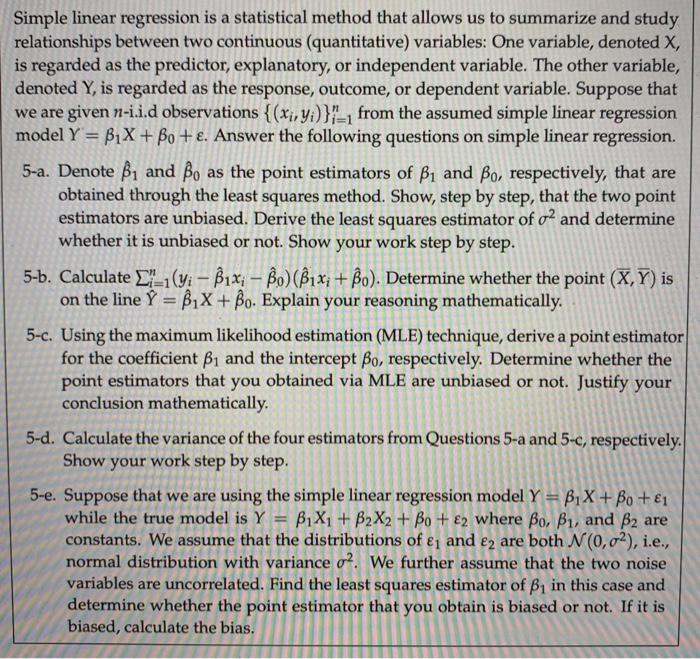
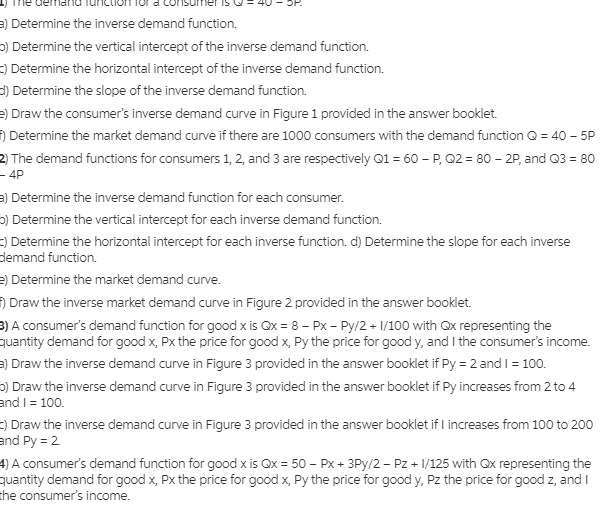

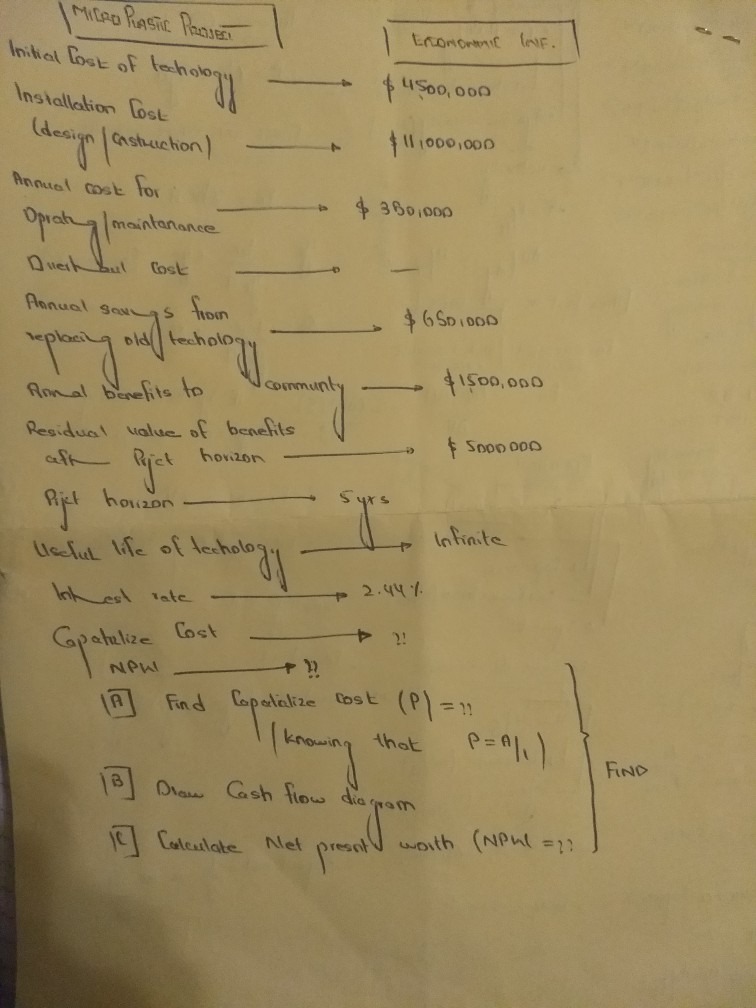
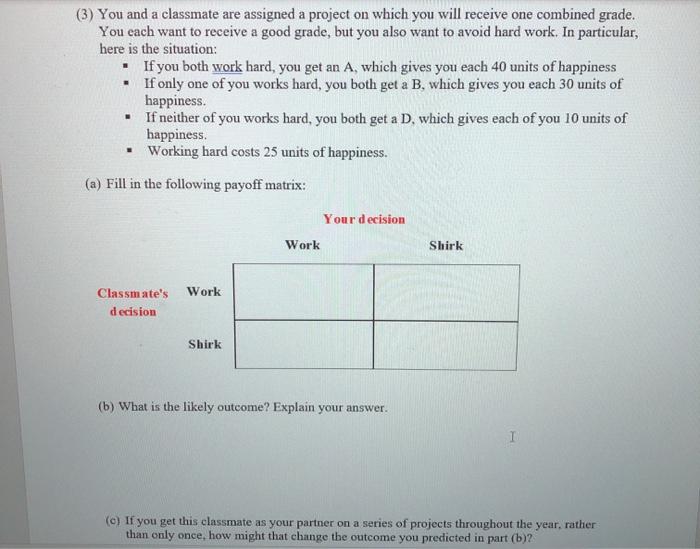
Simple linear regression is a statistical method that allows us to summarize and study relationships between two continuous (quantitative) variables: One variable, denoted X, is regarded as the predictor, explanatory, or independent variable. The other variable, denoted Y, is regarded as the response, outcome, or dependent variable. Suppose that we are given n-i.i.d observations { (x;, y;)}"_, from the assumed simple linear regression model Y = BIX + Bo + . Answer the following questions on simple linear regression. 5-a. Denote 1 and Bo as the point estimators of B, and Bo, respectively, that are obtained through the least squares method. Show, step by step, that the two point estimators are unbiased. Derive the least squares estimator of of and determine whether it is unbiased or not. Show your work step by step. 5-b. Calculate _'_1(yi - Bix; - Bo) (Bix, + Bo). Determine whether the point (X, Y) is on the line Y = 1X + Bo. Explain your reasoning mathematically. 5-c. Using the maximum likelihood estimation (MLE) technique, derive a point estimator for the coefficient B1 and the intercept Bo, respectively. Determine whether the point estimators that you obtained via MLE are unbiased or not. Justify your conclusion mathematically. 5-d. Calculate the variance of the four estimators from Questions 5-a and 5-c, respectively. Show your work step by step. 5-e. Suppose that we are using the simple linear regression model Y = B1 X + Bo + 1 while the true model is Y = 1X1 + B2X2 + Bo + 82 where Bo, B1, and B2 are constants. We assume that the distributions of &, and e2 are both N(0,02), i.e., normal distribution with variance o?. We further assume that the two noise variables are uncorrelated. Find the least squares estimator of B, in this case and determine whether the point estimator that you obtain is biased or not. If it is biased, calculate the bias.) Determine the inverse demand function. 0) Determine the vertical intercept of the inverse demand function. )Determine the horizontal intercept of the inverse demand function. d) Determine the slope of the inverse demand function. 2) Draw the consumer's inverse demand curve in Figure 1 provided in the answer booklet. Determine the market demand curve if there are 1000 consumers with the demand function Q = 40 - 5P 2) The demand functions for consumers 1, 2, and 3 are respectively Q1 = 60 - P, Q2 = 80 - 2P, and Q3 = 80 4P ) Determine the inverse demand function for each consumer. 0) Determine the vertical intercept for each inverse demand function. Determine the horizontal intercept for each inverse function. d) Determine the slope for each inverse demand function. 2) Determine the market demand curve. Draw the inverse market demand curve in Figure 2 provided in the answer booklet. 8) A consumer's demand function for good x is Qx = 8 - Px - Py/2 + 1/100 with Ox representing the quantity demand for good x, Px the price for good x, Py the price for good y, and I the consumer's income. ) Draw the inverse demand curve in Figure 3 provided in the answer booklet if Py = 2 and I = 100. 0) Draw the inverse demand curve in Figure 3 provided in the answer booklet if Py increases from 2 to 4 and I = 100. () Draw the inverse demand curve in Figure 3 provided in the answer booklet if I increases from 100 to 200 and Py = 2 1) A consumer's demand function for good x is @x = 50 - Px + 3Py/2 - Pz + 1/125 with Qx representing the quantity demand for good x, Px the price for good x, Py the price for good y, Pz the price for good z, and I the consumer's income.?.1 Country T produces rice and vegetable and imports pork. The following table shows the price and quantity of the production and imports in 201T and 201 B. In both years. Country T exports half ofthe vegetable produced to Country 8. All the imports and outputs without being exported are for consumption within Country T. (For simplicity. no capital investment and no government expenditure are involved in this country.) Use 201? as the base year. 201T 2015 Produced Rice 10 50 11 55 Vegetable 10 40 10.5 45 Imported Pork 10 22 9 25 (a) Calculate the growth rates of real and nominal GDP of Country T for 2018 over 2017. (b) Why is real GDP generally a better measure of economic performance? (c) Calculate the GDP deflator of Country T for 201 B. (d) Calculate the size of each component under the expenditure approach for Country T in 2013 at current market prices. (Hint: Some components may be zero. Also. make sure that they add up to the nominal GDP you have calculated in part (a).) (e) Calculate the consumer price index (CPI) for Country T for 2018 using 201? as the base year. Why is it different from the GDP deflator calculated in part (b)? MICRO PLASTIC PROJECT ECONOMIE INF. Initial Cost of techology $ 450D, OOD Installation Lost (design | Castruction) $11 1000, DOD Annual cost For Opratug / maintenance $ 3BoiDDD Duch bul Cost Annual savings from $ 6SDIDOD replacing old techolog Annal benefits to communty $ 1500, DDD Residual value of benefits aft Pict horizon $ SOOD DOD Pjet horizon 5 yrs Useful life of techology Infinite Inhest rate + 2.44% Capatalize Cost NPHI ? ! ! A Find Capartialize Cost ( P ) = 1! knowing that P = Al . ) FIND B Draw Cash flow diagram it Calculate Net presity worth ( NPHI = ?(3) You and a classmate are assigned a project on which you will receive one combined grade. You each want to receive a good grade, but you also want to avoid hard work. In particular, here is the situation: If you both work hard, you get an A, which gives you each 40 units of happiness .If only one of you works hard, you both get a B, which gives you each 30 units of happiness. .If neither of you works hard, you both get a D, which gives each of you 10 units of happiness. . Working hard costs 25 units of happiness. (a) Fill in the following payoff matrix: Your decision Work Shirk Classmate's Work decision Shirk (b) What is the likely outcome? Explain your answer. T (c) If you get this classmate as your partner on a series of projects throughout the year, rather than only once, how might that change the outcome you predicted in part (b)
Step by Step Solution
There are 3 Steps involved in it

Get step-by-step solutions from verified subject matter experts
 Study Help