







Question: Solve the problem Question 4 (35 points) Suppose that you were hired as a consultant by the Niagara School Board to assess the effectiveness of
Solve the problem
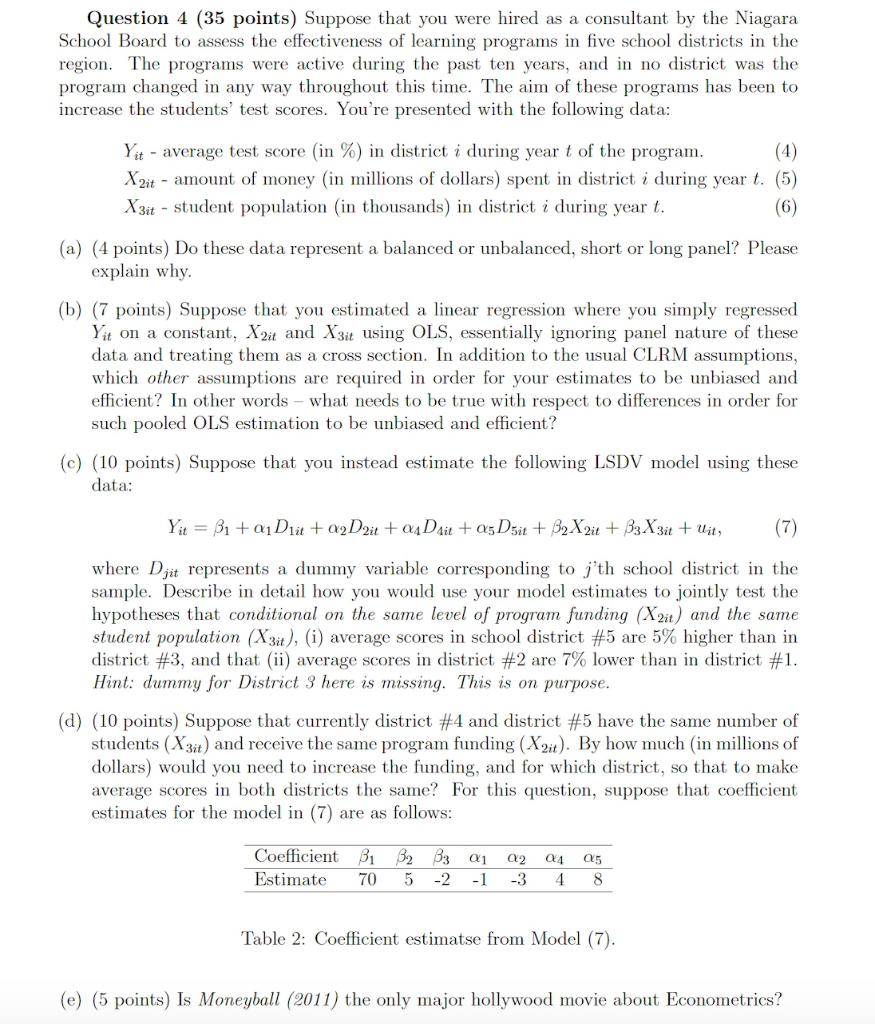
Question 4 (35 points) Suppose that you were hired as a consultant by the Niagara School Board to assess the effectiveness of learning programs in ve school districts in the region. The programs were active during the past ten years, and in no district was the program changed in any way throughout this time. The aim of these programs has been to increase the students\" test scores. You're presented with the following data: Y\" - average test score ( in {it} in district 1' during year t of the program. [4} X311 - amount of money (in millions of dollars) spent in district i during year t. [5} X311; student population (in thousands} in district i during year t. [5} (a) (4 points) Do these data represent a balanced or unbalanced, short or long panel? Please explain why. (b) (7" points) Suppose that you estimated a linear regression where you simply regressed H, on a constant, X3\" and X3\" using DLS, essentially ignoring panel nature of these data and treating them as a cross section. In addition to the usual CLRM assumptions, which other assumptions are required in order for your estimatm to be unbiased and eicient? Ill other words what needs to be true with respect to differences in order for such pooled DLS estimation to be unbiased and efcient? (c) [it] points] Suppose that you instead estimate the following LSD'v' model using these data: Ya = {51 + 0519111 + asa + (1494;: + (1535\" + sXaa + aXa': + ea, [7} where DJ\" represents a dummy variabie corrmponding to j'th school district in the sample. Describe in detail how you would use your model estimates to jointly test the hypotheses that conditional! on the some ievei of program. nding {Km} and the some student population {Xm}, (i) average scores in school district #5 are 5% higher than in district #3, and that (ii) average scores in district #2 are 7% lower than in district #1. Hint: dummy for District 3 here is missing. This is on purpose. (d) (10 points) Suppose that currently district #4 and district #5 have the same number of students {Jim} and receive the same program funding (X 2,1). By how much [in millions of dollars) would you need to increase the funding, and for which district, so that to make average scores in both districts the same? For this question, suppose that coefcient estimates for the model in (T) are as follows: Coefcient 31 g '53 on r13 13:4 in Estimate 7D 5 2 1 3 4 8 Table 2: Coefcient estimatse from Model (7'). (e) (5 points] Is Moneybaii {2011) the only major holiywood movie about Econometrics
Step by Step Solution
There are 3 Steps involved in it

Get step-by-step solutions from verified subject matter experts
 Study Help