



Question: solve the question The diagram shows a conical section fabricated from pyroceram. It is of circular cross section with the diameter D = ax, where
solve the question
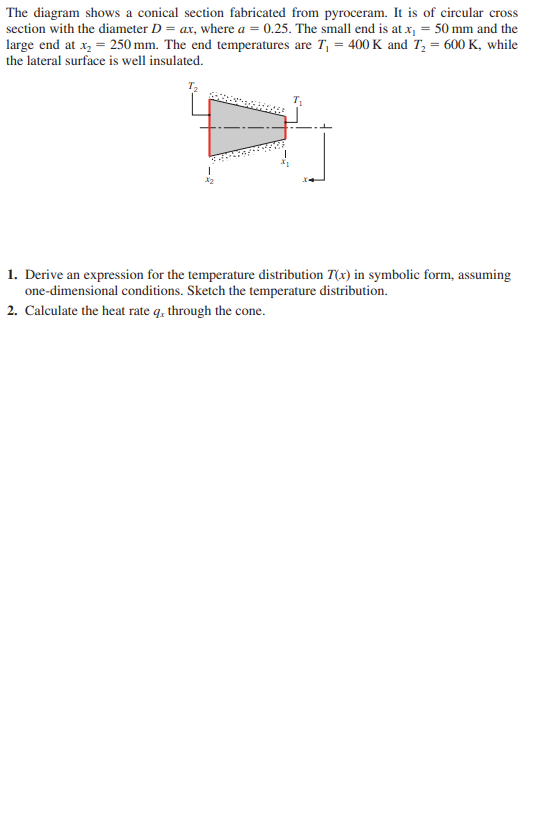
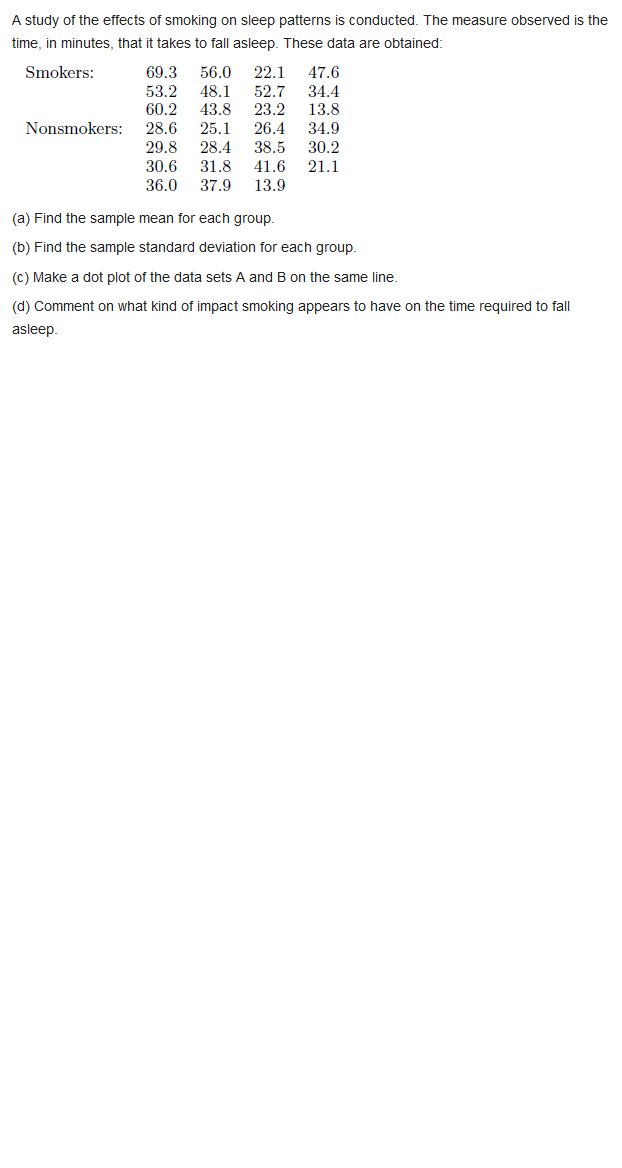
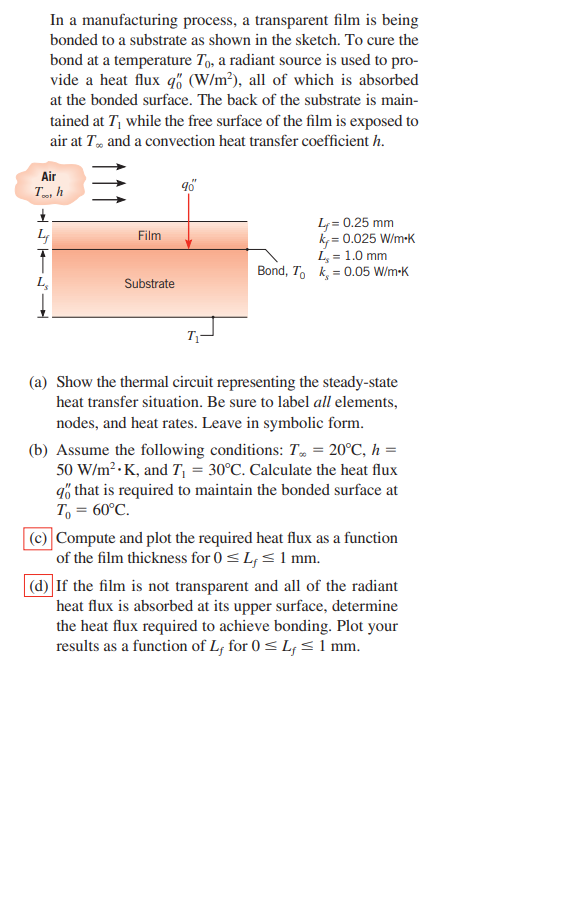
The diagram shows a conical section fabricated from pyroceram. It is of circular cross section with the diameter D = ax, where a = 0.25. The small end is at x, = 50 mm and the large end at x2 = 250 mm. The end temperatures are 7, = 400 K and 72 = 600 K, while the lateral surface is well insulated. 12 1. Derive an expression for the temperature distribution 7(x) in symbolic form, assuming one-dimensional conditions. Sketch the temperature distribution. 2. Calculate the heat rate q, through the cone.\fConsider a long solid tube, insulated at the outer radius r2 and cooled at the inner radius ri, with uniform heat generation q (W/m ) within the solid. 1. Obtain the general solution for the temperature distribution in the tube. 2. In a practical application a limit would be placed on the maximum temperature that is permissible at the insulated surface (r = r2). Specifying this limit as 7,2, identify appropriate boundary conditions that could be used to determine the arbitrary con- stants appearing in the general solution. Determine these constants and the correspond- ing form of the temperature distribution. 3. Determine the heat removal rate per unit length of tube. 4. If the coolant is available at a temperature 7%, obtain an expression for the convection coefficient that would have to be maintained at the inner surface to allow for operation at prescribed values of 7}2 and q.\f\fIn a manufacturing process, a transparent film is being bonded to a substrate as shown in the sketch. To cure the bond at a temperature To, a radiant source is used to pro- vide a heat flux q, (W/m ), all of which is absorbed at the bonded surface. The back of the substrate is main- tained at 7, while the free surface of the film is exposed to air at 7% and a convection heat transfer coefficient h. Air L = 0.25 mm Ly Film ky = 0.025 W/m-K Ly = 1.0 mm Bond, To k, = 0.05 W/m-K Substrate (a) Show the thermal circuit representing the steady-state heat transfer situation. Be sure to label all elements, nodes, and heat rates. Leave in symbolic form. (b) Assume the following conditions: 7% = 20"C, h = 50 W/m' . K, and 7, = 30 C. Calculate the heat flux qo that is required to maintain the bonded surface at To = 60"C. (c) Compute and plot the required heat flux as a function of the film thickness for 0 = Ly = 1 mm. (d) If the film is not transparent and all of the radiant heat flux is absorbed at its upper surface, determine the heat flux required to achieve bonding. Plot your results as a function of Ly for 0 = Ly = 1 mm.\f\f
Step by Step Solution
There are 3 Steps involved in it

Get step-by-step solutions from verified subject matter experts