







Question: Solve these problems using graphical linear programming and then answer the questions that follow. Use simultaneous equations to determine the optimal values of the decision
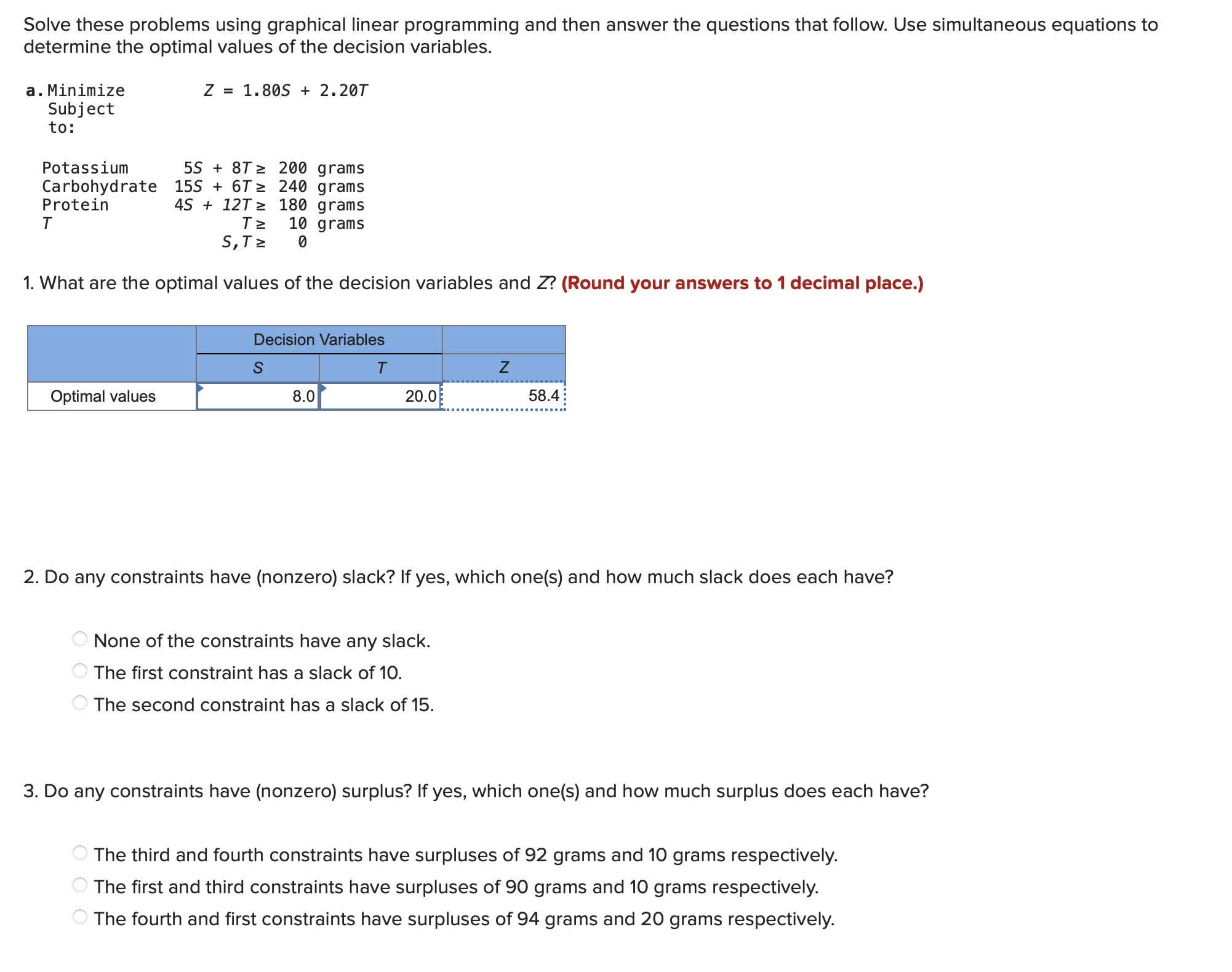
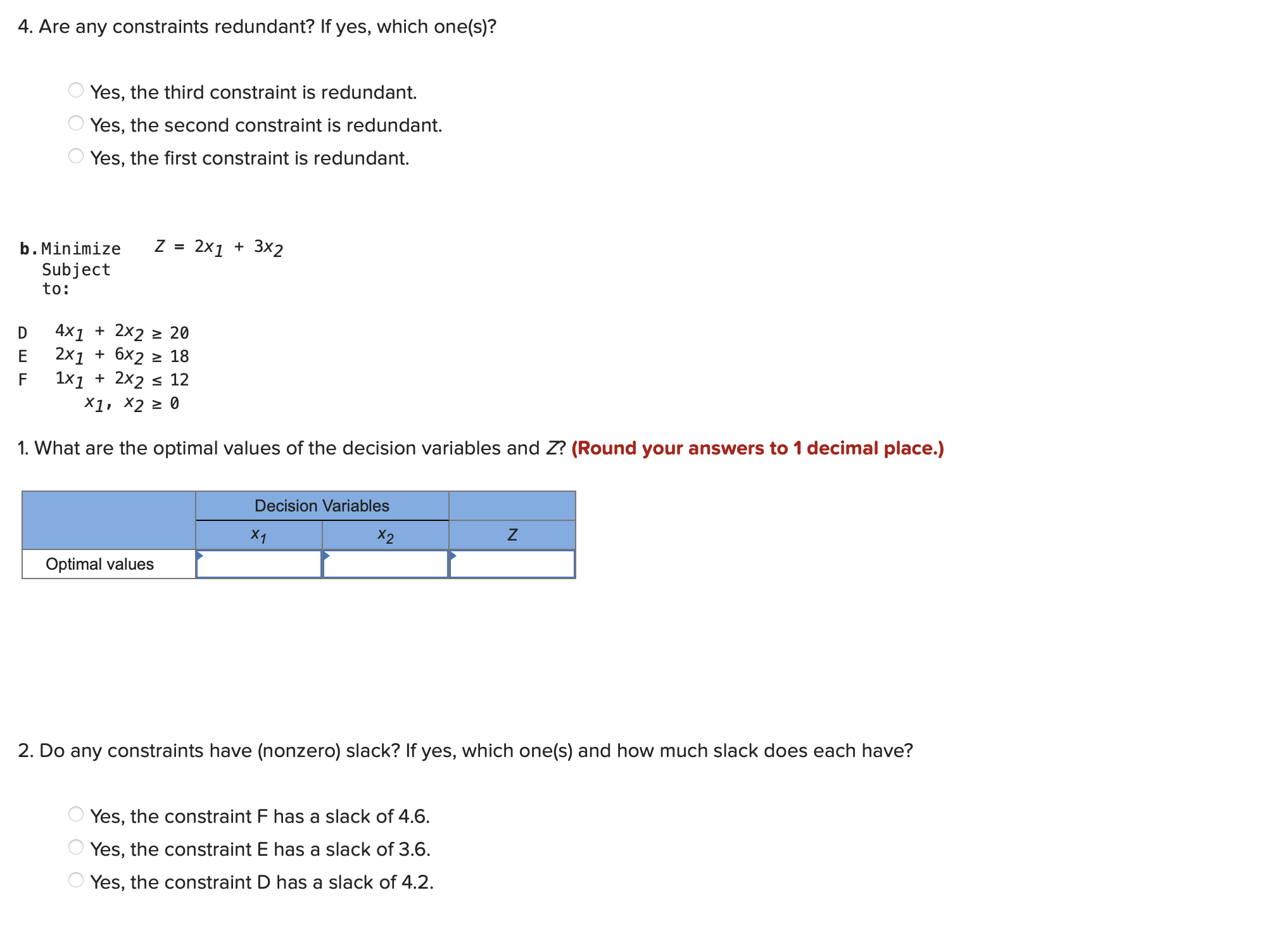
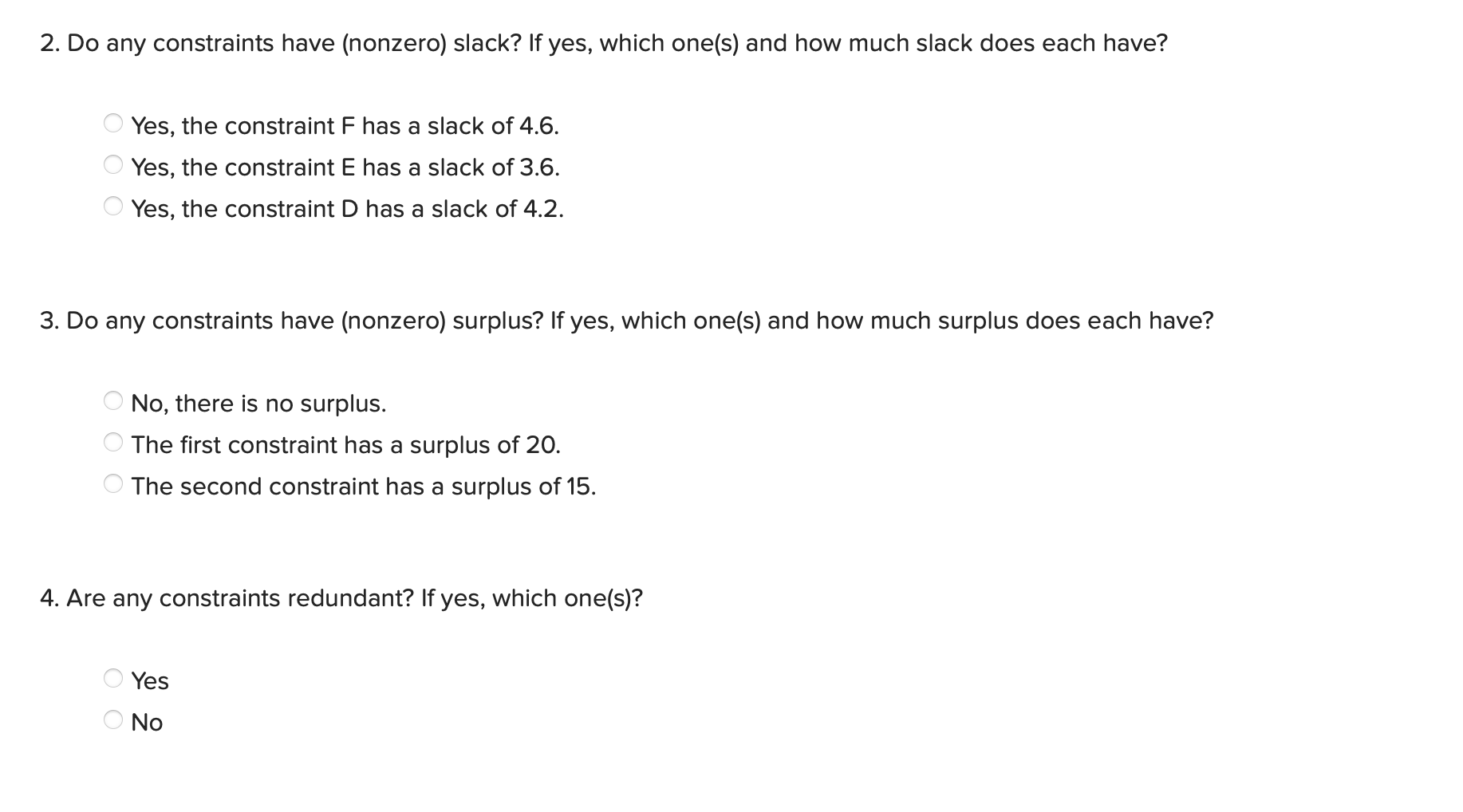
Solve these problems using graphical linear programming and then answer the questions that follow. Use simultaneous equations to determine the optimal values of the decision variables. 1. What are the optimal values of the decision variables and Z ? (Round your answers to 1 decimal place.) 2. Do any constraints have (nonzero) slack? If yes, which one(s) and how much slack does each have? None of the constraints have any slack. The first constraint has a slack of 10. The second constraint has a slack of 15. 3. Do any constraints have (nonzero) surplus? If yes, which one(s) and how much surplus does each have? The third and fourth constraints have surpluses of 92 grams and 10 grams respectively. The first and third constraints have surpluses of 90 grams and 10 grams respectively. The fourth and first constraints have surpluses of 94 grams and 20 grams respectively. 4. Are any constraints redundant? If yes, which one(s)? Yes, the third constraint is redundant. Yes, the second constraint is redundant. Yes, the first constraint is redundant. b. Minimize Z=2x1+3x2 Subject to: D 4x1+2x220 E 2x1+6x218 F 1x1+2x212 x1,x20 b. Minimize Z=2x1+3x2 Subject to: D 4x1+2x220 E 2x1+6x218 F 1x1+2x212 x1,x20 1. What are the optimal values of the decision variables and Z ? (Round your answers to 1 decimal place.) 2. Do any constraints have (nonzero) slack? If yes, which one(s) and how much slack does each have? Yes, the constraint F has a slack of 4.6. Yes, the constraint E has a slack of 3.6. Yes, the constraint D has a slack of 4.2. 2. Do any constraints have (nonzero) slack? If yes, which one(s) and how much slack does each have? Yes, the constraint F has a slack of 4.6. Yes, the constraint E has a slack of 3.6. Yes, the constraint D has a slack of 4.2. 3. Do any constraints have (nonzero) surplus? If yes, which one(s) and how much surplus does each have? No, there is no surplus. The first constraint has a surplus of 20. The second constraint has a surplus of 15. 4. Are any constraints redundant? If yes, which one(s)? Yes No Solve these problems using graphical linear programming and then answer the questions that follow. Use simultaneous equations to determine the optimal values of the decision variables. 1. What are the optimal values of the decision variables and Z ? (Round your answers to 1 decimal place.) 2. Do any constraints have (nonzero) slack? If yes, which one(s) and how much slack does each have? None of the constraints have any slack. The first constraint has a slack of 10. The second constraint has a slack of 15. 3. Do any constraints have (nonzero) surplus? If yes, which one(s) and how much surplus does each have? The third and fourth constraints have surpluses of 92 grams and 10 grams respectively. The first and third constraints have surpluses of 90 grams and 10 grams respectively. The fourth and first constraints have surpluses of 94 grams and 20 grams respectively. 4. Are any constraints redundant? If yes, which one(s)? Yes, the third constraint is redundant. Yes, the second constraint is redundant. Yes, the first constraint is redundant. b. Minimize Z=2x1+3x2 Subject to: D 4x1+2x220 E 2x1+6x218 F 1x1+2x212 x1,x20 b. Minimize Z=2x1+3x2 Subject to: D 4x1+2x220 E 2x1+6x218 F 1x1+2x212 x1,x20 1. What are the optimal values of the decision variables and Z ? (Round your answers to 1 decimal place.) 2. Do any constraints have (nonzero) slack? If yes, which one(s) and how much slack does each have? Yes, the constraint F has a slack of 4.6. Yes, the constraint E has a slack of 3.6. Yes, the constraint D has a slack of 4.2. 2. Do any constraints have (nonzero) slack? If yes, which one(s) and how much slack does each have? Yes, the constraint F has a slack of 4.6. Yes, the constraint E has a slack of 3.6. Yes, the constraint D has a slack of 4.2. 3. Do any constraints have (nonzero) surplus? If yes, which one(s) and how much surplus does each have? No, there is no surplus. The first constraint has a surplus of 20. The second constraint has a surplus of 15. 4. Are any constraints redundant? If yes, which one(s)? Yes No
Step by Step Solution
There are 3 Steps involved in it

Get step-by-step solutions from verified subject matter experts
 Study Help