







Question: solve this case study Invotve Users or Fail: An It Project Case Study from East Africa Chris Procter, Salford Ausiness School, University of Salford, Manchester,
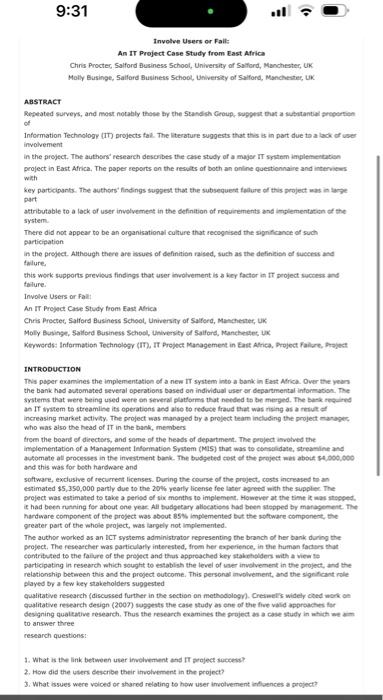
Invotve Users or Fail: An It Project Case Study from East Africa Chris Procter, Salford Ausiness School, University of Salford, Manchester, UK: Molly Businge, Salford Business Schoot, University of Salford, Monchenter, UK. ABSTRACT Reseated surveys, and most notably those by the Standich Croup sogpest that a wututantial preportiont of Information Technologr (IT) projects fail. The literature sugoests that this is in part due to a lack of vser involvement in the project. The authors' research describes the cale study of a majer IT srithm implementabion project in East Africa. The poper reports on the results of boch an online questioninaire and interviems with key participants. The authors' findings suggest that the subsequert felure of this project was in large part attributable to a lack of user invelvement in the sefinition of requirements and inglementation of the system. There did not appear to be an organisational culture that recognised the sapnificance of such participation in the preject. Although there are istues of definition raised, such as the definieish of suecest asd tadure. this work supports previous findings that user levotvement is ab kry factor in If pejeject suctess and talure. Involve users or Falt! An If Preject Case Study trom East Atrica Chris Prectet, Salford Ausinerss Schoot, Universify of Salford, Mathester, UK Moly Buringe, Salford Business School, Universty of Salford, Nanchentes, Ux kerwerds: Infonmation Technolber (IT), IT Project Nanagement in East Atrica, Project Fallore, Praject INTRODUCTION This paper examines the implementation of a new it system into a bank in Eart Africa. Over the years the bank had automated several operations based on indidual user ar departmental informabion. The systems that were being used were on several platforms that heoded to be merged. The bark required an It ivstem to streamine its operations and alse to redese fraud that was nisin as a renult ef increasing market activity. The project was managed by a project tearn including the project manapecc who was also the head of It in the bank, members from the boars of directors, and some of the heads of department. The project invotied the implementatien of a Management Infyematien System (M15) that was to coesulidate, streamine and automate all processes in the investment bart. The budgeted cost of the project met about p4,000,000 and this was for both hardware and software, exclusive of recuerent licenses. During the cearse of the project, costs increased to an estimated $5,350,000 partly due to the 204 yearly license fee iater agreed with the suppler. The project was estimated to take a period of six months to implement, However at the time ic mas atspped. if had beet ruteing for abeut ene year. All tuagetary alscations had been stepped by maragoment. The hardware component of the project was about. B5w implemented but the ablware component, the qreater part of the whole project, was largely not implemented. The author worked ss an ICT systems administrator representing the branch of her bunk during the project. The reseaecher was particularly interested, from her experience, in the human facdan that cantrituled to the fallure of the project and thus appreached key stakxhalden with a viem to participating int reseerch which sought to establish the level of vier involvement in the project, and the relationship between this and the project eutcome. This personal involvement, and the significast rale played by a tew key stakeholders suggested qualitative research (discussed further in the soction on methodologn). Cresimel's widely cbed work on qualitative research design (200?) sugsests the case thudy as ene of the five vald approaches far designing qualcative research. Thus the researth examines the praject as a case study in which we aim to answer three research questions: 1. What is the link between user imvolvement and If peaject suceess? 2. How did the users deseribe their ifvolvement in the project? 3. What issues were volced or shared relating to haw user imvolvement indioences a preject
Step by Step Solution
There are 3 Steps involved in it

Get step-by-step solutions from verified subject matter experts
 Study Help