







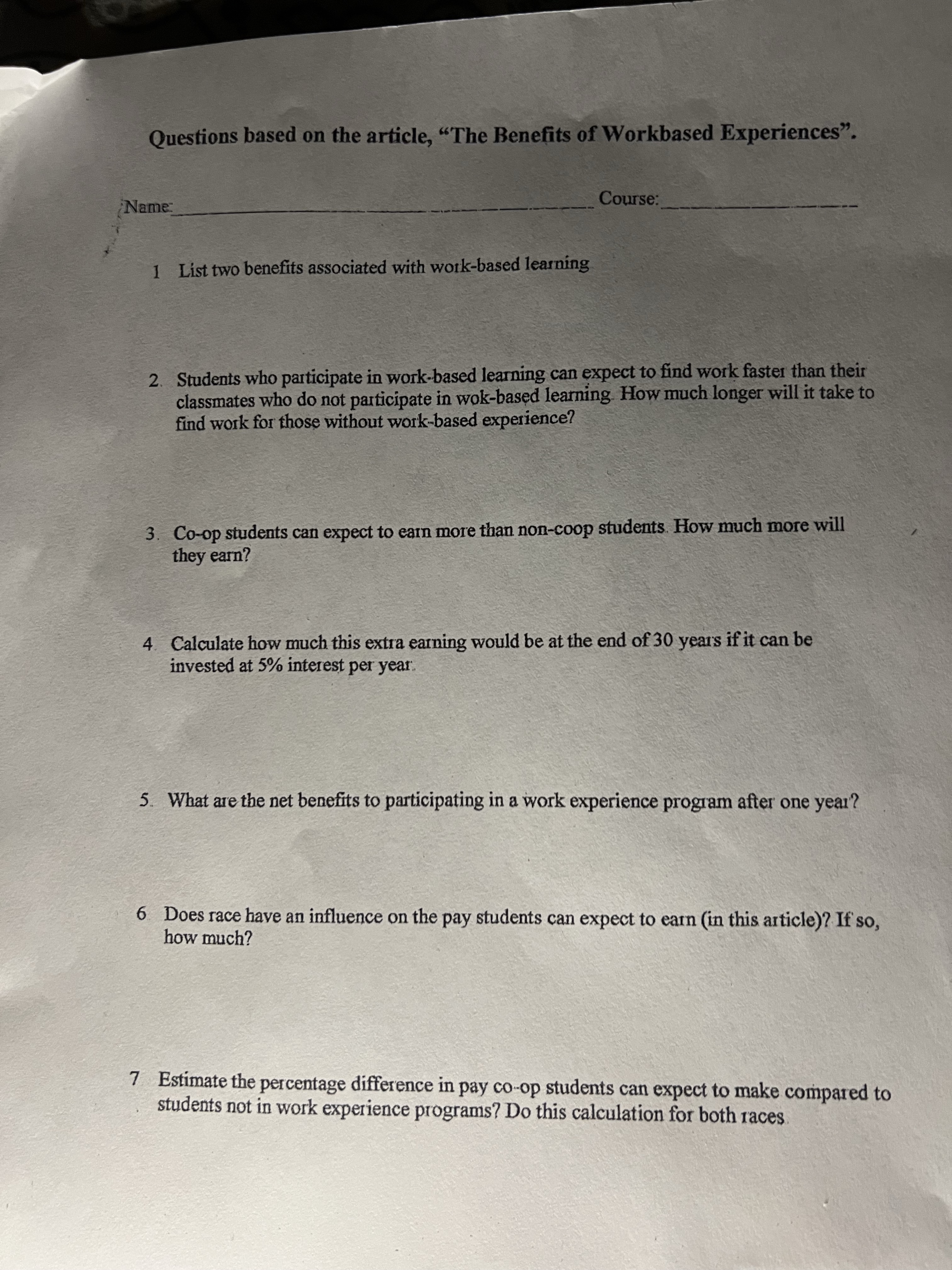
Question: Solve this paper Using the article What Is Work - based Learning? Ididleamalolthat Work - based learning - including internship, extended job shadowing, could not
Solve this paper Using the article
What Is Workbased Learning?
Ididleamalolthat Workbased learning including internship, extended job shadowing, could not be learned froma book or class, and to still have it show on my transcript is very valuable"
Marine Science studant apprenticeship and "cooperative work experience" is an instructional strategy that integrates classroom study with planned and supervised experiences in the workplace to enhance learning. In this study, we focus on "Cooperative Work Experience" Coop as a surrogate measure for all workbased learning. Coop courses allow students to earn credit for paid or unpaid employment that is related to a specific program of study.
Time to Employment
pentu the employet Challenge ine and manc gyeat business
Fratis jolsp founci atotralaled to my bitavious job but more Sifiorf to my lastes. Cestume Design student
A key measure of students' postgraduation success is how long it takes them to find a job. Those who participate in Coop appear to find jobs sooner than their nonCoop classmates: Coop students record first earnings on average at about weeks after graduation, while nonCoop students find work' after about weeks Further, Coop students enter the workplace faster than their classmates for up to two and a half years after graduation. After this time, all graduates have roughly equal employment rates.
Auerage Earnings
We find that the benefits of workbased learning are also reflected in graduates' paychecks. Students who participate in workbased learning have higher average annual earnings than their classmates in all four years after graduation. Although the earnings gain enjoyed by Coop students diminishes over time, Coop students earn about $ more than theit classmates overall. who participare in workbased learning have
Earnings in Each Year After Graduatio
hu :nann narticination.
than their classmates.
Workbased Learning: Benefits from the Student's Perspective
The study finds that workbased learning has immediate financial benefits for students. As shown above, students with Coop experience earn $ more in the first year of work. Given the reasonable cost of taking classes in the community colleges students participating in workbased learning can therefore earn back their course fees and materials costs up to times over in just one year. This additional income also generates benefits to communities, as well as higher tax revenues to the State.
Fotmmonlmestment GoDp stuten Codp course cast
'The mean number of Coop ceredits for students who took these courses is At $ per unit plus modest direct expenses we estimate average : ourse cossts for Coop of be $ per unit or $ for unies
Workbased leaming participants eumn a substantial return on their Co op coursc inestment
Earnings Gains by Ethnicity and Gender
I have Iearned more uselul knowledge about my future career
ideas this semester inrough interning than
I have in any other class thatl K
Music Solve this paper Using the article
What Is Workbased Learning?
Ididleamalolthat Workbased learning including internship, extended job shadowing, could not be learned froma book or class, and to still have it show on my transcript is very valuable"
Marine Science studant apprenticeship and "cooperative work experience" is an instructional strategy that integrates classroom study with planned and supervised experiences in the workplace to enhance learning. In this study, we focus on "Cooperative Work Experience" Coop as a surrogate measure for all workbased learning. Coop courses allow students to earn credit for paid or unpaid employment that is related to a specific program of study.
Time to Employment
pentu the employet Challenge ine and manc gyeat business
Fratis jolsp founci atotralaled to my bitavious job but more Sifiorf to my lastes. Cestume Design student
A key measure of students' postgraduation success is how long it takes them to find a job. Those who participate in Coop appear to find jobs sooner than their nonCoop classmates: Coop students record first earnings on average at about weeks after graduation, while nonCoop students find work' after about weeks Further, Coop students enter the workplace faster than their classmates for up to two and a half years after graduation. After this time, all graduates have roughly equal employment rates.
Auerage Earnings
We find that the benefits of workbased learning are also reflected in graduates' paychecks. Students who participate in workbased learning have higher average annual earnings than their classmates in all four years after graduation. Although the earnings gain enjoyed by Coop students diminishes over time, Coop students earn about $ more than theit classmates overall. who participare in workbased learning have
Earnings in Each Year After Graduatio
hu :nann narticination.
than their classmates.
Workbased Learning: Benefits from the Student's Perspective
The study finds that workbased learning has immediate financial benefits for students. As shown above, students with Coop experience earn $ more in the first year of work. Given the reasonable cost of taking classes in the community colleges students participating in workbased learning can therefore earn back their course fees and materials costs up to times over in just one year. This additional income also generates benefits to communities, as well as higher tax revenues to the State.
Fotmmonlmestment GoDp stuten Codp course cast
'The mean number of Coop ceredits for students who took these courses is At $ per unit plus modest direct expenses we estimate average : ourse cossts for Coop of be $ per unit or $ for unies
Workbased leaming participants eumn a substantial return on their Co op coursc inestment
Earnings Gains by Ethnicity and Gender
I have Iearned more uselul knowledge about my future career
ideas this semester inrough interning than
I have in any other class thatl K
Music Solve this paper Using the article
What Is Workbased Learning?
Ididleamalolthat Workbased learning including internship, extended job shadowing, could not be learned froma book or class, and to still have it show on my transcript is very valuable"
Marine Science studant apprenticeship and "cooperative work experience" is an instructional strategy that integrates classroom study with planned and supervised experiences in the workplace to enhance learning. In this study, we focus on "Cooperative Work Experience" Coop as a surrogate measure for all workbased learning. Coop courses allow students to earn credit for paid or unpaid employment that is related to a specific program of study.
Time to Employment
pentu the employet Challenge ine and manc gyeat business
Fratis jolsp founci atotralaled to my bitavious job but more Sifiorf to my lastes. Cestume Design student
A key measure of students' postgraduation success is how long it takes them to find a job. Those who participate in Coop appear to find jobs sooner than their nonCoop classmates: Coop students record first earnings on average at about weeks after graduation, while nonCoop students find work' after about weeks Further, Coop students enter the workplace faster than their classmates for up to two and a half years after graduation. After this time, all graduates have roughly equal employment rates.
Auerage Earnings
We find that the benefits of workbased learning are also reflected in graduates' paychecks. Students who participate in workbased learning have higher average annual earnings than their classmates in all four years after graduation. Although the earnings gain enjoyed by Coop students diminishes over time, Coop students earn about $ more than theit classmates overall. who participare in workbased learning have
Earnings in Each Year After Graduatio
hu :nann narticination.
than their classmates.
Workbased Learning: Benefits from the Student's Perspective
The study finds that workbased learning has immediate financial benefits for students. As shown above, students with Coop experience earn $ more in the first year of work. Given the reasonable cost of taking classes in the community colleges students participating in workbased learning can therefore earn back their course fees and materials costs up to times over in just one year. This additional income also generates benefits to communities, as well as higher tax revenues to the State.
Fotmmonlmestment GoDp stuten Codp course cast
'The mean number of Coop ceredits for students who took these courses is At $ per unit plus modest direct expenses we estimate average : ourse cossts for Coop of be $ per unit or $ for unies
Workbased leaming participants eumn a substantial return on their Co op coursc inestment
Earnings Gains by Ethnicity and Gender
I have Iearned more uselul knowledge about my future career
ideas this semester inrough interning than
I have in any other class thatl K
Music Solve this paper Using the article
What Is Workbased Learning?
Ididleamalolthat Workbased learning including internship, extended job shadowing, could not be learned froma book or class, and to still have it show on my transcript is very valuable"
Marine Science studant apprenticeship and "cooperative work experience" is an instructional strategy that integrates classroom study with planned and supervised experiences in the workplace to enhance learning. In this study, we focus on "Cooperative Work Experience" Coop as a surrogate measure for all workbased learning. Coop courses allow students to earn credit for paid or unpaid employment that is related to a specific program of study.
Time to Employment
pentu the employet Challenge ine and manc gyeat business
Fratis jolsp founci atotralaled to my bitavious job but more Sifiorf to my lastes. Cestume Design student
A key measure of students' postgraduation success is how long it takes them to find a job. Those who participate in Coop appear to find jobs sooner than their nonCoop classmates: Coop students record first earnings on average at about weeks after graduation, while nonCoop students find work' after about weeks Further, Coop students enter the workplace faster than their classmates for up to two and a half years after graduation. After this time, all graduates have roughly equal employment rates.
Auerage Earnings
We find that the benefits of workbased learning are also reflected in graduates' paychecks. Students who participate in workbased learning have higher average annual earnings than their classmates in all four years after graduation. Although the earnings gain enjoyed by Coop students diminishes over time, Coop students earn about $ more than theit classmates overall. who participare in workbased learning have
Earnings in Each Year After Graduatio
hu :nann narticination.
than their classmates.
Workbased Learning: Benefits from the Student's Perspective
The study finds that workbased learning has immediate financial benefits for students. As shown above, students with Coop experience earn $ more in the first year of work. Given the reasonable cost of taking classes in the community colleges students participating in workbased learning can therefore earn back their course fees and materials costs up to times over in just one year. This additional income also generates benefits to communities, as well as higher tax revenues to the State.
Fotmmonlmestment GoDp stuten Codp course cast
'The mean number of Coop ceredits for students who took these courses is At $ per unit plus modest direct expenses we estimate average : ourse cossts for Coop of be $ per unit or $ for unies
Workbased leaming participants eumn a substantial return on their Co op coursc inestment
Earnings Gains by Ethnicity and Gender
I have Iearned more uselul knowledge about my future career
ideas this semester inrough interning than
I have in any other class thatl K
Music
Step by Step Solution
There are 3 Steps involved in it
1 Expert Approved Answer
Step: 1 Unlock

Question Has Been Solved by an Expert!
Get step-by-step solutions from verified subject matter experts
Step: 2 Unlock
Step: 3 Unlock
 Study Help