







Question: Solve using Matlab please. 4. Use the Implicit Function Theorem to find the partial derivatives (a) ey sin(x) = x + xy, dy/dx (b) x2-y2
Solve using Matlab please. 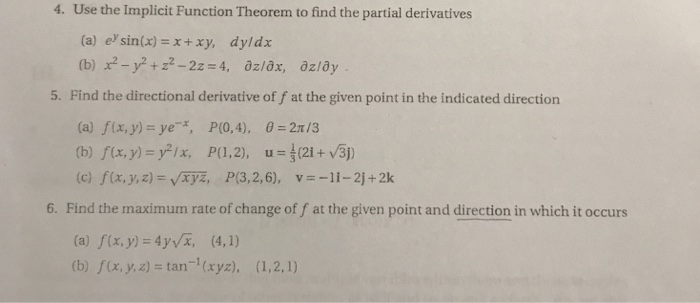
4. Use the Implicit Function Theorem to find the partial derivatives (a) ey sin(x) = x + xy, dy/dx (b) x2-y2 + z2-2z = 4, dziax, dziay 5. Find the directional derivative of f at the given point in the indicated direction (a) f(x,y) = ye-x, P(0,4), =2 /3 (b)f(x,y) = y21x, P(1,2), u= (21 + V3j) (c) f(x,y,z)-Vxyz, P(3, 2,6), v=-11-21+2k 6. Find the maximum rate of change of f at the given point and direction in which it occurs (a) f(x,y) = 4YVx, (4,1) (b) f(x, y, z)= tan-1 (xyz), (1,2,1)
Step by Step Solution
There are 3 Steps involved in it
1 Expert Approved Answer
Step: 1 Unlock

Question Has Been Solved by an Expert!
Get step-by-step solutions from verified subject matter experts
Step: 2 Unlock
Step: 3 Unlock
 Study Help