



Question: Some liquid (e.g., coffee) is being cooled from hot temperature (T0=95C). You want the liquid to be cooled down to (T=25C) before you drink. Newton's
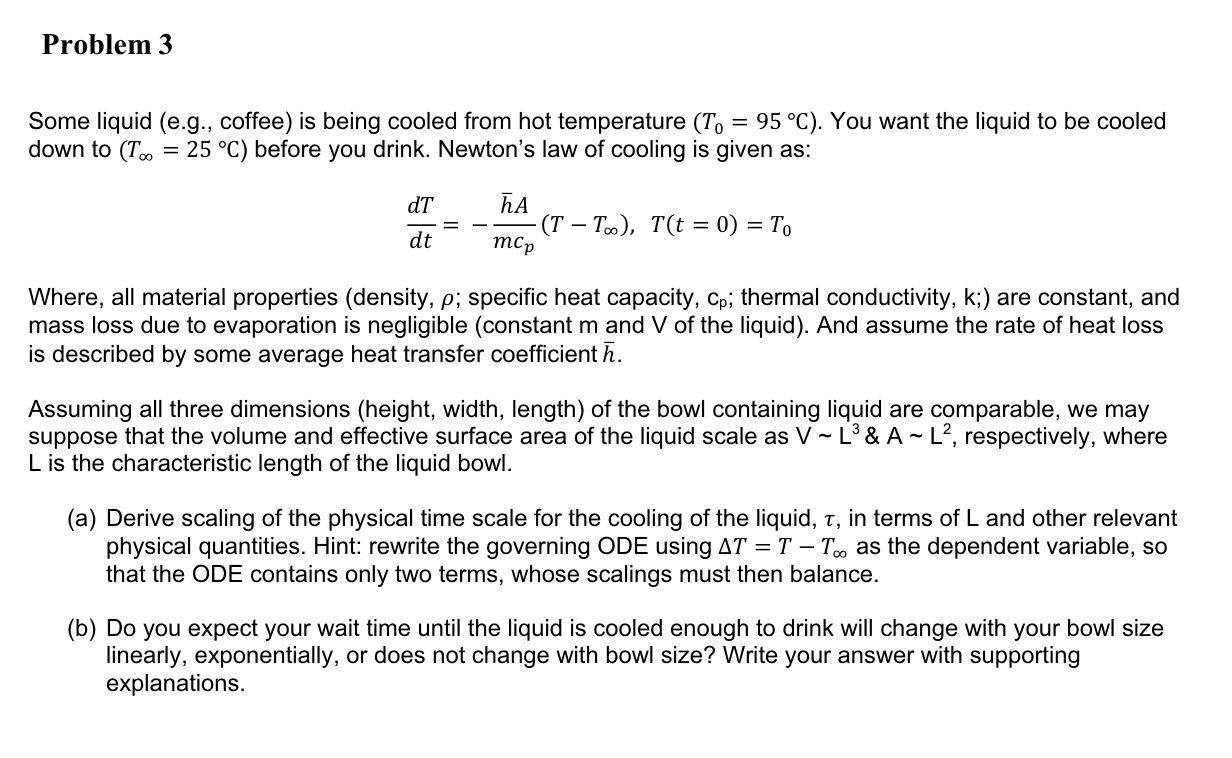
Some liquid (e.g., coffee) is being cooled from hot temperature (T0=95C). You want the liquid to be cooled down to (T=25C) before you drink. Newton's law of cooling is given as: dtdT=mcphA(TT),T(t=0)=T0 Where, all material properties (density, ; specific heat capacity, cp; thermal conductivity, k;) are constant, and mass loss due to evaporation is negligible (constant m and V of the liquid). And assume the rate of heat loss is described by some average heat transfer coefficient h. Assuming all three dimensions (height, width, length) of the bowl containing liquid are comparable, we may suppose that the volume and effective surface area of the liquid scale as VL3&AL2, respectively, where L is the characteristic length of the liquid bowl. (a) Derive scaling of the physical time scale for the cooling of the liquid, , in terms of L and other relevant physical quantities. Hint: rewrite the governing ODE using T=TT as the dependent variable, so that the ODE contains only two terms, whose scalings must then balance. (b) Do you expect your wait time until the liquid is cooled enough to drink will change with your bowl size linearly, exponentially, or does not change with bowl size? Write your answer with supporting explanations
Step by Step Solution
There are 3 Steps involved in it

Get step-by-step solutions from verified subject matter experts