







Question: ( Somehow solve it please whatever you can do . its urgent ! ) Current density in an interconnect, for a harmonic voltage V (
Somehow solve it please whatever you can doits urgent
Current density in an interconnect, for a harmonic voltage is given by
vechat
where,
and is the conductivity. is the DC value of current density, is the length of the interconnect.
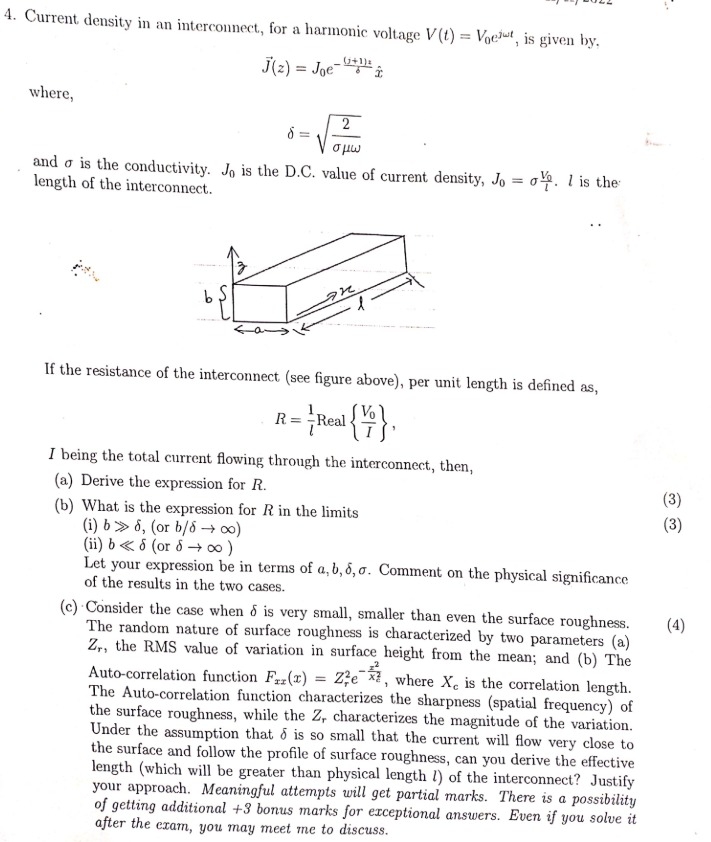
If the resistance of the interconnect see figure above per unit length is defined as
Real
I being the total current flowing through the interconnect, then,
a Derive the expression for
b What is the expression for in the limits
ior
ii or
Let your expression be in terms of Comment on the physical significance of the results in the two cases.
c Consider the case when is very small, smaller than even the surface roughness. The random nature of surface roughness is characterized by two parameters a the RMS value of variation in surface height from the mean; and b The Autocorrelation function where is the correlation length. The Autocorrelation function characterizes the sharpness spatial frequency of the surface roughness, while the characterizes the magnitude of the variation. Under the assumption that is so small that the current will flow very close to the surface and follow the profile of surface roughness, can you derive the effective length which will be greater than physical length of the interconnect? Justify your approach. Meaningful attempts will get partial marks. There is a possibility of getting additional bonus marks for exceptional answers. Even if you solve it after the exam, you may meet me to discuss.
Step by Step Solution
There are 3 Steps involved in it
1 Expert Approved Answer
Step: 1 Unlock

Question Has Been Solved by an Expert!
Get step-by-step solutions from verified subject matter experts
Step: 2 Unlock
Step: 3 Unlock
 Study Help