







Question: someone please help me answer b, g and h subject: economics (microeconomics, ppf) below is answer f and g. i do not understand how to
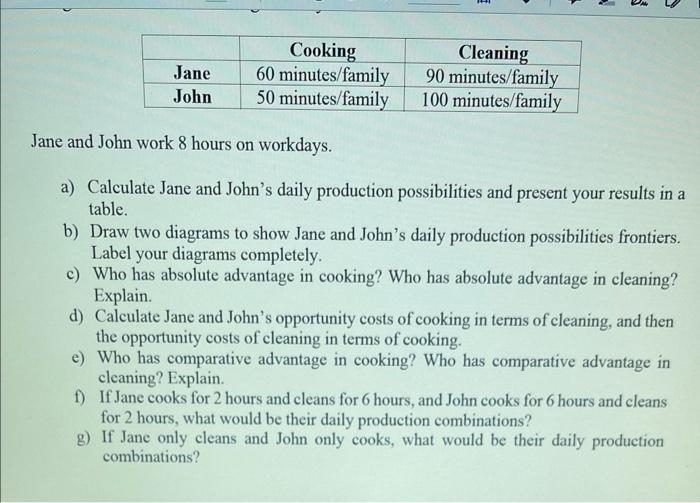

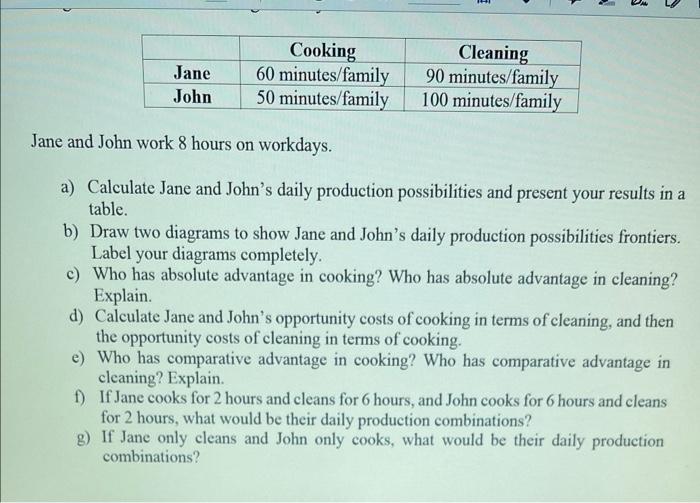

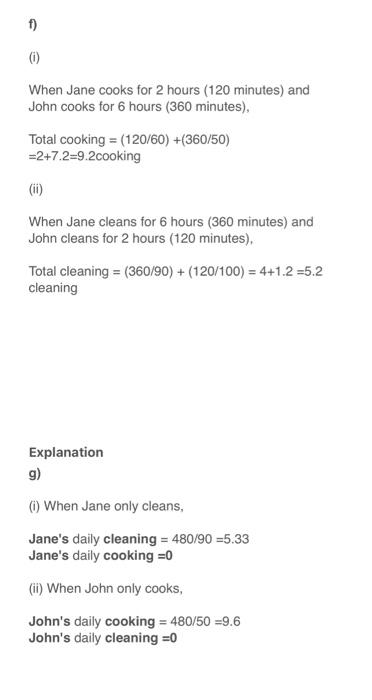
Jane and John work 8 hours on workdays. a) Calculate Jane and John's daily production possibilities and present your results in a table. b) Draw two diagrams to show Jane and John's daily production possibilities frontiers. Label your diagrams completely. c) Who has absolute advantage in cooking? Who has absolute advantage in cleaning? Explain. d) Calculate Jane and John's opportunity costs of cooking in terms of cleaning, and then the opportunity costs of cleaning in terms of cooking. e) Who has comparative advantage in cooking? Who has comparative advantage in cleaning? Explain. f) If Jane cooks for 2 hours and cleans for 6 hours, and John cooks for 6 hours and cleans for 2 hours, what would be their daily production combinations? g) If Jane only cleans and John only cooks, what would be their daily production combinations? h) Suppose the prices of cooking and cleaning services are identical at $100 each. Would the production possibilities in Part f ) and Part g ) lead to different revenues? If so, which one is more? By how much? Jane and John work 8 hours on workdays. a) Calculate Jane and John's daily production possibilities and present your results in a table. b) Draw two diagrams to show Jane and John's daily production possibilities frontiers. Label your diagrams completely. c) Who has absolute advantage in cooking? Who has absolute advantage in cleaning? Explain. d) Calculate Jane and John's opportunity costs of cooking in terms of cleaning, and then the opportunity costs of cleaning in terms of cooking. e) Who has comparative advantage in cooking? Who has comparative advantage in cleaning? Explain. f) If Jane cooks for 2 hours and cleans for 6 hours, and John cooks for 6 hours and cleans for 2 hours, what would be their daily production combinations? g) If Jane only cleans and John only cooks, what would be their daily production combinations? h) Suppose the prices of cooking and cleaning services are identical at $100 each. Would the production possibilities in Part f ) and Part g ) lead to different revenues? If so, which one is more? By how much? f) (i) When Jane cooks for 2 hours ( 120 minutes) and John cooks for 6 hours ( 360 minutes), Total cooking =(120/60)+(360/50) =2+7.2=9.2 cooking (ii) When Jane cleans for 6 hours ( 360 minutes) and John cleans for 2 hours ( 120 minutes). Total cleaning =(360/90)+(120/100)=4+1.2=5.2 cleaning Explanation g) (i) When Jane only cleans, Jane's daily cleaning =480/90=5.33 Jane's daily cooking =0 (ii) When John only cooks, John's daily cooking =480/50=9.6 John's daily cleaning =0
Step by Step Solution
There are 3 Steps involved in it

Get step-by-step solutions from verified subject matter experts
 Study Help