







Question: Sorry for multi question, but they are all based on the same passage. Will thumbs up. TIA The Nuclear Waste Challenge at Fukushima 6 Years
Sorry for multi question, but they are all based on the same passage. Will thumbs up. TIA
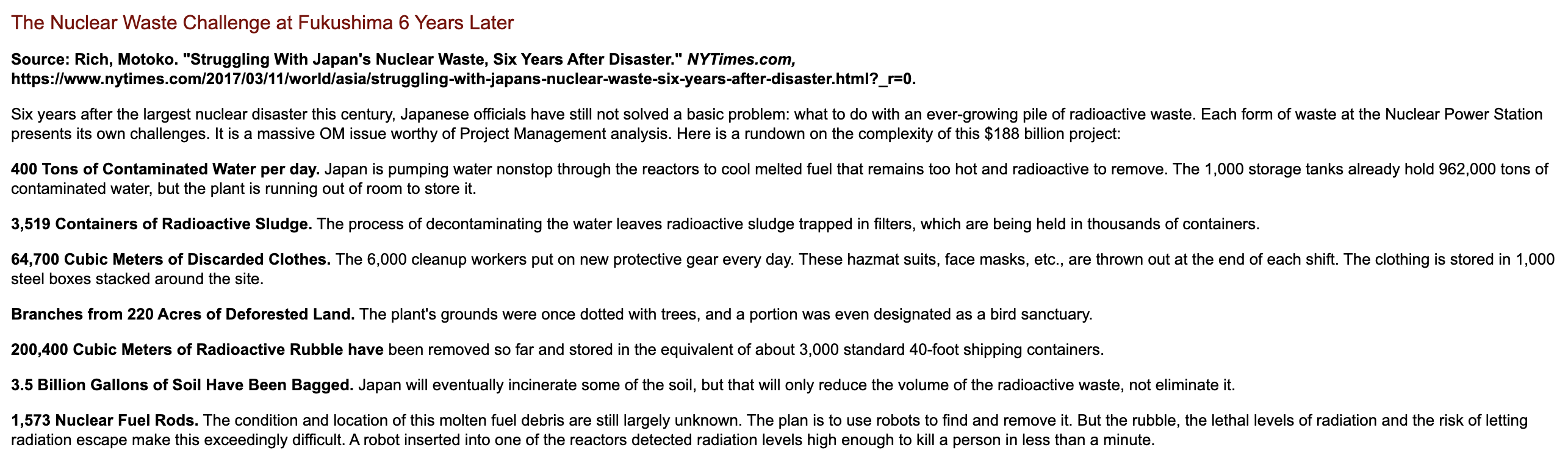
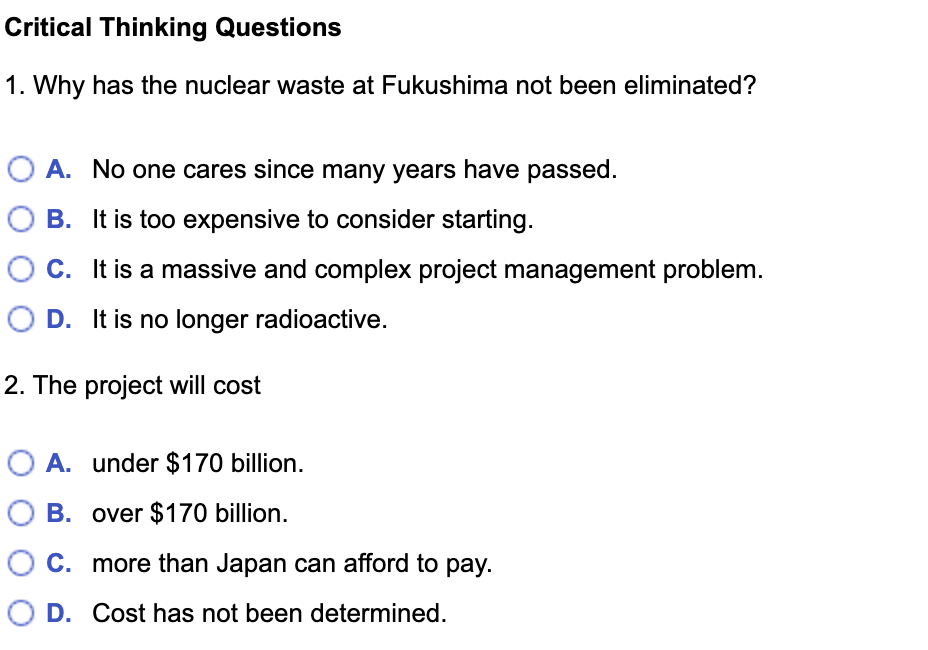
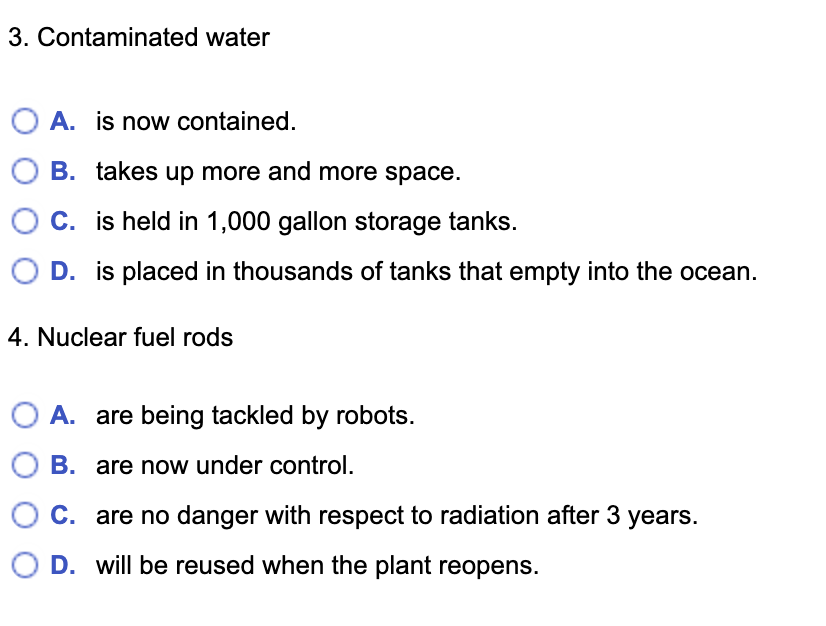
The Nuclear Waste Challenge at Fukushima 6 Years Later Source: Rich, Motoko. "Struggling With Japan's Nuclear Waste, Six Years After Disaster." NYTimes.com, https://www.nytimes.com/2017/03/11/world/asia/struggling-with-japans-nuclear-waste-six-years-after-disaster.html?_r=0. Six years after the largest nuclear disaster this century, Japanese officials have still not solved a basic problem: what to do with an ever-growing pile of radioactive waste. Each form of waste at the Nuclear Power Station presents its own challenges. It is a massive OM issue worthy of Project Management analysis. Here is a rundown on the complexity of this $188 billion project: 400 Tons of Contaminated Water per day. Japan is pumping water nonstop through the reactors to cool melted fuel that remains too hot and radioactive to remove. The 1,000 storage tanks already hold 962,000 tons of contaminated water, but the plant is running out of room to store it. 3,519 Containers of Radioactive Sludge. The process of decontaminating the water leaves radioactive sludge trapped in filters, which are being held in thousands of containers. 64,700 Cubic Meters of Discarded Clothes. The 6,000 cleanup workers put on new protective gear every day. These hazmat suits, face masks, etc., are thrown out at the end of each shift. The clothing is stored in 1,000 steel boxes stacked around the site. Branches from 220 Acres of Deforested Land. The plant's grounds were once dotted with trees, and a portion was even designated as a bird sanctuary. 200,400 Cubic Meters of Radioactive Rubble have been removed so far and stored in the equivalent of about 3,000 standard 40-foot shipping containers. 3.5 Billion Gallons of Soil Have Been Bagged. Japan will eventually incinerate some of the soil, but that will only reduce the volume of the radioactive waste, not eliminate it. 1,573 Nuclear Fuel Rods. The condition and location of this molten fuel debris are still largely unknown. The plan is to use robots to find and remove it. But the rubble, the lethal levels of radiation and the risk of letting radiation escape make this exceedingly difficult. A robot inserted into one of the reactors detected radiation levels high enough to kill a person in less than a minute. Critical Thinking Questions 1. Why has the nuclear waste at Fukushima not been eliminated? O A. No one cares since many years have passed. O B. It is too expensive to consider starting. O C. It is a massive and complex project management problem. OD. It is no longer radioactive. 2. The project will cost O A. under $170 billion. O B. over $170 billion. . C. more than Japan can afford to pay. OD. Cost has not been determined. 3. Contaminated water O A. is now contained. . B. takes up more and more space. C. is held in 1,000 gallon storage tanks. D. is placed in thousands of tanks that empty into the ocean. 4. Nuclear fuel rods O A. are being tackled by robots. B. are now under control. C. are no danger with respect to radiation after 3 years. D. will be reused when the plant reopensStep by Step Solution
There are 3 Steps involved in it
1 Expert Approved Answer
Step: 1 Unlock

Question Has Been Solved by an Expert!
Get step-by-step solutions from verified subject matter experts
Step: 2 Unlock
Step: 3 Unlock
 Study Help