







Question: Sorry for multi quesitons, but they are all based on the same reading. Will thumbs up. TIA Life and Death of the Third Shift Source:
Sorry for multi quesitons, but they are all based on the same reading. Will thumbs up. TIA
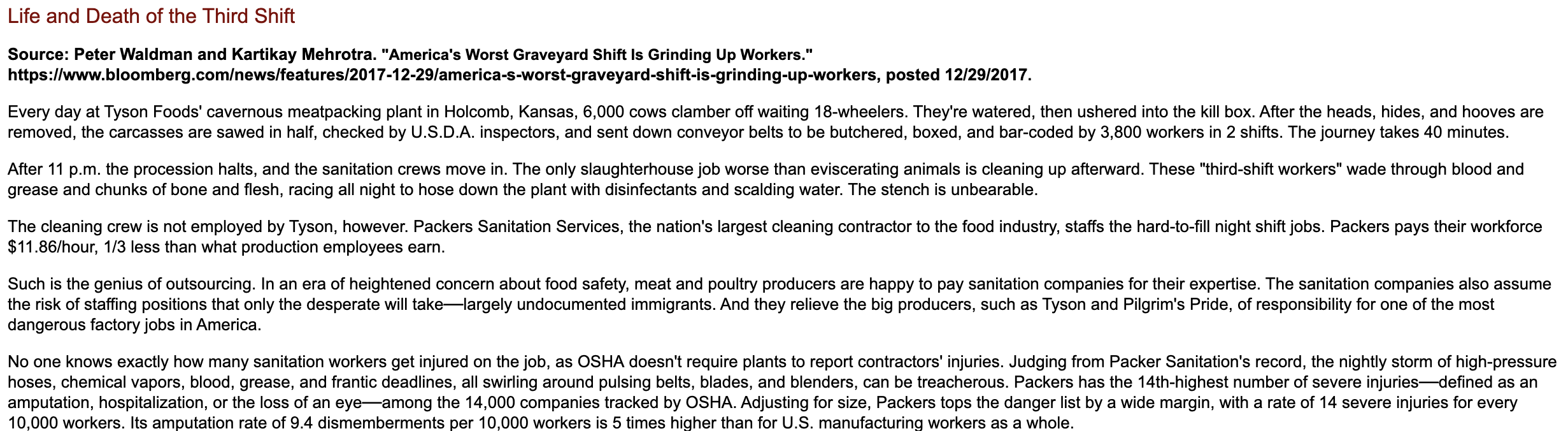
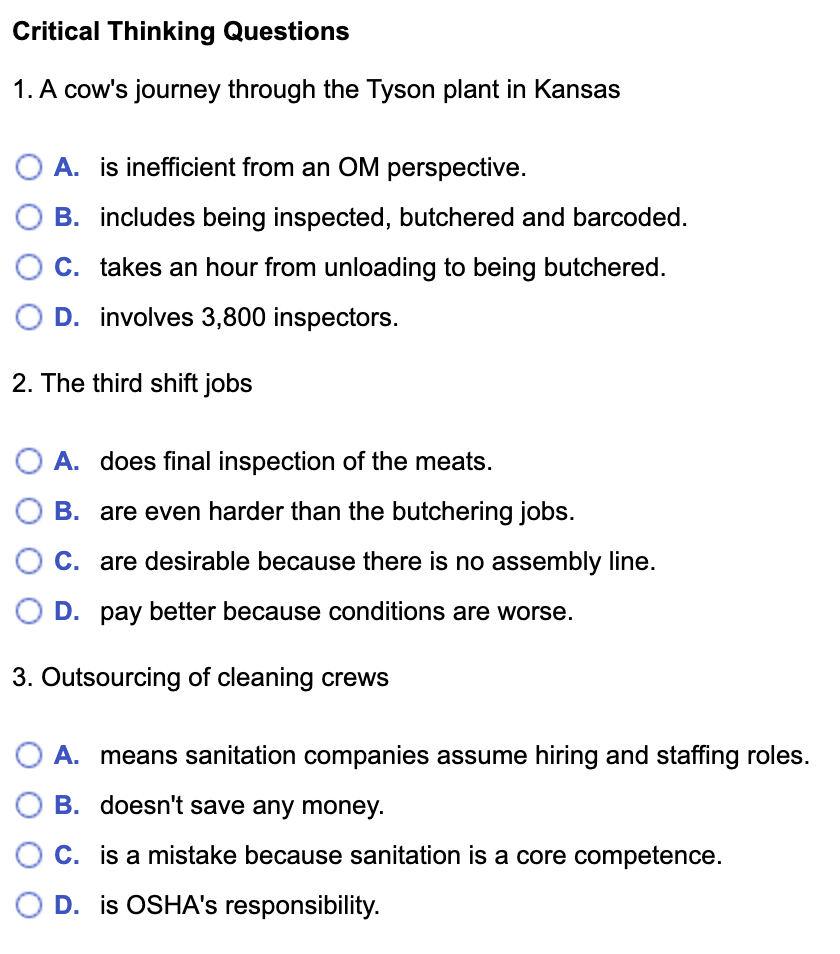
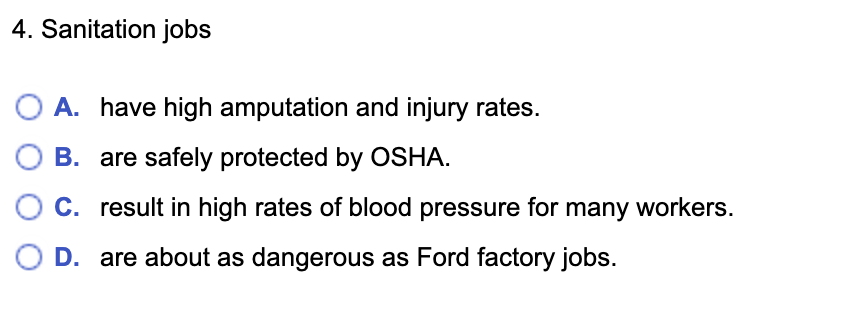
Life and Death of the Third Shift Source: Peter Waldman and Kartikay Mehrotra. "America's Worst Graveyard Shift Is Grinding Up Workers." https://www.bloomberg.comews/features/2017-12-29/america-s-worst-graveyard-shift-is-grinding-up-workers, posted 12/29/2017. Every day at Tyson Foods' cavernous meatpacking plant in Holcomb, Kansas, 6,000 cows clamber off waiting 18-wheelers. They're watered, then ushered into the kill box. After the heads, hides, and hooves are removed, the carcasses are sawed in half, checked by U.S.D.A. inspectors, and sent down conveyor belts to be butchered, boxed, and bar-coded by 3,800 workers in 2 shifts. The journey takes 40 minutes. After 11 p.m. the procession halts, and the sanitation crews move in. The only slaughterhouse job worse than eviscerating animals is cleaning up afterward. These "third-shift workers" wade through blood and grease and chunks of bone and flesh, racing all night to hose down the plant with disinfectants and scalding water. The stench is unbearable. The cleaning crew is not employed by Tyson, however. Packers Sanitation Services, the nation's largest cleaning contractor to the food industry, staffs the hard-to-fill night shift jobs. Packers pays their workforce $11.86/hour, 1/3 less than what production employees earn. Such is the genius of outsourcing. In an era of heightened concern about food safety, meat and poultry producers are happy to pay sanitation companies for their expertise. The sanitation companies also assume the risk of staffing positions that only the desperate will take largely undocumented immigrants. And they relieve the big producers, such as Tyson and Pilgrim's Pride, of responsibility for one of the most dangerous factory jobs in America. No one knows exactly how many sanitation workers get injured on the job, as OSHA doesn't require plants to report contractors' injuries. Judging from Packer Sanitation's record, the nightly storm of high-pressure hoses, chemical vapors, blood, grease, and frantic deadlines, all swirling around pulsing belts, blades, and blenders, can be treacherous. Packers has the 14th-highest number of severe injuriesdefined as an amputation, hospitalization, or the loss of an eye-among the 14,000 companies tracked by OSHA. Adjusting for size, Packers tops the danger list by a wide margin, with a rate of 14 severe injuries for every 10,000 workers. Its amputation rate of 9.4 dismemberments per 10,000 workers is 5 times higher than for U.S. manufacturing workers as a whole. Critical Thinking Questions 1. A cow's journey through the Tyson plant in Kansas O A. is inefficient from an OM perspective. B. includes being inspected, butchered and barcoded. C. takes an hour from unloading to being butchered. OD. involves 3,800 inspectors. 2. The third shift jobs O A. does final inspection of the meats. B. are even harder than the butchering jobs. C. are desirable because there is no assembly line. D. pay better because conditions are worse. 3. Outsourcing of cleaning crews A. means sanitation companies assume hiring and staffing roles. O B. doesn't save any money. C. is a mistake because sanitation is a core competence. D. is OSHA's responsibility. 4. Sanitation jobs A. have high amputation and injury rates. B. are safely protected by OSHA. . C. result in high rates of blood pressure for many workers. D. are about as dangerous as Ford factory jobsStep by Step Solution
There are 3 Steps involved in it
1 Expert Approved Answer
Step: 1 Unlock

Question Has Been Solved by an Expert!
Get step-by-step solutions from verified subject matter experts
Step: 2 Unlock
Step: 3 Unlock
 Study Help