







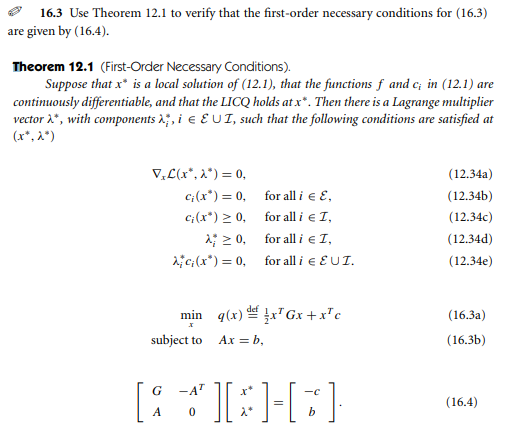
Question: source from : http://www.bioinfo.org.cn/~wangchao/maa/Numerical_Optimization.pdf 16.3 Use Theorem 12.1 to verify that the first-order necessary conditions for (16.3) are given by (16.4). Theorem 12.1 (First-Order Necessary
source from :
http://www.bioinfo.org.cn/~wangchao/maa/Numerical_Optimization.pdf
16.3 Use Theorem 12.1 to verify that the first-order necessary conditions for (16.3) are given by (16.4). Theorem 12.1 (First-Order Necessary Conditions). continuously differentiable, and that the LICQ holds atx*. Then there is a Lagrange multiplier Suppose that is a local solution of (12.1), that the functions f and ci in (12.1) are vector X, with components ??, ? E UT, such that the following conditions are satisfied at ci(x)0, oEE ci(x) 0, fo ali E T, l' (12.34a) (12.34b) (12.34c) (12.34d) (12.34e) -0, for all i a;ci(x*) = 0, for all i Eul def 1T (16.3a) subject to Axb (16.3b) G -A A 0 (16.4) 16.3 Use Theorem 12.1 to verify that the first-order necessary conditions for (16.3) are given by (16.4). Theorem 12.1 (First-Order Necessary Conditions). continuously differentiable, and that the LICQ holds atx*. Then there is a Lagrange multiplier Suppose that is a local solution of (12.1), that the functions f and ci in (12.1) are vector X, with components ??, ? E UT, such that the following conditions are satisfied at ci(x)0, oEE ci(x) 0, fo ali E T, l' (12.34a) (12.34b) (12.34c) (12.34d) (12.34e) -0, for all i a;ci(x*) = 0, for all i Eul def 1T (16.3a) subject to Axb (16.3b) G -A A 0 (16.4)
Step by Step Solution
There are 3 Steps involved in it

Get step-by-step solutions from verified subject matter experts
 Study Help