







Question: SQL MS Access 1. Display all the columns in Customer for those customers who purchased a vehicle that has the same date value in icontract
SQL MS Access
1. Display all the columns in Customer for those customers who purchased a vehicle that has the same date value in icontract and isold. In other words, customers who signed a contract and completed the sale of a vehicle on the same day so they could drive it home that same day.
2. Display all the columns in Employee for those employees who sold at least one vehicle within 7 days of being hired.
3. Display all the columns in Customer for those customers that have relationships but have never been a purchaser. In other words, formed one or more relationships with dealerships shopping for a car, but never became a purchaser by buying one.
4. Display all the columns in Employee for those employees who sold at least one vehicle owned by a dealership that is different from the dealership they work for.
5. Display all the columns in Dealership whose employees collectively sold more than $200,000 worth of vehicles in the month of February, 2018. The $200,000 limit could be exceeded by just one employee, or by a team of employees working at the same dealership each selling less than $200,000 individually; either case is valid.
6. Display all the columns in Invoice for those invoices with the 3 lowest unique iprice values. Note that there may be more than one invoice for each of the 3 lowest iprice values.
7. Display all the columns in Vehicle for those vehicles sold two or more times and at least one resale price is more than the first (initial) sale price.
8. Display vvin, vyear, vmake, vbody, vcolor, cid, clast, cfirst, cmi for those customers who purchased the same vehicle more than once.
( Rules All joins must be done by matching the appropriate columns in the WHERE clause. In other words, you are not to use INNER, LEFT, or RIGHT JOIN and ON syntax to perform the join operation.
Use native SQL syntax for date arithmetic; do not use any functions, such as DateDiff, to do date arithmetic.)
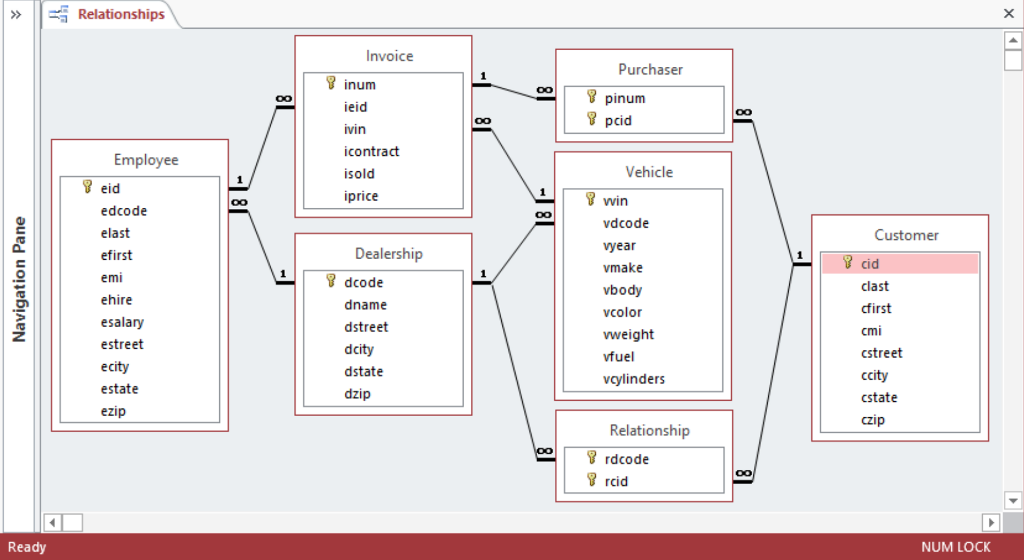
Relationships Invoice inum ieid vin icontract isold iprice Purchaser pinum pcid Employee eid edcode elast efirst emi ehire esalary estreet ecity estate ezip Vehicle win 3 vdcode Customer Dealership dcode dname dstreet dcity dstate dzip vmake cid clast cfirst cmi cstreet ccity cstate czip vweight vcylinders Relationship rdcode rcid Ready NUM LOCK Relationships Invoice inum ieid vin icontract isold iprice Purchaser pinum pcid Employee eid edcode elast efirst emi ehire esalary estreet ecity estate ezip Vehicle win 3 vdcode Customer Dealership dcode dname dstreet dcity dstate dzip vmake cid clast cfirst cmi cstreet ccity cstate czip vweight vcylinders Relationship rdcode rcid Ready NUM LOCK
Step by Step Solution
There are 3 Steps involved in it

Get step-by-step solutions from verified subject matter experts
 Study Help